Loading...
Done
A picture of Moon Ji-sung, a high school student who died in the Sewol ferry disaster, hangs in her room in Ansan April 7, 2015. Her dream was to be a flight attendant. (Photo by Kim Hong-Ji/Reuters)

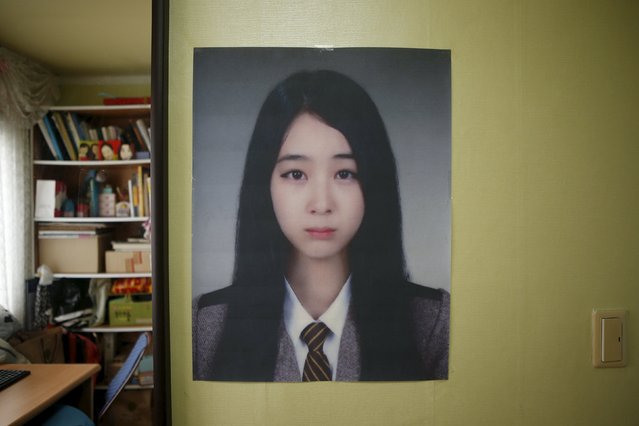
A picture of Moon Ji-sung, a high school student who died in the Sewol ferry disaster, hangs in her room in Ansan April 7, 2015. Her dream was to be a flight attendant. Nearly a year after the Sewol ferry sank on April 16, 2014, with the death of 250 students, some families keep their children’s bedrooms intact to remember and honour their loved ones. More than 300 people, most of them students and teachers from Danwon High School, are dead, or missing and presumed dead, after the Sewol ferry sank on a routine trip from the port of Incheon, near Seoul, to the holiday island of Jeju. (Photo by Kim Hong-Ji/Reuters)
Details
14 Apr 2015 11:18:00
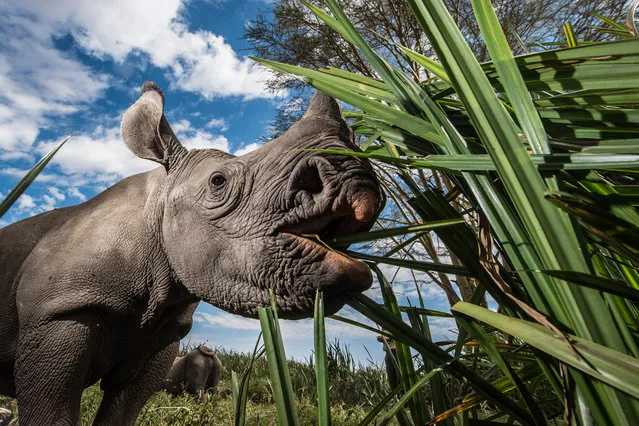
Orphaned baby rhinos seen on August 28, 2014 in Lewa Wildlife Conservancy, Ngare Ndare Forest, Kenya. (Photo by Luca Ghidoni/Barcroft Media)

Orphaned baby rhinos seen on August 28, 2014 in Lewa Wildlife Conservancy, Ngare Ndare Forest, Kenya. Lewa Wildlife Conservancy in Kenya is hand-raising three orphaned baby rhinos; Nicky, Hope and Kilifi. Baby rhino Hope was rescued by rangers when the poachers killed his mother – now he is been taken care off 24 hours-a-day at Lewa Wildlife Conservancy. The wildlife reserve hit the headlines when Prince William proposed to Kate Middleton there in 2010. Rhinos around the world are becoming extinct as a result of the brutal poaching fuelled by an illegal international market for their horns. (Photo by Luca Ghidoni/Barcroft Media)
Details
14 Sep 2014 10:27:00
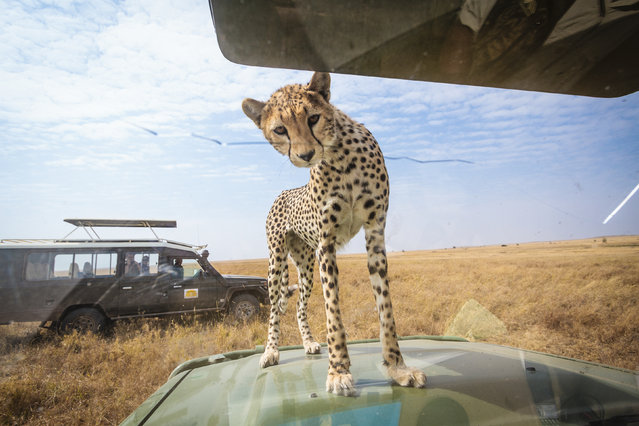
The cheetah peers inside the car to see who is inside. (Photo by Bobby-Jo Clow/Caters News)

“This is the heart-stopping moment a photographer came within inches of a young cheetah when it stuck its head through her sun roof. Australian Bobby-Jo Clow, 31, was on safari in Tanzania when the juvenile started heading towards her Landrover with his sibling. She snapped away as the young male dangled its paws in front of her face and smelt her hair before its mother called it away into the wilds of the Serengeti National Park. But not until Bobby-Jo, a full-time elephant keeper at a Tanzanian Zoo, had leaned forward enough to capture the perfect shot, causing the cheetah to hiss and bare its teeth”. – Caters News. (Photo by Bobby-Jo Clow/Caters News)
Details
16 Mar 2014 08:22:00
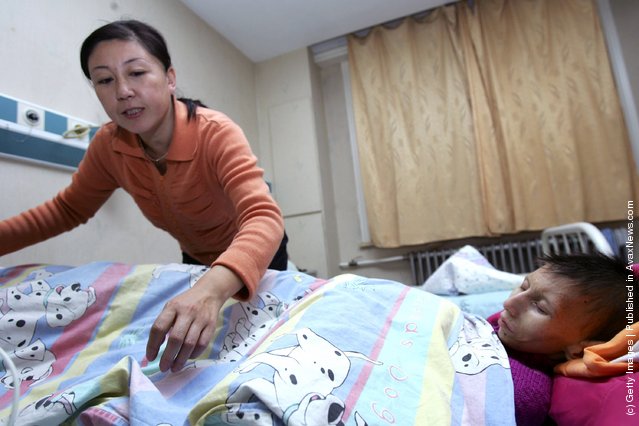
12-year-old Chinese girl Sun Yangyang suffering from Cockayne syndrome

“Cockayne syndrome (also called Weber-Cockayne syndrome, or Neill-Dingwall Syndrome) is a rare autosomal recessive congenital disorder characterized by growth failure, impaired development of the nervous system, abnormal sensitivity to sunlight (photosensitivity), and premature aging. Hearing loss and eye abnormalities (pigmentary retinopathy) are other common features, but problems with any or all of the internal organs are possible. It is associated with a group of disorders called leukodystrophies. The underlying disorder is a defect in a DNA repair mechanism. It is named after English physician Edward Alfred Cockayne (1880–1956)”. – Wikipedia

Photo: Mother of 12-year-old Chinese girl Sun Yangyang suffering from Cockayne syndrome, tends her at the First Affiliated Hospital of Jilin University on November 11, 2006 in Changchun of Jilin Province, China. The disease results in the senile appearance of Yangyang and also causes eyesight, hearing weakness and other problems. Doctors failed to cure the girl... (Photo by China Photos/Getty Images)
Details
08 Aug 2011 11:17:00
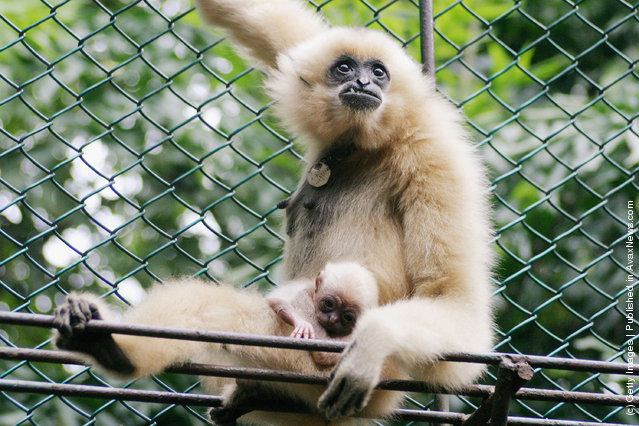
Newborn White-Cheeked Gibbon Nomascus

“Nomascus is the second most speciose genus of gibbons (family Hylobatidae). Originally this genus was a subgenus of Hylobates, and all individuals were considered one species, Hylobates concolor. Species within Nomascus are characterized by 52 chromosomes. Some species are all black, some light with a distinct black tuft of crown fur, and some by distinct, light-colored cheek patches. Nomascus is found from southern China (Yunnan) to southern Vietnam, and also on Hainan Island. One of the genus' species, Nomascus nasutus, has been deemed “the most critically endangered ape species in the world”. All of the species in this genus are endangered or critically endangered”. – Wikipedia

Photo: A newborn White-Cheeked Gibbon clings to its mother in the Nanning Zoo on April 12, 2004 in Nanning, Guangxi province, China. The White-Cheeked Gibbon's natural habitat is Southern China as well as Vietnam and Laos. They are classified as highly endangered and are on the brink of extinction due to poaching and reduction of natural rainforests. (Photo by Getty Images)
Details
12 Aug 2011 11:51:00
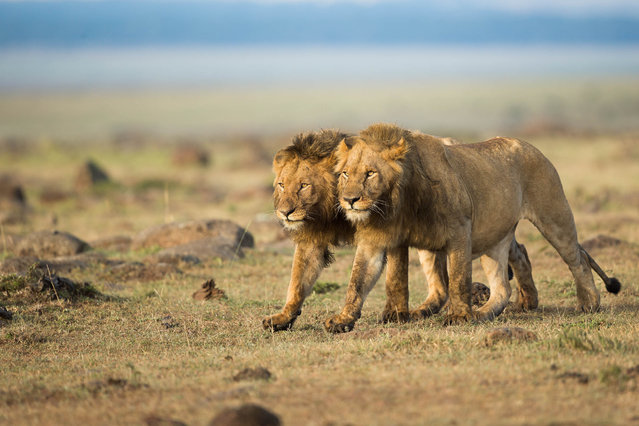
“Two Brothers”. We found about 20 lions eating a buffalo. When the male leaved the group we anticipated him to take photos. It is 8AM, light is perfect and the position too. The lion stops and looks down from the hill, another lion is coming up, it stiffens, I think that will be a fight, i'm tense, the camera is OK, the shots previously made perfect. Photo location: Masai Mara, Kenya. (Photo and caption by Massimo Mei/National Geographic Photo Contest)

“Two Brothers”. We found about 20 lions eating a buffalo. When the male leaved the group we anticipated him to take photos. It is 8AM, light is perfect and the position too. The lion stops and looks down from the hill, another lion is coming up, it stiffens, I think that will be a fight, i'm tense, the camera is OK, the shots previously made perfect. The two meet, looking directly into their eyes, they sniff, rub against their heads, the tension drops, they start walking with the same step as when they were puppies, they are two brothers. Photo location: Masai Mara, Kenya. (Photo and caption by Massimo Mei/National Geographic Photo Contest)
Details
02 Jul 2014 09:45:00
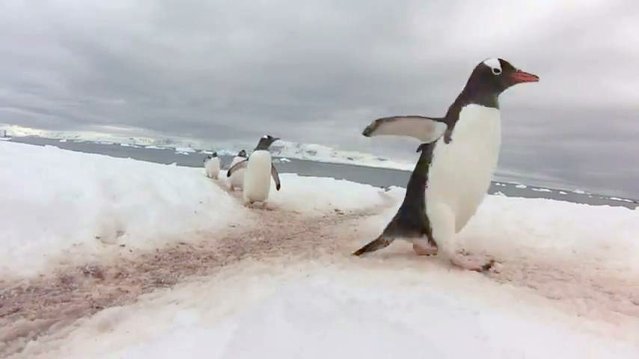
“Penguin Highway” in Antarctica by Melissa Brennan

“Penguin Highway” in Antarctica by Melissa Brennan (Video by Melissa Brennan). Very funny, I recommend to look! =)
Details
13 Feb 2013 18:11:00
Wide-angle category winner. Part of the Illusion by Marcus Blatchford (UK). Location: National Dive & Activity Centre, Chepstow, Wales. “This is the deepest inland dive centre in the UK. The dive plan was to explore the deep end, but this time I dived ‘unplugged’ (without my strobes). With the exception of this change to my camera technique, there were no planned shots I wanted to achieve – just a fun dive with ad-hoc photos along the way. Shortly after this photo was captured, in 6C water and two hours of decompression ahead of us, we turned and started the long ascent back to the surface”. (Photo by Marcus Blatchford/Underwater Photographer of the Year 2016)

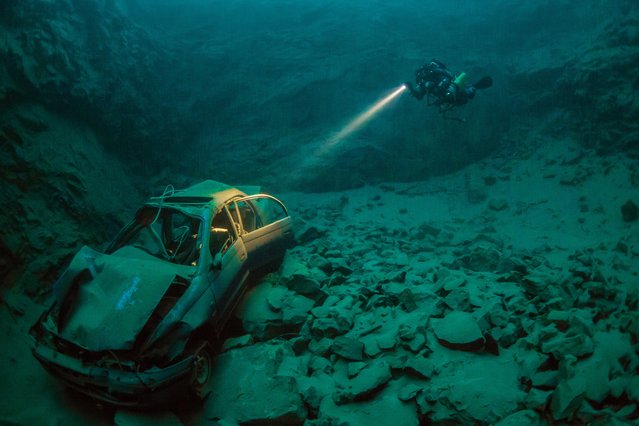
Wide-angle category winner. Part of the Illusion by Marcus Blatchford (UK). Location: National Dive & Activity Centre, Chepstow, Wales. “This is the deepest inland dive centre in the UK. The dive plan was to explore the deep end, but this time I dived ‘unplugged’ (without my strobes). With the exception of this change to my camera technique, there were no planned shots I wanted to achieve – just a fun dive with ad-hoc photos along the way. Shortly after this photo was captured, in 6C water and two hours of decompression ahead of us, we turned and started the long ascent back to the surface”. (Photo by Marcus Blatchford/Underwater Photographer of the Year 2016)
Details
18 Feb 2016 13:44:00