Luna the French Bulldog is dressed in red, white, and blue during the National Independence Day Parade in Washington, DC, on July 4, 2023. (Photo by Stefani Reynolds/AFP Photo)
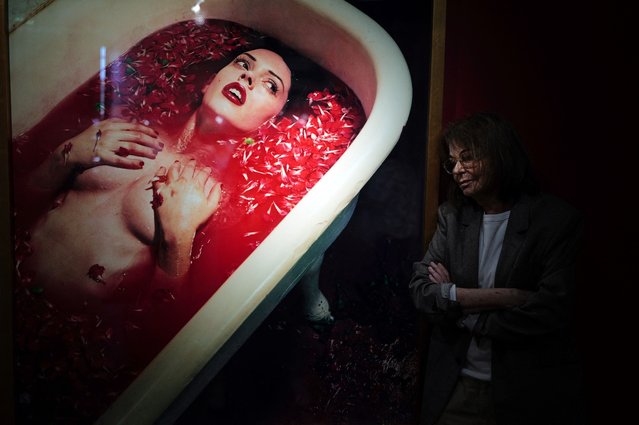
French photographer Bettina Rheims poses next to her work, two days before the opening of her exhibition “Pourquoi m'as-tu abandonnée ?” (Why did you abandon me?) at the Museum of Photography Charles Negre, in Nice on June 13, 2024. (Photo by Valery Hache/AFP Photo)
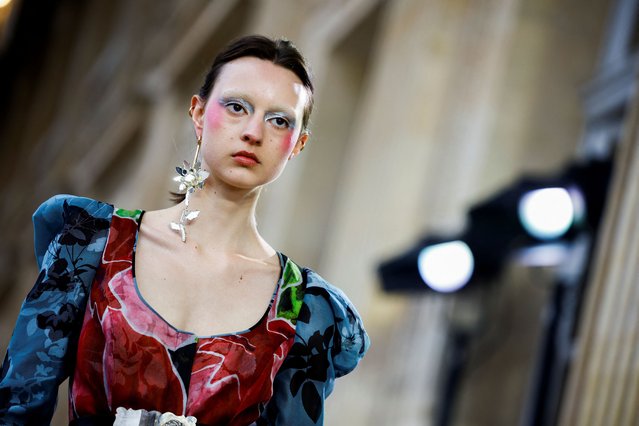
A model presents a creation by designer Andreas Kronthaler as part of his Fall-Winter 2023/2024 Women's ready-to-wear collection show for late designer Vivienne Westwood's namesake label during Paris Fashion Week in Paris, France on March 4, 2023. (Photo by Sarah Meyssonnier/Reuters)
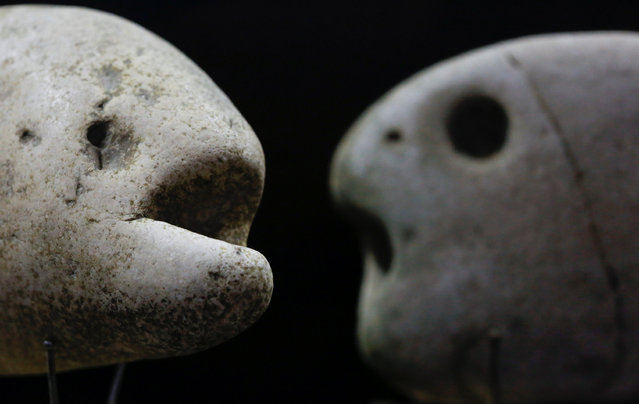
Stones collected and categorised by shape (fish) are seen at the home workshop of Luigi Lineri in Zevio, near Verona, Italy, June 10, 2016. Luigi Lineri's home workshop is covered in stones – tens of thousands of them. They resemble animal heads, human faces and other forms, and the artist and poet believes may have been shaped by prehistoric humans. (Photo by Alessandro Bianchi/Reuters)
Photo: Vladimir Ilyich Lenin (1870 – 1924) lying in state in the Kremlin. (Photo by Hulton Archive/Getty Images). 1924
Important! For the same article in Russian language click here.
Something quite intriguing is happening within Russian-speaking internet during the last few – should you type a fully academic inquiry (at least, according to Russian academic requirements) in national search engines for "Lenin's mausoleum" – the first thing you get (even in top 10 searches) is website pages talking about black magic and occult. Website authors view this construction differently, but unconditionally agree on one thing: the mausoleum of the "leader of the world proletariat” – the essence of a magical artifact, a sort of “energy vampire”. It was built with a certain purpose: to drain the energy out of miserable Soviet citizens on one hand; and to poison the anthroposphere of one-sixth part of the earth with its vibes (the exact territory that was occupied by the former Soviet Union), depriving the Russian people of will to resist on the other hand. Complete nonsense? No doubt. Nevertheless, an intriguing one. Well, probably because some oddities do exist in mausoleum's history. These oddities are the thing we are going to discuss this time. First, let me refresh you memory on the subject.
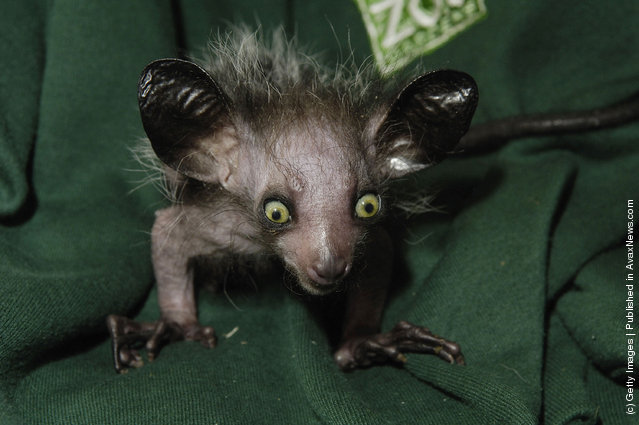
“The aye-aye (Daubentonia madagascariensis) is a lemur, a strepsirrhine primate native to Madagascar that combines rodent-like teeth and a special thin middle finger to fill the same ecological niche as a woodpecker. It is the world's largest nocturnal primate, and is characterized by its unusual method of finding food; it taps on trees to find grubs, then gnaws holes in the wood and inserts its narrow middle finger to pull the grubs out. The only other animal species known to find food in this way is the striped possum. From an ecological point of view the aye-aye fills the niche of a woodpecker as it is capable of penetrating wood to extract the invertebrates within”. – Wikipedia
Photo: In this handout image from Bristol Zoo is seen the first captive bred aye-aye in the UK named “Kintana” (meaning star in Malagasy) April 15, 2005 at Bristol Zoo Gardens, England. The zoo announced today only the second baby aye-aye to be hand-reared in the world (the first was in Jersey Zoo) and has now made his first public appearance since his birth on 11 February 2005. (Photo by Rob Cousins/Bristol Zoo via Getty Images)
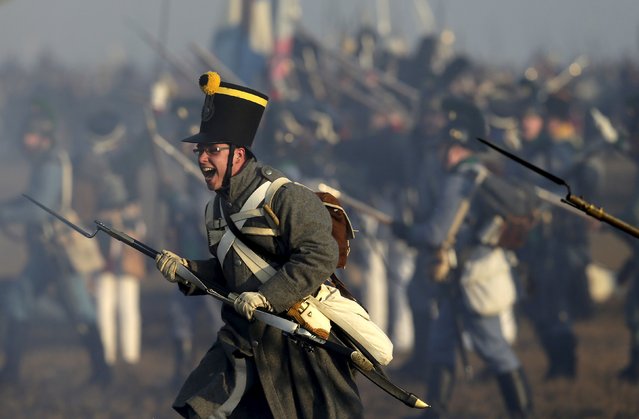
A history enthusiast, dressed as a soldier, fights during the re-enactment of Napoleon's famous battle of Austerlitz near the southern Moravian town of Slavkov u Brna December 5, 2015. Hundreds of history enthusiasts gathered near the city of Slavkov before a re-enactment of Napoleon's famous battle of Austerlitz on Saturday to mark its 210th anniversary. (Photo by David W. Cerny/Reuters)