Loading...
Done
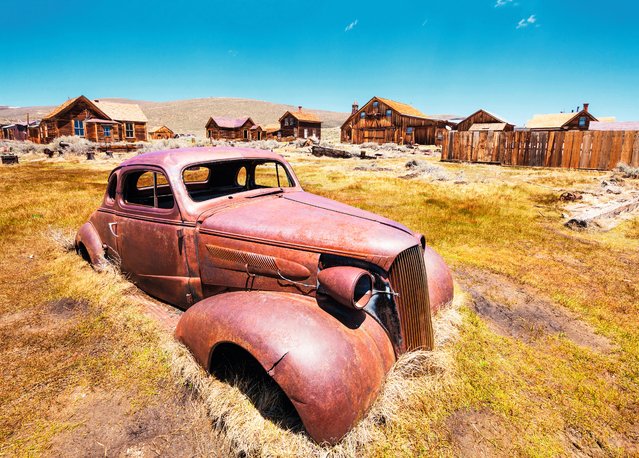
Bodie, Mono County, California. Gold was discovered at Bodie in 1859 (just after the initial California gold rush) and it went from mining camp to boomtown. Its decline began in 1880, when word spread of new boomtowns elsewhere. The Standard Consolidated Mine closed in 1913, and four years later the Bodie Railway was abandoned. By 1940 the population was down to 40. Today, Bodie is maintained in a state of arrested decay as a visitor attraction. (Photo by Alamy Stock Photo)

Kieron Connolly’s new book of photographs of more than 100 once-busy and often elegant buildings gives an idea of how the world might look if humankind disappeared. Here: Bodie, Mono County, California. Gold was discovered at Bodie in 1859 (just after the initial California gold rush) and it went from mining camp to boomtown. Its decline began in 1880, when word spread of new boomtowns elsewhere. The Standard Consolidated Mine closed in 1913, and four years later the Bodie Railway was abandoned. By 1940 the population was down to 40. Today, Bodie is maintained in a state of arrested decay as a visitor attraction. (Photo by Alamy Stock Photo)
Details
07 Sep 2016 09:50:00
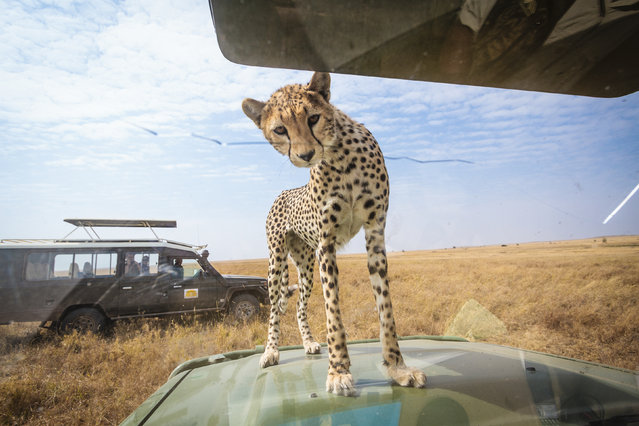
The cheetah peers inside the car to see who is inside. (Photo by Bobby-Jo Clow/Caters News)

“This is the heart-stopping moment a photographer came within inches of a young cheetah when it stuck its head through her sun roof. Australian Bobby-Jo Clow, 31, was on safari in Tanzania when the juvenile started heading towards her Landrover with his sibling. She snapped away as the young male dangled its paws in front of her face and smelt her hair before its mother called it away into the wilds of the Serengeti National Park. But not until Bobby-Jo, a full-time elephant keeper at a Tanzanian Zoo, had leaned forward enough to capture the perfect shot, causing the cheetah to hiss and bare its teeth”. – Caters News. (Photo by Bobby-Jo Clow/Caters News)
Details
16 Mar 2014 08:22:00
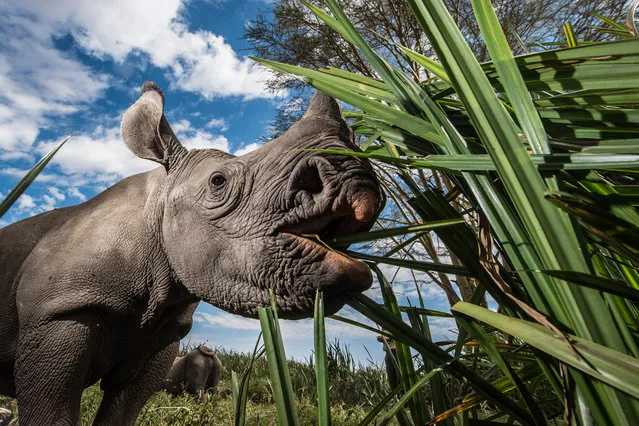
Orphaned baby rhinos seen on August 28, 2014 in Lewa Wildlife Conservancy, Ngare Ndare Forest, Kenya. (Photo by Luca Ghidoni/Barcroft Media)

Orphaned baby rhinos seen on August 28, 2014 in Lewa Wildlife Conservancy, Ngare Ndare Forest, Kenya. Lewa Wildlife Conservancy in Kenya is hand-raising three orphaned baby rhinos; Nicky, Hope and Kilifi. Baby rhino Hope was rescued by rangers when the poachers killed his mother – now he is been taken care off 24 hours-a-day at Lewa Wildlife Conservancy. The wildlife reserve hit the headlines when Prince William proposed to Kate Middleton there in 2010. Rhinos around the world are becoming extinct as a result of the brutal poaching fuelled by an illegal international market for their horns. (Photo by Luca Ghidoni/Barcroft Media)
Details
14 Sep 2014 10:27:00
12-year-old Chinese girl Sun Yangyang suffering from Cockayne syndrome

“Cockayne syndrome (also called Weber-Cockayne syndrome, or Neill-Dingwall Syndrome) is a rare autosomal recessive congenital disorder characterized by growth failure, impaired development of the nervous system, abnormal sensitivity to sunlight (photosensitivity), and premature aging. Hearing loss and eye abnormalities (pigmentary retinopathy) are other common features, but problems with any or all of the internal organs are possible. It is associated with a group of disorders called leukodystrophies. The underlying disorder is a defect in a DNA repair mechanism. It is named after English physician Edward Alfred Cockayne (1880–1956)”. – Wikipedia

Photo: Mother of 12-year-old Chinese girl Sun Yangyang suffering from Cockayne syndrome, tends her at the First Affiliated Hospital of Jilin University on November 11, 2006 in Changchun of Jilin Province, China. The disease results in the senile appearance of Yangyang and also causes eyesight, hearing weakness and other problems. Doctors failed to cure the girl... (Photo by China Photos/Getty Images)
Details
08 Aug 2011 11:17:00
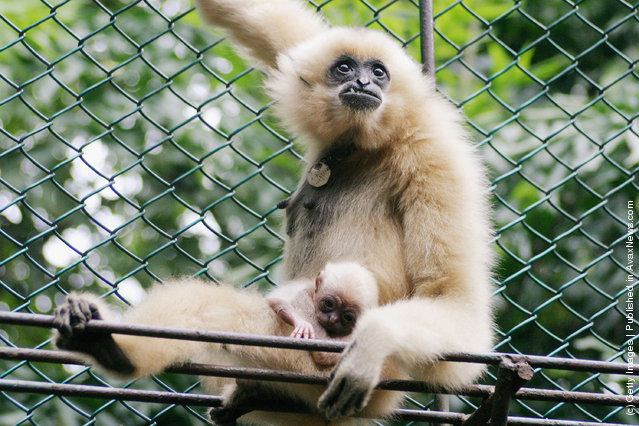
Newborn White-Cheeked Gibbon Nomascus

“Nomascus is the second most speciose genus of gibbons (family Hylobatidae). Originally this genus was a subgenus of Hylobates, and all individuals were considered one species, Hylobates concolor. Species within Nomascus are characterized by 52 chromosomes. Some species are all black, some light with a distinct black tuft of crown fur, and some by distinct, light-colored cheek patches. Nomascus is found from southern China (Yunnan) to southern Vietnam, and also on Hainan Island. One of the genus' species, Nomascus nasutus, has been deemed “the most critically endangered ape species in the world”. All of the species in this genus are endangered or critically endangered”. – Wikipedia

Photo: A newborn White-Cheeked Gibbon clings to its mother in the Nanning Zoo on April 12, 2004 in Nanning, Guangxi province, China. The White-Cheeked Gibbon's natural habitat is Southern China as well as Vietnam and Laos. They are classified as highly endangered and are on the brink of extinction due to poaching and reduction of natural rainforests. (Photo by Getty Images)
Details
12 Aug 2011 11:51:00
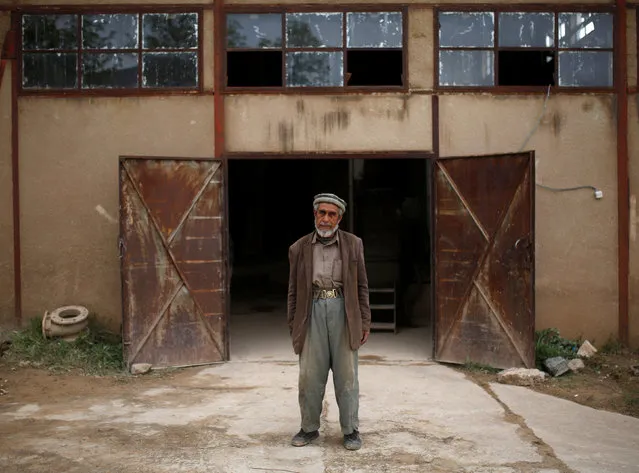
A worker at the Jabal Saraj cement factory poses for a photograph in Jabal Saraj, north of Kabul, Afghanistan April 19, 2016. (Photo by Ahmad Masood/Reuters)

A worker at the Jabal Saraj cement factory poses for a photograph in Jabal Saraj, north of Kabul, Afghanistan April 19, 2016. In an area desperately short of industry and jobs, local workers hope that the relaunch of the plant in Jabal Saraj, built by Czech engineers in 1957 and closed down by the Taliban in 1995, can show that Afghanistan's shattered industry can climb back to its feet after decades of war and destruction. But the outdated state-owned plant some 75 kilometres outside Kabul also shows how far it has to go before that promise can be achieved and there are serious questions over whether it has a viable future unless a new, modern facility is built to replace it. (Photo by Ahmad Masood/Reuters)
Details
31 May 2016 11:29:00
The Swarovski Crystal Head Fountain In Austria

A stone giant exhausted after his long travels decided to rest a while and drink from a pond far below. He lay down and started drinking from the crystal clear pond. So delicious was the water that he was unable to quench his thirst no matter how much he tried. Weeks have passed, months, years. The body of the stone giant became one with the hills and even his tongue has turned to water. This might seem like a fairy tale, yet you’ll be able to see this stone giant if you ever come to Wattens, Austria. He’s still there, guarding the entrance to Swarovski Kristallwelted, otherwise known as the Crystal Worlds. This is a one-of-a-kind theme park that was created by the people who first created Swarovski crystals.
Details
02 Mar 2015 08:30:00
Artist Pyotr Pavlensky sits on the wall enclosing the Serbsky State Scientific Center for Social and Forensic Psychiatry after he cut off a part of his earlobe during his protest action titled “Segregation” in Moscow October 19, 2014. (Photo by Maxim Zmeyev/Reuters)

Artist Pyotr Pavlensky sits on the wall enclosing the Serbsky State Scientific Center for Social and Forensic Psychiatry after he cut off a part of his earlobe during his protest action titled “Segregation” in Moscow October 19, 2014. Pavlensky protested against the usage of forensic psychiatry for politically motivated purposes. He cut off his earlobe to demonstrate how authorities could “cut off” an unwanted individual from society by using psychiatric and medical diagnosis to forcefully send a person to a penitentiary hospital, according to Pavlensky. (Photo by Maxim Zmeyev/Reuters)
Details
21 Oct 2014 12:10:00