Loading...
Done
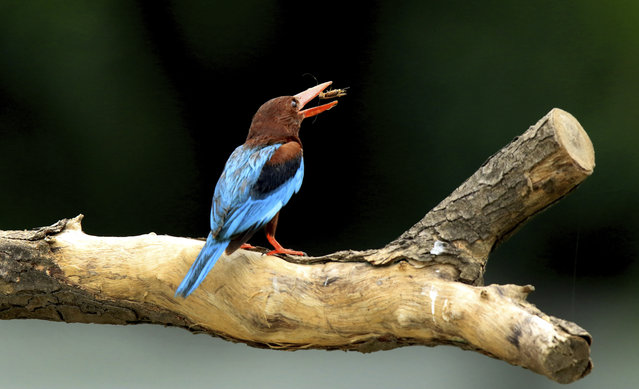
A common kingfisher sits on a branch of a tree after catching an insect in Allahabad, India, Sunday, July 9, 2017. The common kingfisher is a highly territorial bird that has to eat nearly sixty percent of its bodyweight every day. (Photo by Rajesh Kumar Singh/AP Photo)

A common kingfisher sits on a branch of a tree after catching an insect in Allahabad, India, Sunday, July 9, 2017. The common kingfisher is a highly territorial bird that has to eat nearly sixty percent of its bodyweight every day. (Photo by Rajesh Kumar Singh/AP Photo)
Details
16 Jul 2017 07:52:00
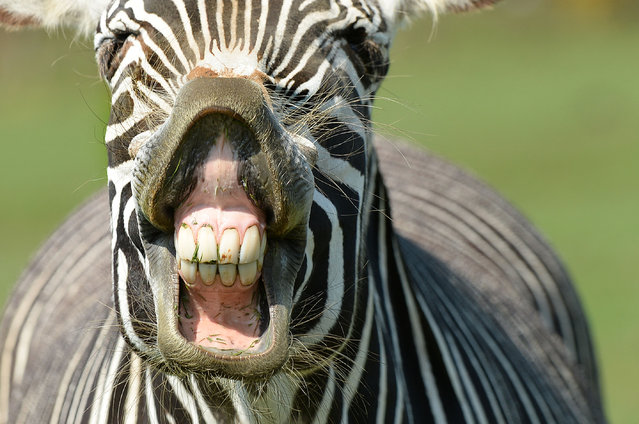
A Grevy’s zebra gets itself noticed at ZSL Whipsnade Zoo in Whipsnade, England on April 20, 2018. (Photo by Tony Margiocchi/Barcroft Media)

A Grevy’s zebra gets itself noticed at ZSL Whipsnade Zoo in Whipsnade, England on April 20, 2018. (Photo by Tony Margiocchi/Barcroft Media)
Details
29 Apr 2018 00:03:00
A youth in costume hurries past a mural after dancing at the Sun Festival in Cotacachi, Ecuador, Sunday, June 24, 2018. Across the Andes, from the tip of Argentina as far north as Colombia, indigenous communities are gathering for the southern hemisphere's winter solstice to honor the ancient sun god. (Photo by Dolores Ochoa/AP Photo)

A youth in costume hurries past a mural after dancing at the Sun Festival in Cotacachi, Ecuador, Sunday, June 24, 2018. Across the Andes, from the tip of Argentina as far north as Colombia, indigenous communities are gathering for the southern hemisphere's winter solstice to honor the ancient sun god. (Photo by Dolores Ochoa/AP Photo)
Details
26 Jun 2018 00:03:00
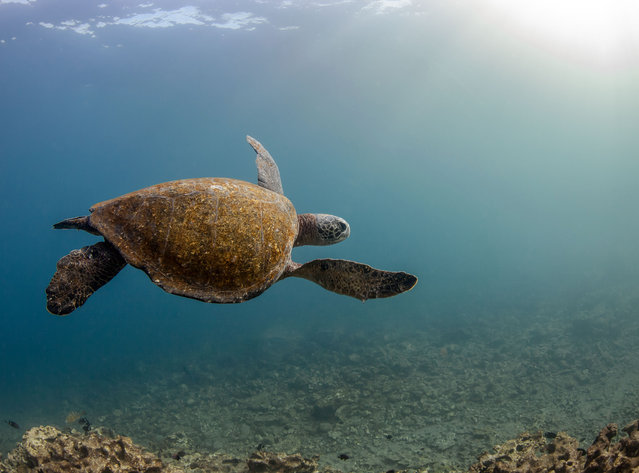
Green turtles take special care of their carapace, scraping algae off on rocks or letting cleaner fish remove parasites. Thanks to long-term protection of nesting sites, and measures to reduce the numbers caught in fishing gear, some green turtle populations are starting to recover. (Photo by Philip Hamilton/The Guardian)

Teeming with images of spectacular underwater scenes from around the world, Call of the Blue is the culmination of a five-year project by the photographer and ocean conservationist Philip Hamilton. This groundbreaking book includes contributions from acclaimed scientists and ocean “guardians”, who reveal what drove them to answer the call of the blue. (Photo by Philip Hamilton/The Guardian)
Details
23 Nov 2018 00:03:00
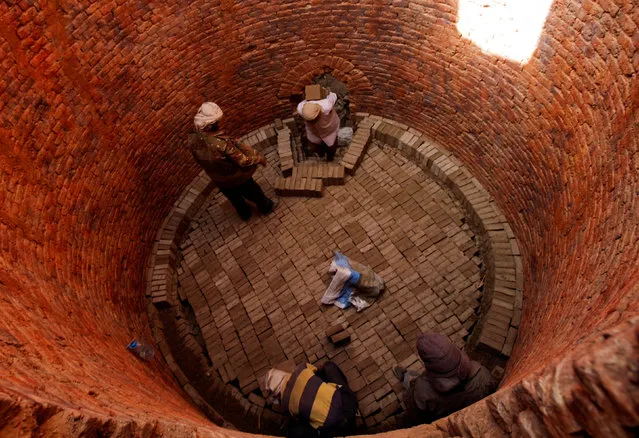
Labourers stack dried bricks inside a kiln, where they will be fired, at a brick factory on the outskirt of Sanaa, Yemen, June 1, 2016. (Photo by Mohamed al-Sayaghi/Reuters)

Labourers stack dried bricks inside a kiln, where they will be fired, at a brick factory on the outskirt of Sanaa, Yemen, June 1, 2016. Traditional mud brick tower houses have always been a source of pride to Yemenis, and over a year into a devastating civil war, they are also providing some much-needed jobs in the ancient capital Sanaa. (Photo by Mohamed al-Sayaghi/Reuters)
Details
27 Jul 2016 09:23:00
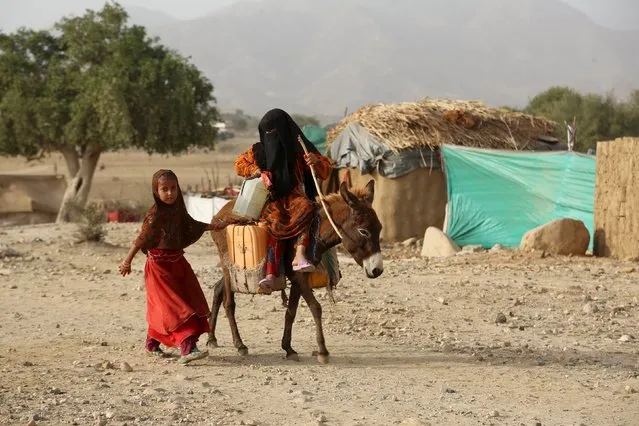
A girl rides a donkey as another walks by at the Shawqaba camp for internally displaced people who were forced to leave their villages by the war in Yemen's northwestern province of Hajjah March 12, 2016. In northwest Yemen, one of the poorest countries in the Middle East, about 400 families uprooted by the war have been stuck in the Shawqaba camp in Hajjah province for the past year. Residents live in poorly built huts that protect them neither from summer heat nor winter cold in a camp that lacks the most basic services. (Photo by Abduljabbar Zeyad/Reuters)

A girl rides a donkey as another walks by at the Shawqaba camp for internally displaced people who were forced to leave their villages by the war in Yemen's northwestern province of Hajjah March 12, 2016. In northwest Yemen, one of the poorest countries in the Middle East, about 400 families uprooted by the war have been stuck in the Shawqaba camp in Hajjah province for the past year. Residents live in poorly built huts that protect them neither from summer heat nor winter cold in a camp that lacks the most basic services. (Photo by Abduljabbar Zeyad/Reuters)
Details
09 Apr 2016 13:16:00
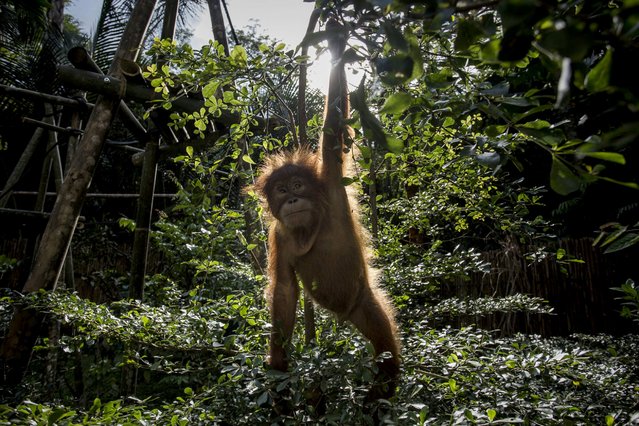
A Baby sumatran orangutan (Pongo abelii) plays around in a tree as they train at Sumatran Orangutan Conservation Programme's rehabilitation center on November 12, 2016 in Kuta Mbelin, North Sumatra, Indonesia. The Orangutans in Indonesia have been known to be on the verge of extinction as a result of deforestation and poaching. Found mostly in South-East Asia, where they live on the islands of Sumatra and Borneo, the endangered species continue to lose their habitat as a result of corporate expansion in a developing economy. Indonesia approved palm oil concessions on nearly 15 million acres of peatlands over the past years and thousands of square miles have been cleared for plantations, including the lowland areas that are the prime habitat for orangutans. (Photo by Ulet Ifansasti/Getty Images)

A Baby sumatran orangutan (Pongo abelii) plays around in a tree as they train at Sumatran Orangutan Conservation Programme's rehabilitation center on November 12, 2016 in Kuta Mbelin, North Sumatra, Indonesia. The Orangutans in Indonesia have been known to be on the verge of extinction as a result of deforestation and poaching. Found mostly in South-East Asia, where they live on the islands of Sumatra and Borneo, the endangered species continue to lose their habitat as a result of corporate expansion in a developing economy. Indonesia approved palm oil concessions on nearly 15 million acres of peatlands over the past years and thousands of square miles have been cleared for plantations, including the lowland areas that are the prime habitat for orangutans. (Photo by Ulet Ifansasti/Getty Images)
Details
16 Nov 2016 11:14:00
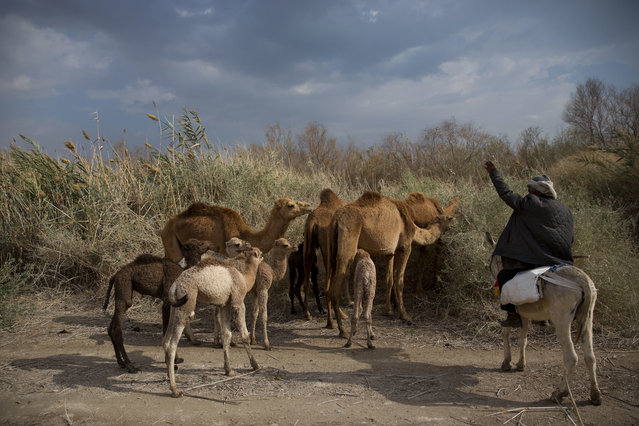
In this Sunday, February 18, 2018 photo, Palestinian camel herder Salem Rashaideh, leads the way for the camels in the territory of Israeli Kibbutz Kalya, near the Dead Sea in the West Bank. (Phoro by Oded Balilty/AP Photo)

In this Sunday, February 18, 2018 photo, Palestinian camel herder Salem Rashaideh, leads the way for the camels in the territory of Israeli Kibbutz Kalya, near the Dead Sea in the West Bank. For three months a year, in the winter time Bedouin Arab herders take their 130 camels to graze on the shores of the Dead Sea, at the lowest place on Earth. (Phoro by Oded Balilty/AP Photo)
Details
19 Mar 2018 00:03:00