Loading...
Done
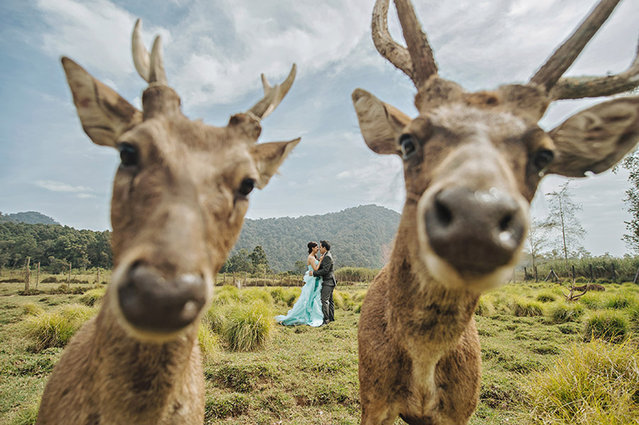
Couples wedding photo photobombed by deer. (Photo by Hendra Lesmana/Caters News Agency/ISPWP)

These hilarious photos will leave people wedding themselves with laughter. The images – which include photobombs, wardrobe malfunctions and unexpected animal behaviour – have been released by the International Society of Professional Wedding Photographs (ISPWP). Each year the society holds quarterly competitions, celebrating a variety of the best image from couples special days. Other categories in the ISPWPs completions include the likes Getting Ready, First Dance, Family Love, and a selection of portrait possibilities. Here: Couples wedding photo photobombed by deer. (Photo by Hendra Lesmana/Caters News Agency/ISPWP)
Details
14 Jan 2016 08:02:00
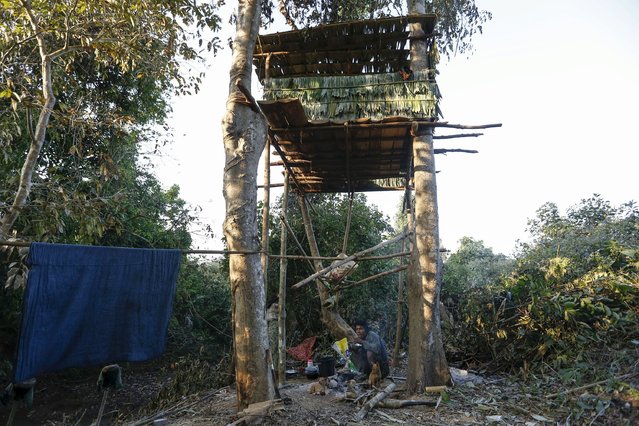
A man eats a meal under his tree house, which acts as a shelter from wild elephants, in Gwe Cho village, Shwe Taung Yan township Ayeyarwady division January 18, 2016. (Photo by Soe Zeya Tun/Reuters)

A man eats a meal under his tree house, which acts as a shelter from wild elephants, in Gwe Cho village, Shwe Taung Yan township Ayeyarwady division January 18, 2016. Wild elephants are driving villagers in a Myanmar township to seek refuge while the animals storm their rice paddies, in Ayeyarwady in the Delta region, West of Yangon. (Photo by Soe Zeya Tun/Reuters)
Details
20 Jan 2016 08:05:00
A bull hits a reveller during the first running of the bulls of the San Fermin festival in Pamplona, Spain, July 7, 2018. (Photo by Vincent West/Reuters)

A bull hits a reveller during the first running of the bulls of the San Fermin festival in Pamplona, Spain, July 7, 2018. Each day at 8am hundreds of people race with six bulls, charging along a winding, 848.6-metre (more than half a mile) course through narrow streets to the city's bull ring, where the animals are killed in a bullfight or corrida, during this festival dating back to medieval times and also featuring religious processions, folk dancing, concerts and round-the-clock drinking. (Photo by Vincent West/Reuters)
Details
11 Jul 2018 00:05:00
Galapagos – Rocking the Cradle: Four major ocean currents converge along the Galapagos archipelago, creating the conditions for an extraordinary diversity of animal life, April 25, 2016. The islands are home to at least 7,000 flora and fauna species, of which 97 percent of the reptiles, 80 percent of the land birds, 50 percent of the insects and 30 percent of the plants are endemic. The local ecosystem is highly sensitive to the changes in temperature, rainfall and ocean currents that characterize the climatic events known as El Niño and La Niña. These changes cause marked fluctuations in weather and food availability. Many scientists expect the frequency of El Niño and La Niña to increase as a result of climate change, making the Galapagos a possible early-warning location for its effects. (Photo by Thomas P. Peschak for National Geographic/World Press Photo)

Galapagos – Rocking the Cradle: Four major ocean currents converge along the Galapagos archipelago, creating the conditions for an extraordinary diversity of animal life, April 25, 2016. The islands are home to at least 7,000 flora and fauna species, of which 97 percent of the reptiles, 80 percent of the land birds, 50 percent of the insects and 30 percent of the plants are endemic. (Photo by Thomas P. Peschak for National Geographic/World Press Photo)
Details
16 Apr 2018 00:01:00
A boy sits on the back of a crocodile on May 19, 2018 at a pond in Bazoule in Burkina Faso, a village which happily shares its local pond with “sacred” crocodiles. Crocodiles may be one of the deadliest hunters in the animal kingdom, but in a small village in Burkina Faso it is not unusual to see someone sitting atop one of the fearsome reptiles. According to local legend, the startling relationship with the predators dates back to at least the 15 th century. The village was in the grip of an agonising drought until the crocodiles led women to a hidden pond where the population could slake their thirst. (Photo by Olympia de Maismont/AFP Photo)

A boy sits on the back of a crocodile on May 19, 2018 at a pond in Bazoule in Burkina Faso, a village which happily shares its local pond with “sacred” crocodiles. Crocodiles may be one of the deadliest hunters in the animal kingdom, but in a small village in Burkina Faso it is not unusual to see someone sitting atop one of the fearsome reptiles. According to local legend, the startling relationship with the predators dates back to at least the 15 th century. The village was in the grip of an agonising drought until the crocodiles led women to a hidden pond where the population could slake their thirst. (Photo by Olympia de Maismont/AFP Photo)
Details
17 Jul 2018 00:01:00
Camel herders scoop up water in plastic buckets from one of the few watering holes in the area, to water their animals near the drought-affected village of Bandarero, near Moyale town on the Ethiopian border, in northern Kenya, Friday, March 3, 2017. The U.N. humanitarian chief, Stephen O'Brien, toured Bandarero village on Friday and called on the international community to act to “avert the very worst of the effects of drought and to avert a famine to make sure we don't go from what is deep suffering to a catastrophe”. (Photo by Ben Curtis/AP Photo)

Camel herders scoop up water in plastic buckets from one of the few watering holes in the area, to water their animals near the drought-affected village of Bandarero, near Moyale town on the Ethiopian border, in northern Kenya, Friday, March 3, 2017. The U.N. humanitarian chief, Stephen O'Brien, toured Bandarero village on Friday and called on the international community to act to “avert the very worst of the effects of drought and to avert a famine to make sure we don't go from what is deep suffering to a catastrophe”. (Photo by Ben Curtis/AP Photo)
Details
05 Mar 2017 00:03:00
Ali Asair, who has left his family behind and traveled hundreds of kilometers in search for a pasture for his animals, attends to his camel in a pastoralists' settlement in the Bandarbeyla district in Somalia's semi-autonomous region of Puntland, Somalia, 24 March 2017. According to media reports, the United Nations says only 31 percent of 864 million US dollars appeal for a drought-hit Somalia is funded. The UN said the world is facing the largest humanitarian crisis since 1945, adding that more than 20 million people are facing the threat of famine in Somalia, Yemen, South Sudan and Nigeria and 1.4 million children could die from starvation this year. (Photo by Dai Kurokawa/EPA)

Ali Asair, who has left his family behind and traveled hundreds of kilometers in search for a pasture for his animals, attends to his camel in a pastoralists' settlement in the Bandarbeyla district in Somalia's semi-autonomous region of Puntland, Somalia, 24 March 2017. According to media reports, the United Nations says only 31 percent of 864 million US dollars appeal for a drought-hit Somalia is funded. The UN said the world is facing the largest humanitarian crisis since 1945, adding that more than 20 million people are facing the threat of famine in Somalia, Yemen, South Sudan and Nigeria and 1.4 million children could die from starvation this year. (Photo by Dai Kurokawa/EPA)
Details
28 Mar 2017 09:01:00
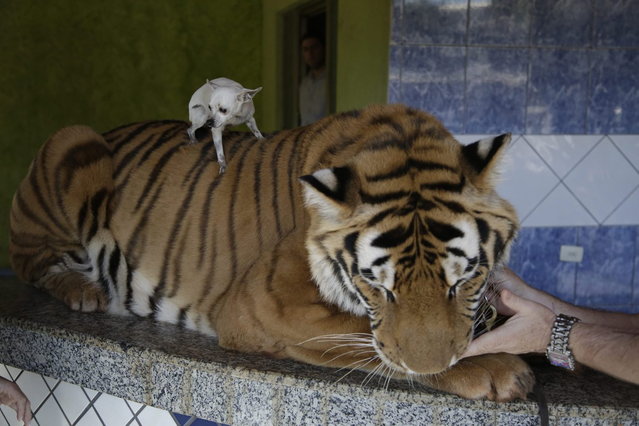
The Borges' family pet dog, Little, is placed on the back of Tom, their tiger, for a photo to be taken, in Maringa, Brazil, Friday, September 27, 2013. The Brazilian family is now locked in a legal dispute for the big cats, they have eight tigers and two lions, with federal wildlife officials working to take them away. While Borges does have a license to raise the animals, Brazilian wildlife officials say he illegally bred the cats, creating a public danger. (Photo by Renata Brito/AP Photo)

“Ary Borges and his family live in southern Brazil like most families the Borges' love animals and have an array of cats living in their home. The only difference between the cats owned by the Borges family and the cat that is cuddled up on your lap as you read this is the Borges' cats weigh over 700 pounds and could kill you just as soon as look at you. The Borges family shares their home with nine tigers, two lionesses, a chimp and a Chihuahua”. – Amanda Schiavo via Latin Times. Photo: The Borges' family pet dog, Little, is placed on the back of Tom, their tiger, for a photo to be taken, in Maringa, Brazil, Friday, September 27, 2013. (Photo by Renata Brito/AP Photo)
Details
04 Oct 2013 11:51:00