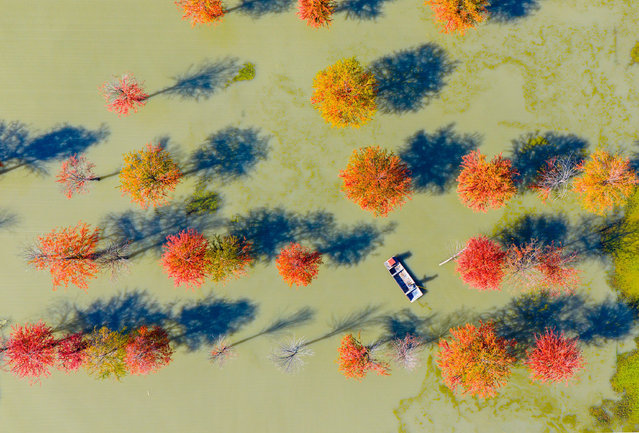
Farmers feed crabs under Metasequoia at the Sihong County Ecological Breeding Base in Suqian City, Jiangsu Province, China, on November 19, 2025. (Photo by Costfoto/NurPhoto/Rex Features/Shutterstock)
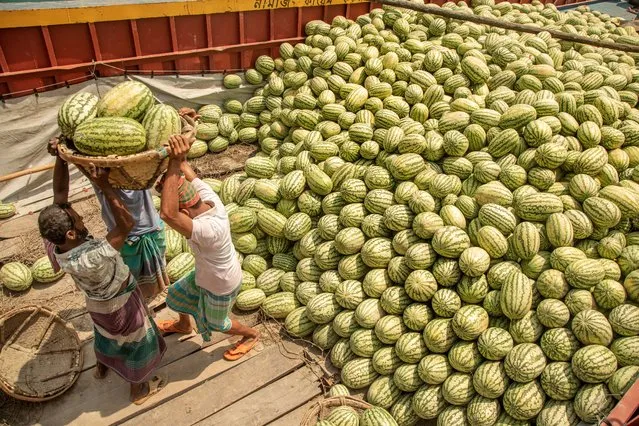
Bangladeshi laborers unload watermelons from a boat at the Buriganga River in Dhaka, Bangladesh, 03 April 2024. Watermelon is in harvesting season and is filling the city markets as it arrives from the southern part of Bangladesh. According to the Department of Agriculture Extension (DAE), Barishal has set an ambitious goal to expand watermelon cultivation to 54,002 hectares across six high-yielding districts in the division, which is 14 percent higher than last year. (Photo by Monirul Alam/EPA/EFE)
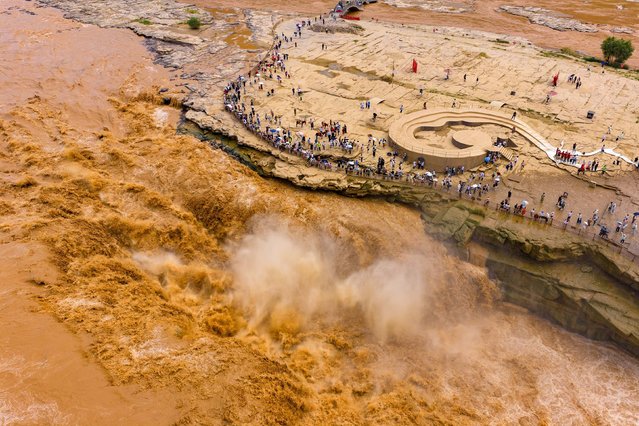
An aerial view of people visiting the roaring Hukou Waterfall on the Yellow River on August 11, 2025 in Yan'an, Shaanxi Province of China. Hukou waterfall is witnessing an increasing water flow lately. (Photo by Liu Yijiang/VCG via Getty Images)
A tourist catches snowflakes on her tongue during snow fall in Times Square, Midtown, New York, on January 3, 2013. A major snowstorm producing blizzard-like conditions hammered the northeastern United States on Friday, causing more than 1,000 U.S. flight delays and cancellations, paralyzing road travel, and closing schools and government offices. (Photo by Darren Ornitz/Reuters)
Jeremy Davis (L) demonstrates the operation of the safe room shelter door lock to homeowner Rob Hamlin on June 18, 2011 in Neosho, Missouri. Once thought of as a luxury item there has been a surge of interest from homeowners in purchasing shelters to ride out damaging storms ever since a F5 tornado tore through the town of Joplin, Missouri. Ranging in price from $3,000 to $5,000 homeowners can supplement the cost with a mortgage insurance program offered by the U.S. Department of Housing and Urban Development for installing a safe room built to FEMA specifications. Lawmakers in Alabama have even considered requiring construction of storm shelters in mobile home parks after forty people died in April. (Photo by Julie Denesha/Getty Images)
Photographer Gregg Segal travelled the world to document children and the food they eat in a week. Partly inspired by the increasing problems of childhood obesity, he tracked traditional regional diets as yet unaffected by globalisation, and ironically, found that the healthiest diets were often eaten by the least well off. (Photo by Gregg Segal/The Guardian)