Loading...
Done
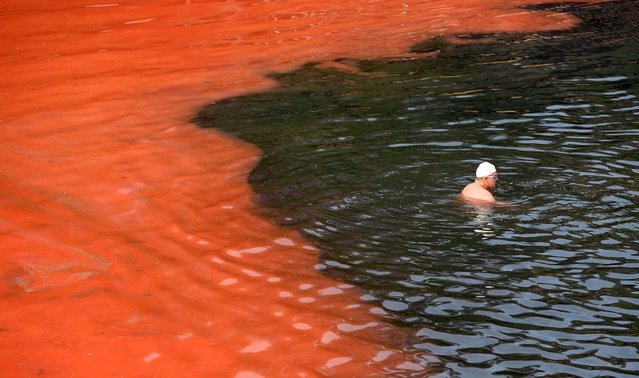
A swimmer stops short of a red algae bloom at Sydney's Clovelly Beach on November 27, 2012, which closed some beaches for swimming including Bondi Beach for a period of time.  While the red algae, known as Noctiluca scintillans or sea sparkle, has no toxic effects, people are still advised to avoid swimming in areas with discoloured water because the algae, which can be high in ammonia, can cause skin irritation. (Photo by William West/AFP Photo)

A swimmer stops short of a red algae bloom at Sydney's Clovelly Beach on November 27, 2012, which closed some beaches for swimming including Bondi Beach for a period of time. While the red algae, known as Noctiluca scintillans or sea sparkle, has no toxic effects, people are still advised to avoid swimming in areas with discoloured water because the algae, which can be high in ammonia, can cause skin irritation. (Photo by William West/AFP Photo)
Details
28 Nov 2012 09:52:00
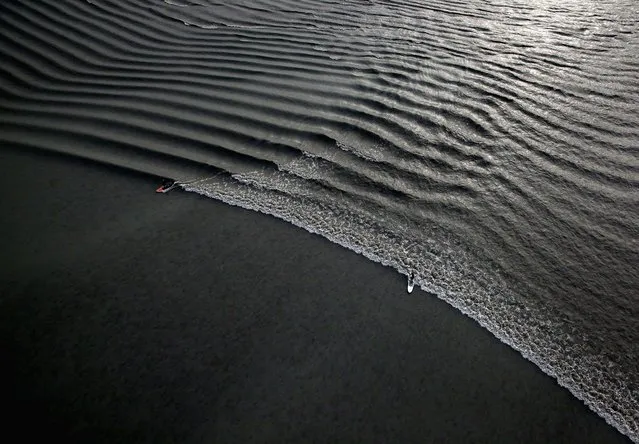
A group of surfers ride the Bore Tide at Turnagain Arm on July 15, 2014 in Anchorage, Alaska. Alaskas most famous Bore Tide, occurs in a spot on the outside of Anchorage in the lower arm of the Cook Inlet, Turnagain Arm, where wave heights can reach 6-10 feet tall, move at 10-15 mph and the water temperature stays around 40 degrees farenheit. This years Supermoon substantially increased the size of the normal wave and made it a destination for surfers. (Photo by Streeter Lecka/Getty Images)

A group of surfers ride the Bore Tide at Turnagain Arm on July 15, 2014 in Anchorage, Alaska. Alaskas most famous Bore Tide, occurs in a spot on the outside of Anchorage in the lower arm of the Cook Inlet, Turnagain Arm, where wave heights can reach 6-10 feet tall, move at 10-15 mph and the water temperature stays around 40 degrees farenheit. This years Supermoon substantially increased the size of the normal wave and made it a destination for surfers. (Photo by Streeter Lecka/Getty Images)
Details
05 Aug 2014 12:08:00
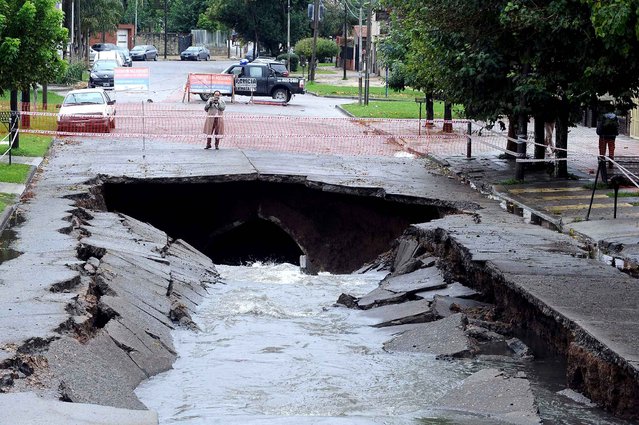
Handout picture released by Telam showing the tarmac of the Pedro Palacios Avenue in Ramos Mejia, province of Buenos Aires, Argentina, under which the channeled waters of the Maldonado stream flow, after it collapsed on April 8, 2014 leaving a 40-metre-long, 1.4-metre-deep hole. About 3000 people had to be evacuated in the Argentine provinces of Neuquen (soutwest), Catamarca (northwest), Santiago del estero (center) and Cordoba (center)due to the foods caused by heavy rain, official sources said. (Photo by Daniel Dabove/AFP Photo)

Handout picture released by Telam showing the tarmac of the Pedro Palacios Avenue in Ramos Mejia, province of Buenos Aires, Argentina, under which the channeled waters of the Maldonado stream flow, after it collapsed on April 8, 2014 leaving a 40-metre-long, 1.4-metre-deep hole. About 3000 people had to be evacuated in the Argentine provinces of Neuquen (soutwest), Catamarca (northwest), Santiago del estero (center) and Cordoba (center)due to the foods caused by heavy rain, official sources said. (Photo by Daniel Dabove/AFP Photo)
Details
12 Apr 2014 12:40:00
People protect themselves behind a trash can as anti-riot olice fires water cannon to disperse thousands of people demonstrating following the death of Berkin Elvan, a teenage boy wounded in mass anti-government demonstrations last year, on March 11, 2014 near the Middle East Technical University (ODTU) in Ankara. (Photo by Adem Altan/AFP Photo)

People protect themselves behind a trash can as anti-riot olice fires water cannon to disperse thousands of people demonstrating following the death of Berkin Elvan, a teenage boy wounded in mass anti-government demonstrations last year, on March 11, 2014 near the Middle East Technical University (ODTU) in Ankara. Elvan's story – he spent 269 days in a coma – gripped the nation and became a symbol of the heavy-handed tactics used by police to reign in the biggest demonstrations against Prime Minister Recep Tayyip Erdogan since he came to power in 2003. (Photo by Adem Altan/AFP Photo)
Details
13 Mar 2014 09:23:00
Snorkelers interact with a Florida Manatee inside of the Three Sisters Springs in Crystal River, Florida January 15, 2015. On winter days, Florida manatees flock by the hundreds to the balmy waters of Three Sisters Springs, drawing crowds of snorkelers and kayakers to the U.S. sanctuary, where people may swim with the endangered species. (Photo by Scott Audette/Reuters)

Snorkelers interact with a Florida Manatee inside of the Three Sisters Springs in Crystal River, Florida January 15, 2015. On winter days, Florida manatees flock by the hundreds to the balmy waters of Three Sisters Springs, drawing crowds of snorkelers and kayakers to the U.S. sanctuary, where people may swim with the endangered species. But as tolerant as the gentle, whiskered sea giants can be of the accidental kicks and splashes of delighted tourists, wild life regulators want to ban most canoes and paddle boards and create people-free zones to protect the wintering “sea cow”. Proposed limitations for this winter are awaiting approval by the U.S. Fish and Wildlife Service. (Photo by Scott Audette/Reuters)
Details
22 Jan 2015 13:34:00
More than 400 people stripped off and ran into freezing waters to celebrate the autumn equinox – and raise money for charity at Druridge Bay, Britain, September 25, 2016. It was the largest turnout the North East Skinny Dip has ever seen in its five-year history, and it was also the first time it has ever rained on the morning of the event. Revellers gathered from 5.30am on Sunday at Druridge Bay, in Northumberland, before baring all in the North Sea. (Photo by David Charlton Photography)

More than 400 people stripped off and ran into freezing waters to celebrate the autumn equinox – and raise money for charity at Druridge Bay, Britain, September 25, 2016. It was the largest turnout the North East Skinny Dip has ever seen in its five-year history, and it was also the first time it has ever rained on the morning of the event. Revellers gathered from 5.30am on Sunday at Druridge Bay, in Northumberland, before baring all in the North Sea. (Photo by David Charlton Photography)
Details
26 Sep 2016 07:09:00
In this February 1, 2017 photo, environmental activist Maruja Inquilla poses for a photo next to a Municipal waste treatment plant with water that flows into Lake Titicaca, in Juliaca, in the Puno region of Peru. “If the frogs could talk they would say, This is killing me”," said Inquilla, who recently showed up at the Puno governor's house carrying plastic bags filled with hundreds of dead frogs in protest. (Photo by Rodrigo Abd/AP Photo)

In this February 1, 2017 photo, environmental activist Maruja Inquilla poses for a photo next to a Municipal waste treatment plant with water that flows into Lake Titicaca, in Juliaca, in the Puno region of Peru. “If the frogs could talk they would say, This is killing me”," said Inquilla, who recently showed up at the Puno governor's house carrying plastic bags filled with hundreds of dead frogs in protest. (Photo by Rodrigo Abd/AP Photo)
Details
04 Mar 2017 00:02:00
In this June 29, 2016 file photo, boats docked at Central Marine in Stuart, Fla., are surrounded by blue green algae. The 153-mile-long Indian River Lagoon has been plagued by harmful algae blooms. Water quality testing data analyzed by the AP showed the average phosphorous level – a byproduct of fertilizers and human waste that algae thrive on, rose nearly 75 percent between 2000 and 2016. (Photo by Greg Lovett/The Palm Beach Post via AP Photo)

In this June 29, 2016 file photo, boats docked at Central Marine in Stuart, Fla., are surrounded by blue green algae. The 153-mile-long Indian River Lagoon has been plagued by harmful algae blooms. Water quality testing data analyzed by the AP showed the average phosphorous level – a byproduct of fertilizers and human waste that algae thrive on, rose nearly 75 percent between 2000 and 2016. (Photo by Greg Lovett/The Palm Beach Post via AP Photo)
Details
11 May 2017 07:26:00