Loading...
Done
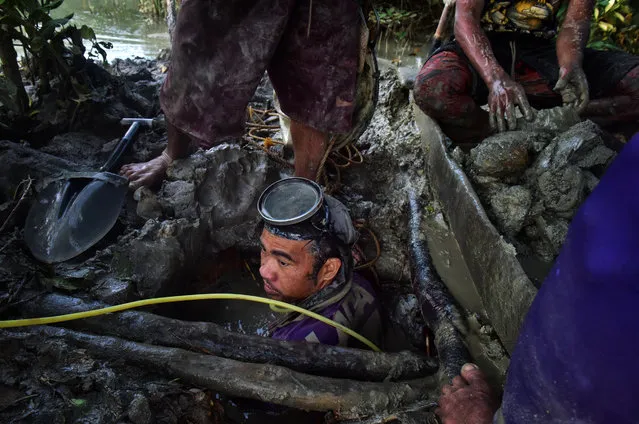
Christian Balderosdasco, 31, is being pulled up a mud pit after diving for 3 hours to look for gold on March 22, 2017 in Paracale, Philippines. (Photo by Jes Aznar/Getty Images)

Christian Balderosdasco, 31, is being pulled up a mud pit after diving for 3 hours to look for gold on March 22, 2017 in Paracale, Philippines. Apart from tunneling and sifting sand, locals dive down murky swamps with the aid of a compressor with air flowing in a small tube for breathing, as they blindly swim under the mud for up to four hours to look for tiny rocks containing gold particles. For decades, local residents at Paracale town work in hazardous conditions scavenging under the earth and diving into tunnels filled with mud using only makeshift tools to mine for gold, often placing their health and lives at risk. (Photo by Jes Aznar/Getty Images)
Details
06 Apr 2017 09:21:00
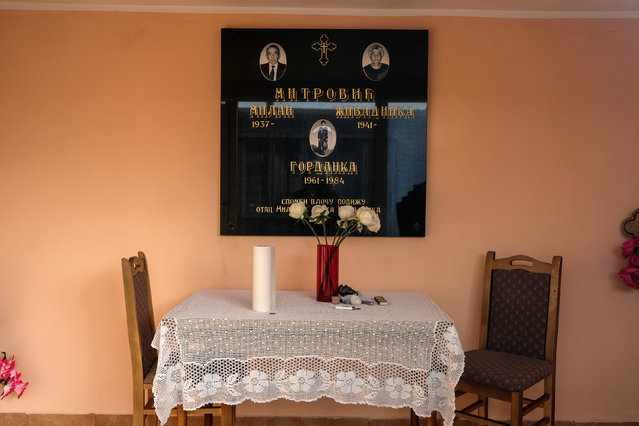
Pictures of deceased people are seen inside a chapel at a cemetery in the village of Smoljinac, Serbia, October 25, 2016. (Photo by Marko Djurica/Reuters)

Pictures of deceased people are seen inside a chapel at a cemetery in the village of Smoljinac, Serbia, October 25, 2016. From a distance, the cemetery in the eastern Serbian village of Smoljinac looks like a residential neighbourhood eerily placed among graves. But once inside the grounds, after passing a section with the usual stone slabs, visitors find rows of small bungalows painted in pastel colours. They have one or two rooms, large windows and ornate plaques – some inside, some outside – memorialising the deceased. These are the burial chapels of Smoljinac, cosy cabins with a furnished room inside, a storage place for wreaths and funeral paraphernalia, and the family crypt below. Some even have electric power inside. (Photo by Marko Djurica/Reuters)
Details
12 Nov 2016 10:37:00
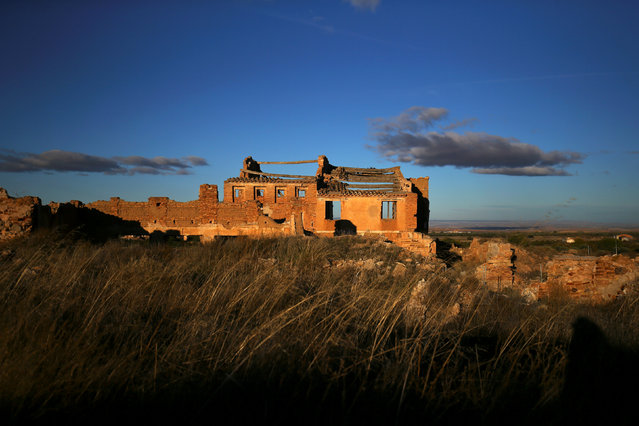
Ruins of a building are seen in the old village of Belchite, in northern Spain, November 13, 2016. (Photo by Andrea Comas/Reuters)

Ruins of a building are seen in the old village of Belchite, in northern Spain, November 13, 2016. Almost 80 years ago Tomas Ortin fled under the cover of night from his home in the small town of Belchite on Spain's northern plains to escape with hundreds of others from one of the bloodiest battles of the country's civil war. At 94 years old, Ortin now lives just across the road from Belchite, which has lain in ruins since Republican forces attacked it, a symbol of the destruction caused by the 1936-1939 war in which an estimated 500,000 people died. (Photo by Andrea Comas/Reuters)
Details
30 Nov 2016 12:31:00
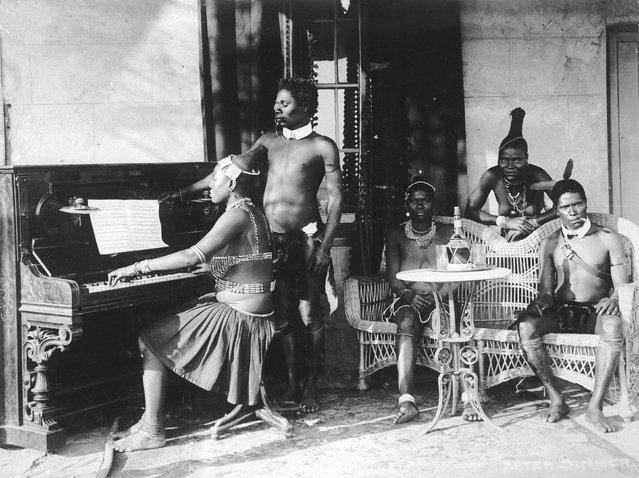
circa 1925:  A Zulu woman playing the piano while a group of others sit and listen.  (Photo by General Photographic Agency/Getty Images)

“The Zulu are the largest South African ethnic group, with an estimated 10–11 million people living mainly in the province of KwaZulu-Natal. Small numbers also live in Zimbabwe, Zambia, and Mozambique. Their language, Zulu, is a Bantu language; more specifically, part of the Nguni subgroup. The Zulu Kingdom played a major role in South African history during the 19th and 20th centuries. Under apartheid, Zulu people were classed as third-class citizens and suffered from state-sanctioned discrimination. They remain today the most numerous ethnic group in South Africa, and now have equal rights along with all other citizens”. – Wikipedia.

Photo: A Zulu woman playing the piano while a group of others sit and listen (to put it briefly, Englishmen scoff over Zulu). South Africa, circa 1925. (Photo by General Photographic Agency)

Details
03 Feb 2014 09:40:00
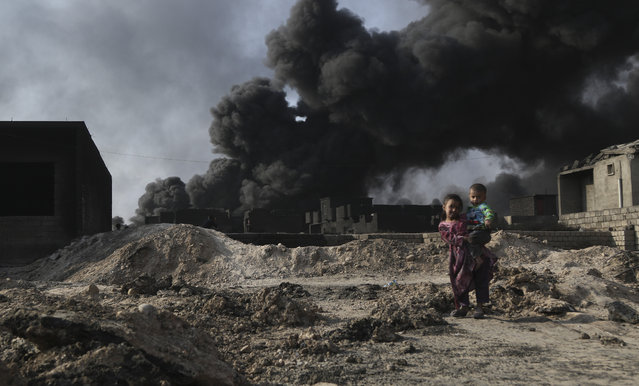
A girl holds her brother in her arm as black smoke rises after an oil well set on fire in the center of al-Kayyara town to the south of Daesh terror organization-held Mosul in Iraq on October 25, 2016. The oil well in the center of al-Kayyara town, which was set alight by retreating Daesh militants in advance of the Iraqi army's takeover of the town on August 24, 2016 has still not entirely been put out. The raw petrol which is still alight is creating black clouds above the city. The residents and wildlife beneath this polluting smoke cloud may find their health at risk. The effects of the fire in the town center on unprotected civilians' health can easily be seen on the hands and faces of children playing on the street. (Photo by dris Okuducu/Anadolu Agency/Getty Images)

A girl holds her brother in her arm as black smoke rises after an oil well set on fire in the center of al-Kayyara town to the south of Daesh terror organization-held Mosul in Iraq on October 25, 2016. The oil well in the center of al-Kayyara town, which was set alight by retreating Daesh militants in advance of the Iraqi army's takeover of the town on August 24, 2016 has still not entirely been put out. The raw petrol which is still alight is creating black clouds above the city. The residents and wildlife beneath this polluting smoke cloud may find their health at risk. The effects of the fire in the town center on unprotected civilians' health can easily be seen on the hands and faces of children playing on the street. (Photo by dris Okuducu/Anadolu Agency/Getty Images)
Details
27 Oct 2016 11:54:00
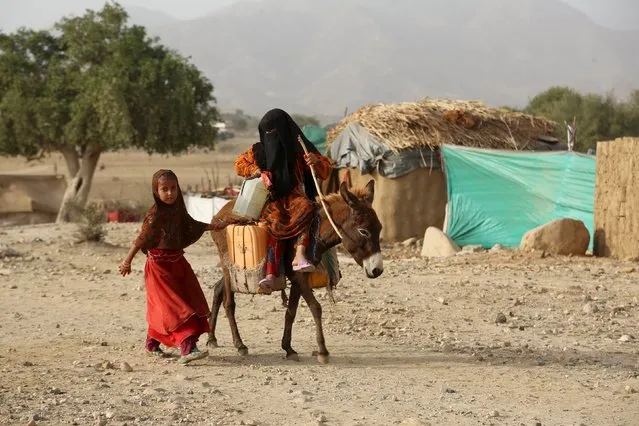
A girl rides a donkey as another walks by at the Shawqaba camp for internally displaced people who were forced to leave their villages by the war in Yemen's northwestern province of Hajjah March 12, 2016. In northwest Yemen, one of the poorest countries in the Middle East, about 400 families uprooted by the war have been stuck in the Shawqaba camp in Hajjah province for the past year. Residents live in poorly built huts that protect them neither from summer heat nor winter cold in a camp that lacks the most basic services. (Photo by Abduljabbar Zeyad/Reuters)

A girl rides a donkey as another walks by at the Shawqaba camp for internally displaced people who were forced to leave their villages by the war in Yemen's northwestern province of Hajjah March 12, 2016. In northwest Yemen, one of the poorest countries in the Middle East, about 400 families uprooted by the war have been stuck in the Shawqaba camp in Hajjah province for the past year. Residents live in poorly built huts that protect them neither from summer heat nor winter cold in a camp that lacks the most basic services. (Photo by Abduljabbar Zeyad/Reuters)
Details
09 Apr 2016 13:16:00
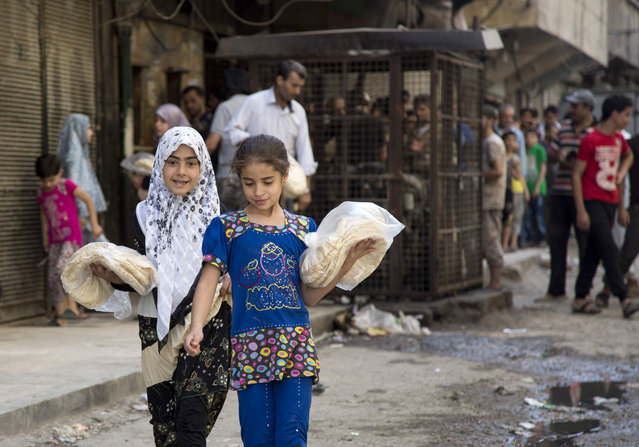
Syrian girls carry bags with bread as people queue up outisde a bakery in a rebel held neighbourhood in the northern city of Aleppo on July 12, 2016. Since mid-2012, Aleppo has been roughly divided between government control in the west and rebel control in the east, and has suffered enormous destruction in the war that has killed more than 280,000 people nationwide. Last week, a government advance brought regime troops within firing range of the Castello Road, the only remaining supply route into the opposition-held east, effectively severing rebel neighbourhoods from the outside world. With their route to the outside world cut, there is no new flour coming to the city's bakeries, and fuel to light their ovens is also now hard to find. (Photo by Karam Al-Masri/AFP Photo)

Syrian girls carry bags with bread as people queue up outisde a bakery in a rebel held neighbourhood in the northern city of Aleppo on July 12, 2016. Since mid-2012, Aleppo has been roughly divided between government control in the west and rebel control in the east, and has suffered enormous destruction in the war that has killed more than 280,000 people nationwide. Last week, a government advance brought regime troops within firing range of the Castello Road, the only remaining supply route into the opposition-held east, effectively severing rebel neighbourhoods from the outside world. With their route to the outside world cut, there is no new flour coming to the city's bakeries, and fuel to light their ovens is also now hard to find. (Photo by Karam Al-Masri/AFP Photo)
Details
08 Aug 2016 10:02:00
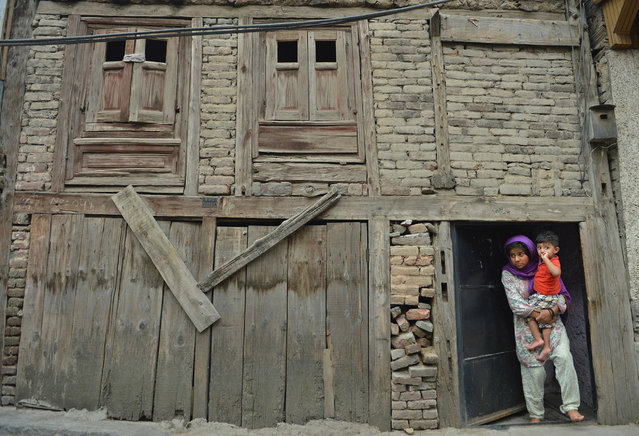
A Kashmiri girl holds her brother in the doorway of their home while watching protesters shout pro-freedom and anti-Indian slogans during  mourning and protests held in downtown Srinagar on August 22, 2016, following the killing of teenager Irfan Ahmed by security forces. Teenager Irfan Ahmed was killed after he was hit in the chest by a teargas canister fired by Indian security forces to quell pro-freedom protests in the Kashmiri capital on August 21. More than 60 civilians have been killed in clashes between protesters and security forces, and thousands more injured in the worst violence to hit the Himalayan region since 201. Indian-administered Kashmir has been in the grip of almost daily anti-India protests and rolling curfews sparked by the killing on July 8 of a popular rebel leader, Burhan Wani, in a gunfight with government forces. (Photo by Tauseef Mustafa/AFP Photo)

A Kashmiri girl holds her brother in the doorway of their home while watching protesters shout pro-freedom and anti-Indian slogans during mourning and protests held in downtown Srinagar on August 22, 2016, following the killing of teenager Irfan Ahmed by security forces. Teenager Irfan Ahmed was killed after he was hit in the chest by a teargas canister fired by Indian security forces to quell pro-freedom protests in the Kashmiri capital on August 21. More than 60 civilians have been killed in clashes between protesters and security forces, and thousands more injured in the worst violence to hit the Himalayan region since 201. Indian-administered Kashmir has been in the grip of almost daily anti-India protests and rolling curfews sparked by the killing on July 8 of a popular rebel leader, Burhan Wani, in a gunfight with government forces. (Photo by Tauseef Mustafa/AFP Photo)
Details
25 Aug 2016 09:48:00