Loading...
Done
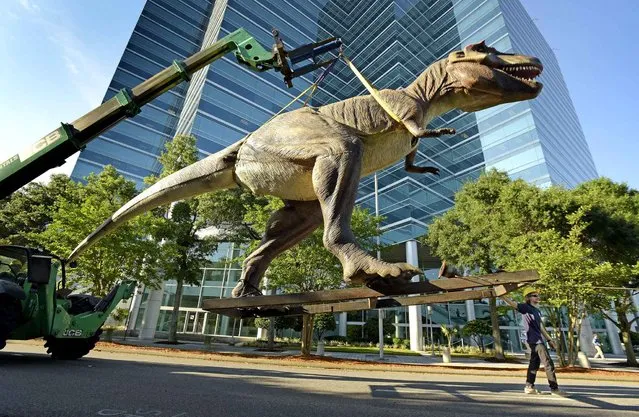
Crews move a 39 foot long, 16 foot tall, 2400 lbs. replica of a Tyrannosaurus Rex from behind the Museum Of Science And History in Jacksonville, Fla., to its new location in front of the entrance of the museum Wednesday morning, May 20, 2015, to kickoff the upcoming Dinosaurs Unearthed exhibit. (Photo by Bob Self/The Florida Times-Union via AP Photo)

Crews move a 39 foot long, 16 foot tall, 2400 lbs. replica of a Tyrannosaurus Rex from behind the Museum Of Science And History in Jacksonville, Fla., to its new location in front of the entrance of the museum Wednesday morning, May 20, 2015, to kickoff the upcoming Dinosaurs Unearthed exhibit. The exhibiti, which opens this week, includes animatronic dinosaurs as well as prehistoric fossils and runs through September 7. (Photo by Bob Self/The Florida Times-Union via AP Photo)
Details
23 May 2015 11:22:00
Macaque monkeys crowd together in their cage at a monkey farm on February 3, 2016 in Xinye county, Henan province, China. The area boasts a centuries-long and lucrative history of raising and training monkeys for performance. In Xinye, villagers are seeing an increase in business with the lunar calendar's “Year of the Monkey”. Farmers say most of the monkeys are bred and raised for domestic zoos, circuses, and performing groups, but add that some are also sold for medical research in China and the United States. Despite the popularity of the tradition, critics contend the training methods and conditions constitute animal cruelty. (Photo by Kevin Frayer/Getty Images)

Macaque monkeys crowd together in their cage at a monkey farm on February 3, 2016 in Xinye county, Henan province, China. The area boasts a centuries-long and lucrative history of raising and training monkeys for performance. In Xinye, villagers are seeing an increase in business with the lunar calendar's “Year of the Monkey”. Farmers say most of the monkeys are bred and raised for domestic zoos, circuses, and performing groups, but add that some are also sold for medical research in China and the United States. Despite the popularity of the tradition, critics contend the training methods and conditions constitute animal cruelty. (Photo by Kevin Frayer/Getty Images)
Details
31 Dec 2016 09:56:00
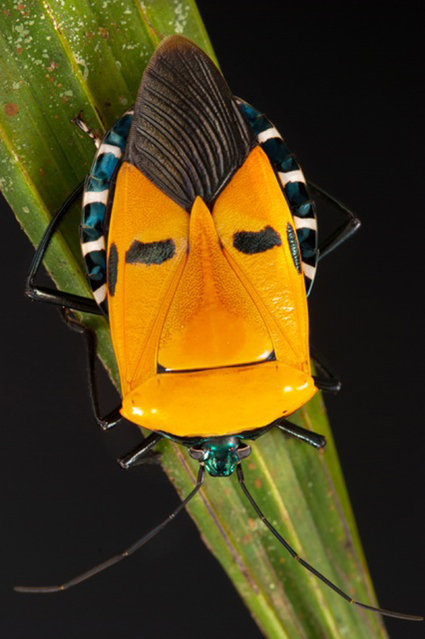
Pentomid bug. (Photo by Darlyne Murawsk/National Geographic Creative/Caters News)

It’s a bug’s life for these colorful insects – whose natural markings resemble incredible smiling faces. These dazzling insects, with their colorful patterns and markings, look as if they are living a happy bugs life. But they’re also the spitting image of a whole host of stars from stage and screen from a creeping Charlie Chaplin to Elvis Presley. Photo: Pentomid bug. (Photo by Darlyne Murawsk/National Geographic Creative/Caters News)
Details
29 Apr 2014 10:08:00
“Red Land: Sunset Cloud Village is one of the most picturesque places in Red Land, China. As its name indicates, it's best to see before sunset. The reddish brown soil turns redder after rainfall and after farmers plow the land”. (Photo and comment by Peng Jiang/National Geographic Photo Contest via The Atlantic)

“Red Land: Sunset Cloud Village is one of the most picturesque places in Red Land, China. As its name indicates, it's best to see before sunset. The reddish brown soil turns redder after rainfall and after farmers plow the land”. (Photo and comment by Peng Jiang/National Geographic Photo Contest via The Atlantic)


Details
05 Dec 2012 11:07:00
An explosion at a petrochemical plant is seen in Rizhao, Shandong province, July 16, 2015. According to Xinhua News Agency, a fire broke out after the explosion, which was caused by a liquified hydrocarbon leak at the plant, on Thursday morning. There was no report of casualties yet. (Photo by Reuters/China Daily)

An explosion at a petrochemical plant is seen in Rizhao, Shandong province, July 16, 2015. According to Xinhua News Agency, a fire broke out after the explosion, which was caused by a liquified hydrocarbon leak at the plant, on Thursday morning. There was no report of casualties yet. (Photo by Reuters/China Daily)
Details
17 Jul 2015 14:03:00
A man takes photo of his colleague with a mobile phone on the burning oil tanker at the ship-breaking yard in Gaddani, Pakistan, November 2, 2016. (Photo by Akhtar Soomro/Reuters)

A man takes photo of his colleague with a mobile phone on the burning oil tanker at the ship-breaking yard in Gaddani, Pakistan, November 2, 2016. Reports state that at least eighteen workers were killed and more than 100 were wounded in a blast at Gaddani ship breaking yard near Karachi on 01 November. Initial reports suggest the blast occurred when a gas cylinder exploded inside an oil tanker being broken up for scrap. (Photo by Akhtar Soomro/Reuters)
Details
04 Nov 2016 12:44:00
In this Saturday, September 5, 2015, photo, three women in costumes look at sea life swimming above them during a private party held at the Georgia Aquarium as part of Dragon Con in Atlanta. (Photo by Ron Harris/AP Photo)

In this Saturday, September 5, 2015, photo, three women in costumes look at sea life swimming above them during a private party held at the Georgia Aquarium as part of Dragon Con in Atlanta. The convention draws fans from around the country to take part in sci-fi and fantasy costume contests, a massive parade through downtown Atlanta and educational seminars about science and costume making. (Photo by Ron Harris/AP Photo)
Details
07 Sep 2015 14:19:00
“Cassowaries are large, flightless birds related to emus and (more distantly) to ostriches, rheas, and kiwis”, writes Olivia Judson in the September issue of National Geographic magazine. (Photo by Christian Ziegler/National Geographic)

“Cassowaries are large, flightless birds related to emus and (more distantly) to ostriches, rheas, and kiwis”, writes Olivia Judson in the September issue of National Geographic magazine. How large? People-size: Adult males stand well over five foot five and top 110 pounds. Females are even taller, and can weigh more than 160 pounds. Dangerous when roused, they’re shy and peaceable when left alone. But even birds this big and tough are prey to habitat loss. The dense New Guinea and Australia rain forests where they live have dwindled. Today cassowaries might number 1,500 to 2,000. And because they help shape those same forests – by moving seeds from one place to another – “if they vanish”, Judson writes, “the structure of the forest would gradually change” too. (Photo by Christian Ziegler/National Geographic)
Details
06 Jan 2014 12:21:00