Loading...
Done
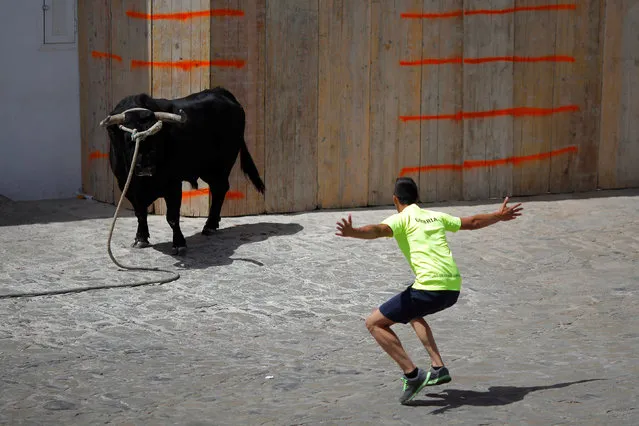
A runner tries to get the attention of a bull, named Santon, during the “Toro de Cuerda” (Bull on Rope) festival at Plaza de Espana square in Grazalema, southern Spain, July 18, 2016. (Photo by Jon Nazca/Reuters)

A runner tries to get the attention of a bull, named Santon, during the “Toro de Cuerda” (Bull on Rope) festival at Plaza de Espana square in Grazalema, southern Spain, July 18, 2016. Three bulls restrained by a rope are allowed to run through the streets of the village during the annual festival. (Photo by Jon Nazca/Reuters)
Details
19 Jul 2016 12:53:00
A man with a mask poses for a portrait as he takes part in festivities in honour of patron saint San Jeronimo in Masaya city, Nicaragua November 20, 2016. (Photo by Oswaldo Rivas/Reuters)

A man with a mask poses for a portrait as he takes part in festivities in honour of patron saint San Jeronimo in Masaya city, Nicaragua November 20, 2016. (Photo by Oswaldo Rivas/Reuters)
Details
22 Nov 2016 11:04:00
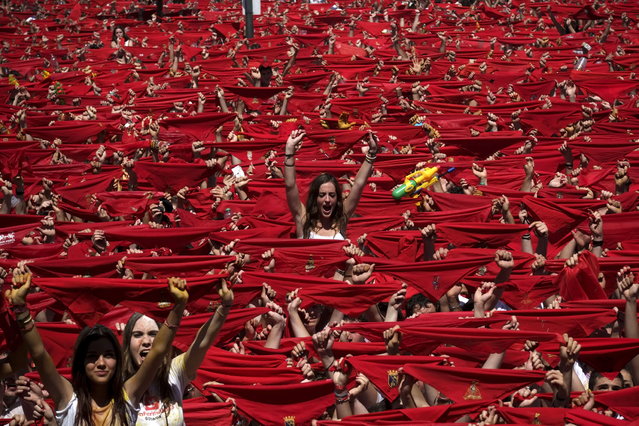
Participants hold red scarves as they celebrate the “Chupinazo” marking the start at noon sharp of the San Fermin Festival at Castle square in Pamplona, northern Spain on July 6, 2013. Ten of thousands of people packed Pamplona's streets for a drunken kick-off to Spain's best-known fiesta: the nine-day San Fermin bull-running festival. (Photo by Pedro Armestre/AFP Photo)

Participants hold red scarves as they celebrate the “Chupinazo” marking the start at noon sharp of the San Fermin Festival at Castle square in Pamplona, northern Spain on July 6, 2013. Ten of thousands of people packed Pamplona's streets for a drunken kick-off to Spain's best-known fiesta: the nine-day San Fermin bull-running festival. (Photo by Pedro Armestre/AFP Photo)
Details
11 Jul 2013 09:30:00
Participants celebrate during the “Chupinazo” (start rocket) to mark the kickoff at noon sharp of the San Fermin Festival, in front of the Town Hall of Pamplona, northern Spain, on July 6, 2018. (Photo by Jaime Reina/AFP Photo)

Participants celebrate during the “Chupinazo” (start rocket) to mark the kickoff at noon sharp of the San Fermin Festival, in front of the Town Hall of Pamplona, northern Spain, on July 6, 2018. (Photo by Jaime Reina/AFP Photo)
Details
09 Jul 2018 00:05:00
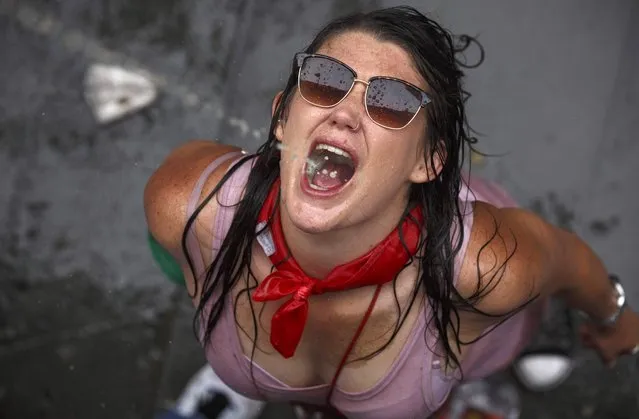
A reveller catches beer thrown from a balcony during the opening day or “Chupinazo” of the San Fermin Running of the Bulls fiesta on July 6, 2017 in Pamplona, Spain. The annual Fiesta de San Fermin, made famous by the 1926 novel of US writer Ernest Hemmingway entitled “The Sun Also Rises”, involves the daily running of the bulls through the historic heart of Pamplona to the bull ring. (Photo by Pablo Blazquez Dominguez/Getty Images)

A reveller catches beer thrown from a balcony during the opening day or “Chupinazo” of the San Fermin Running of the Bulls fiesta on July 6, 2017 in Pamplona, Spain. The annual Fiesta de San Fermin, made famous by the 1926 novel of US writer Ernest Hemmingway entitled “The Sun Also Rises”, involves the daily running of the bulls through the historic heart of Pamplona to the bull ring. (Photo by Pablo Blazquez Dominguez/Getty Images)
Details
08 Jul 2017 08:59:00
A catholic faithful smeared in burnt oil, takes part in the opening of the ten-day celebration of the Santo Domingo de Guzman festival in Managua, on August 1, 2019. (Photo by Inti Ocon/AFP Photo)

A catholic faithful smeared in burnt oil, takes part in the opening of the ten-day celebration of the Santo Domingo de Guzman festival in Managua, on August 1, 2019. In Central America the black devil, or El Cadejo, is an evil dog-like spirit with glowing red eyes that locals believe eats new born puppies. (Photo by Inti Ocon/AFP Photo)
Details
06 Aug 2019 00:01:00
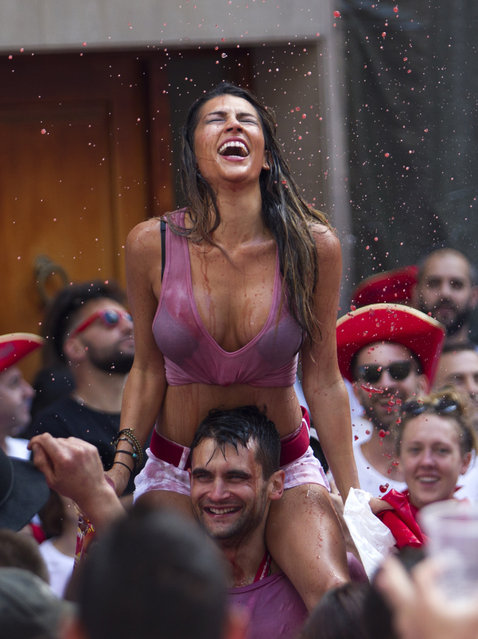
A man pours red wine on a girl's head during the Batalla del Vino (Battle of Wine) in Haro, on June 29, 2015. Every year thousands of locals and tourists climb a mountain in the northern Spanish province of La Rioja to celebrate St. Peter's day covering each other in red wine while tanker trucks filled with wine distribute the alcoholic beverage to water pistols, back mounted spraying devices, buckets which are randomly poured on heads and into any other available container. (Photo by Cesar Manso/AFP Photo)

A man pours red wine on a girl's head during the Batalla del Vino (Battle of Wine) in Haro, on June 29, 2015. Every year thousands of locals and tourists climb a mountain in the northern Spanish province of La Rioja to celebrate St. Peter's day covering each other in red wine while tanker trucks filled with wine distribute the alcoholic beverage to water pistols, back mounted spraying devices, buckets which are randomly poured on heads and into any other available container. More than nine thousand people threw around 130,000 litres of wine during this year's Haro Wine Festival, according to local media. (Photo by Cesar Manso/AFP Photo)
Details
30 Jun 2015 11:56:00
A view of traditional bolinhos de bacalhau (fried codfish balls) in Rio de Janeiro, Brazil, May 7, 2016. (Photo by Sergio Moraes/Reuters)

If the most popular foods of Rio de Janeiro have one thing in common, it is their informality. You can find fine restaurants in the city, but they do not set Rio apart from other places. What does set it apart, and what invariably brings its residents, known as "Cariocas," together is the unpretentious food they eat in bright, loud, crowded bars and restaurants, on busy street corners, or after a day at the beach. Here: A view of traditional bolinhos de bacalhau (fried codfish balls) in Rio de Janeiro, Brazil, May 7, 2016. (Photo by Sergio Moraes/Reuters)
Details
05 Aug 2016 13:20:00