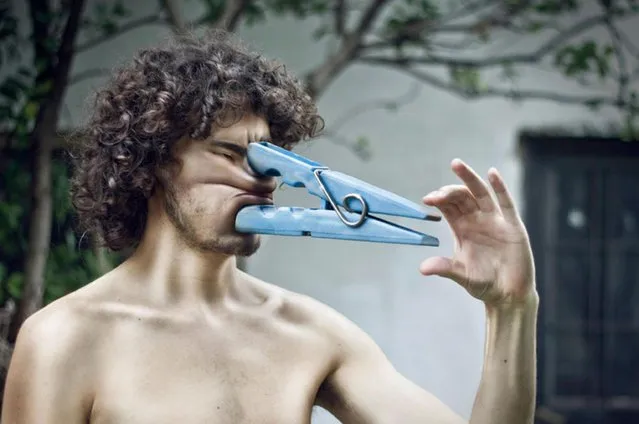
Martin De Pasquale with his creative photographs. Here's a look at the incredible world of a digital artist who creates mind-bending works of art with Photoshop. (Photo by Martin De Pasquale/Caters News)
Thai emergency staff help the injured after the scene of an explosion near Erawan Shrine, central Bangkok, Thailand, 17 August 2015. An explosion in a busy commercial district in the Thai capital killed at least 15 people. Witnesses said the explosion happened around 7:15 pm (12:15 GMT) at the Rajprasong Intersection, a business area famous among tourists and locals for a revered Hindu shrine. (Photo by EPA/Stringer)
Performers participate in the Day of the Dead parade on Mexico City's main Reforma Avenue, Saturday, October 28, 2017. Mexico's capital is holding its Day of the Dead parade, an idea actually born out of the imagination of a scriptwriter for the James Bond movie “Spectre”. (Photo by Eduardo Verdugo/AP Photo)
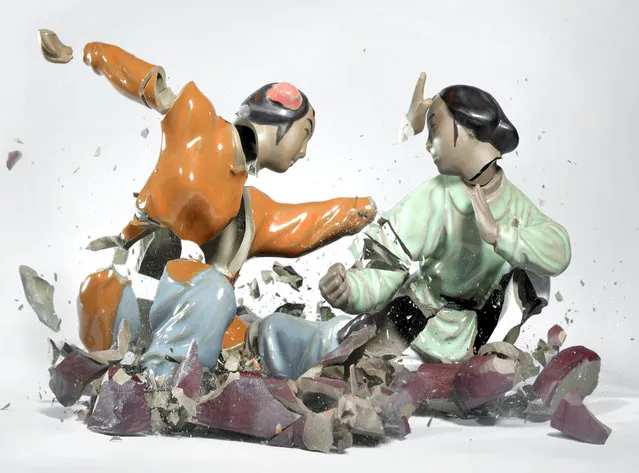
From a height of three meters, porcelain figurines are dropped on the ground, and the sound they make when they hit trips the shutter release. The result: razor-sharp images of disturbing beauty—temporary sculptures made visible to the human eye by high-speed photography technology. The porcelain statuette bursting into pieces isn't what really captures the attention; the fascination lies in the genesis of a dynamic figure that replaces the static pose. In contrast to the inertness of the intact kitsch figurines Klimas started out with, the photographs of their destruction possess a powerfully narrative character.
Michael Read, director of Flight Operations from New Zealand-based Martin Aircraft Company, flies a Martin Jetpack during a demonstration at a water park in Shenzhen, China December 6, 2015. KuangChi Science Ltd, a Hong Kong-listed Chinese company and investor of Martin Aircraft, will sell the flying machine in mainland China for 1.6 million yuan ($249,902), according to the company. (Photo by Bobby Yip/Reuters)
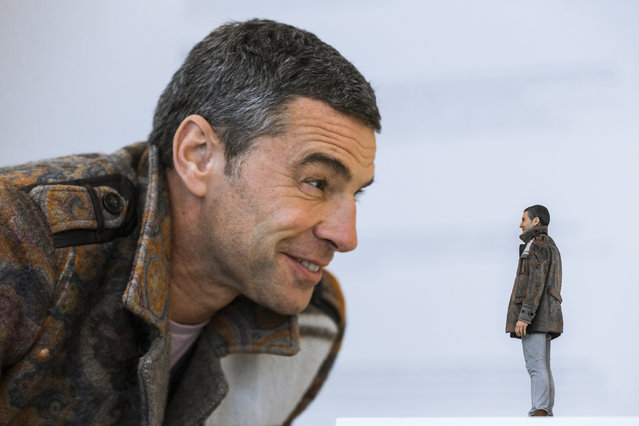
Customer Andreas Kroker looks at a 3D-printed figure of himself at the Twinkind 3D printing studio in Berlin, December 13, 2013. A 3D-printed likeness is produced by taking a 360 degree photographic scan of a person, which is then rendered into a 3D digital model and retouched to meet the requirements for printing. The printing machine uses this digital model to produce a high-resolution solid figure. Twinkind co-founder Timo Schaedel said, people often come to the session well-groomed, with fresh hair-cuts and their best clothes, “just as they used to do in the past, when they had their portrait taken in a photo studio”. (Photo by Thomas Peter/Reuters)
A car buff came home to find his prized motor looking a like a dog's dinner after his pet pooch chewed through the £80,000 Aston Martin.
Luce, a four-year-old border collie spaniel cross, waited until builder Royston Grimstead had left for work before she started chomping her way through the DB9 Volante's wheel arch, doing £3,000 worth of damage.