Loading...
Done
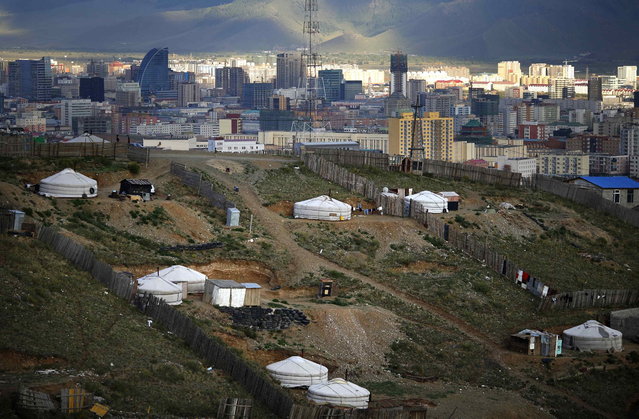
Gers, traditional Mongolian tents, are seen on a hill in an area known as a ger district in Ulan Bator June 26, 2013. (Photo by Carlos Barria/Reuters)

Gers, traditional Mongolian tents, are seen on a hill in an area known as a ger district in Ulan Bator June 26, 2013. Approximately 60 percent of the population of Ulan Bator live in settlements known as ger districts and in many cases residents have limited access to basic services such as water and sanitation. According to a 2010 National Population Center census, every year between thirty and forty thousand people migrate from the countryside to the capital Ulan Bator. Ger districts in the city have been expanding rapidly in recent years. Mongolia is the world's least densely populated country, with 2.8 million people spread across an area around three times the size of France. (Photo by Carlos Barria/Reuters)
Details
11 Aug 2013 11:45:00
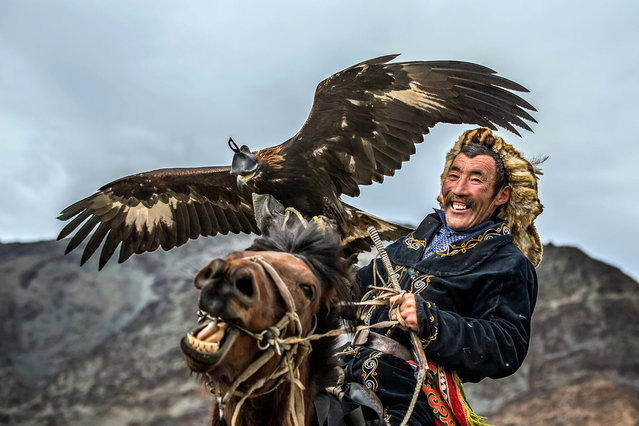
He said: "The photos were taken during the 17th Golden Eagle Festival in the Bayan-Ulgii province in Altai Mountains of Western Mongolia and the festival is just amazing”. (Photo by Batzaya Choijiljav/Caters News)

With their wings at full length, these beautiful golden eagles soar through the skies in a glorious training session to hunt their prey. Others sit on the arms of their owners and trainers. Batzaya Choijiljav, 41, from Mongolia has taken these magnificent pictures at the annual traditional Kazakhs festival, October 2015. (Photo by Batzaya Choijiljav/Caters News)
Details
06 Nov 2015 08:04:00
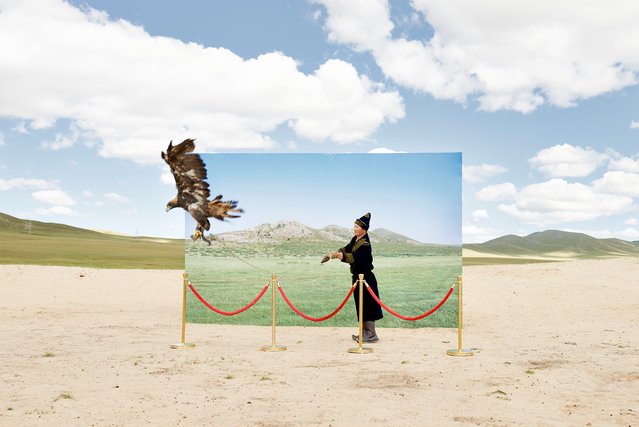
Up to 35% of Mongolians still live a nomadic life, depending on their land to survive. But environmental changes, particularly desertification, means this way of life is under threat. Korean photographer Daesung Lee’s Futuristic Archaeology images show billboard-size backdrops of lush steppe contrasting with actual scenery as former nomads enact scenes of hunting, herding and Mongolian wrestling. (Photo by Daesung Lee)

Up to 35% of Mongolians still live a nomadic life, depending on their land to survive. But environmental changes, particularly desertification, means this way of life is under threat. Korean photographer Daesung Lee’s Futuristic Archaeology images show billboard-size backdrops of lush steppe contrasting with actual scenery as former nomads enact scenes of hunting, herding and Mongolian wrestling. (Photo by Daesung Lee)
Details
24 Nov 2016 08:01:00
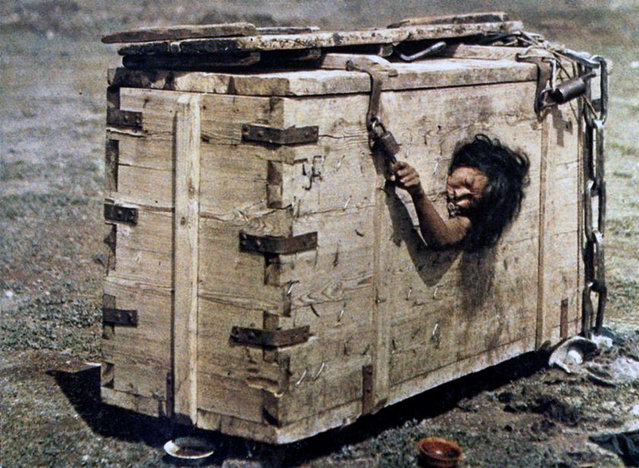
A woman sentenced to starvation death

A woman sentenced to starvation death...
Details
18 May 2012 13:05:00
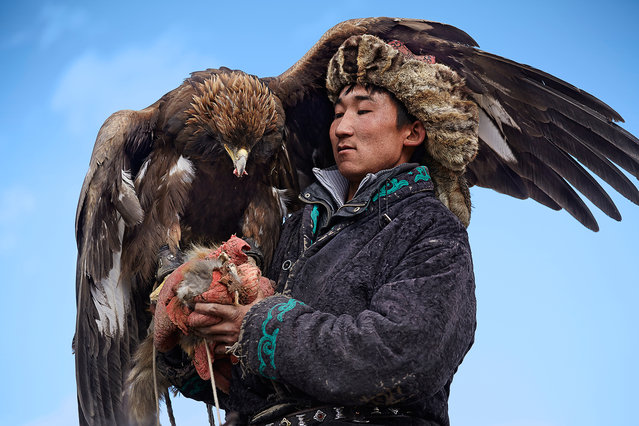
In one of the planet’s most desolate and harsh terrains, the Altai Mountains which run from Siberia in Russia down to Mongolia’s Gobi Desert, hunting with eagles is currently only practiced by a handful of Kyrgyz and Kazakhs. This form of falconry, the practice of hunting with the aid of birds of prey, can be traced back as far as 4,000 years in Central Asia. (Photo by Tariq Zaidi/The Washington Post)

In one of the planet’s most desolate and harsh terrains, the Altai Mountains which run from Siberia in Russia down to Mongolia’s Gobi Desert, hunting with eagles is currently only practiced by a handful of Kyrgyz and Kazakhs. This form of falconry, the practice of hunting with the aid of birds of prey, can be traced back as far as 4,000 years in Central Asia. Here: after a successful hunt, a proud hunter rewards his eagle by feeding it the lungs of the prey, which is considered the most highly prized part of the animal. (Photo by Tariq Zaidi/The Washington Post)
Details
22 Aug 2015 12:46:00
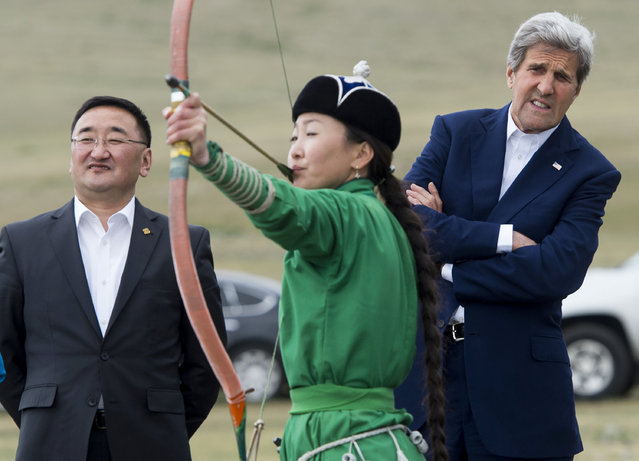
U.S. Secretary of State John Kerry and Mongolian Foreign Minister Lundeg Purevsuren watch an archer during a Naadam ceremony, a competition which traditionally includes horse racing, Mongolian wrestling and archery, in Ulan Bator, Mongolia, June 5, 2016. (Photo by Saul Loeb/Reuters)

U.S. Secretary of State John Kerry and Mongolian Foreign Minister Lundeg Purevsuren watch an archer during a Naadam ceremony, a competition which traditionally includes horse racing, Mongolian wrestling and archery, in Ulan Bator, Mongolia, June 5, 2016. (Photo by Saul Loeb/Reuters)
Details
06 Jun 2016 11:10:00
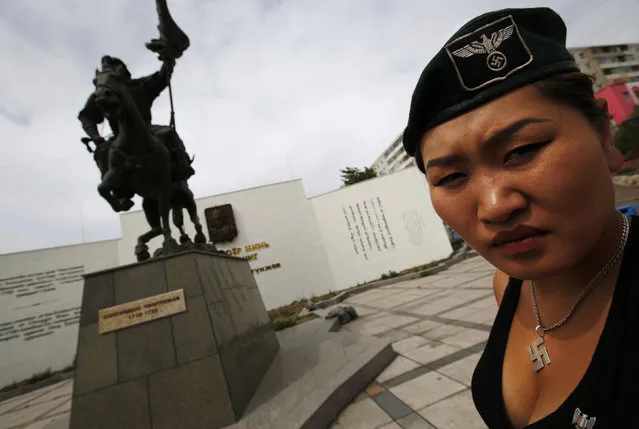
Uranjargal, a leader of the Mongolian neo-Nazi group Tsagaan Khass, stands next to a statue of Chingunjav, a Mongolian national hero, in Ulan Bator June 22, 2013. (Photo by Carlos Barria/Reuters)

Uranjargal, a leader of the Mongolian neo-Nazi group Tsagaan Khass, stands next to a statue of Chingunjav, a Mongolian national hero, in Ulan Bator June 22, 2013. The group has rebranded itself as an environmentalist organisation fighting pollution by foreign-owned mines, seeking legitimacy as it sends Swastika-wearing members to check mining permits. Over the past years, ultra-nationalist groups have expanded in the country and among those garnering attention is Tsagaan Khass, which has recently shifted its focus from activities such as attacks on women it accuses of consorting with foreign men to environmental issues, with the stated goal of protecting Mongolia from foreign mining interests. This ultra-nationalist group was founded in the 1990s and currently has 100-plus members. (Photo by Carlos Barria/Reuters)
Details
09 Jul 2013 07:23:00
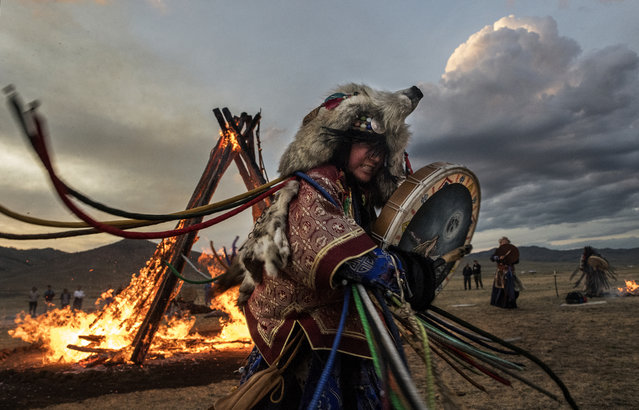
A Mongolian Shamaness or Buu, beats her drum while taking part with others in a fire ritual meant to summon spirits to mark the period of the Summer Solstice in the grasslands on June 22, 2018 outside Ulaanbaatar, Mongolia. (Photo by Kevin Frayer/Getty Images)

A Mongolian Shamaness or Buu, beats her drum while taking part with others in a fire ritual meant to summon spirits to mark the period of the Summer Solstice in the grasslands on June 22, 2018 outside Ulaanbaatar, Mongolia. Banned for 70 years under Communist rule, shamanism has seen a resurgence in Mongolia since 1992, when the ancient practice became protected by the country's Constitution. Known as Tengrism, in which Shamans channel ancestral spirits, it is widely regarded as Mongolia's national religion and part of its indigenous identity. (Photo by Kevin Frayer/Getty Images)
Details
30 Jun 2018 00:05:00