Loading...
Done
Children jump into the water despite strong waves after a strong downpour at Manila's bay, Philippines, Wednesday, July 17, 2019. Schools in metropolitan Manila have been suspended as Tropical Storm Danas, locally named Falcon, continue to enhance the southwest monsoon as it maintains its strength bringing heavy rains over parts of Luzon and Visayas according to the Philippine Atmospheric Geophysical and Astronomical Services Administration. (Photo by Aaron Favila/AP Photo)

Children jump into the water despite strong waves after a strong downpour at Manila's bay, Philippines, Wednesday, July 17, 2019. Schools in metropolitan Manila have been suspended as Tropical Storm Danas, locally named Falcon, continue to enhance the southwest monsoon as it maintains its strength bringing heavy rains over parts of Luzon and Visayas according to the Philippine Atmospheric Geophysical and Astronomical Services Administration. (Photo by Aaron Favila/AP Photo)
Details
19 Jul 2019 00:01:00
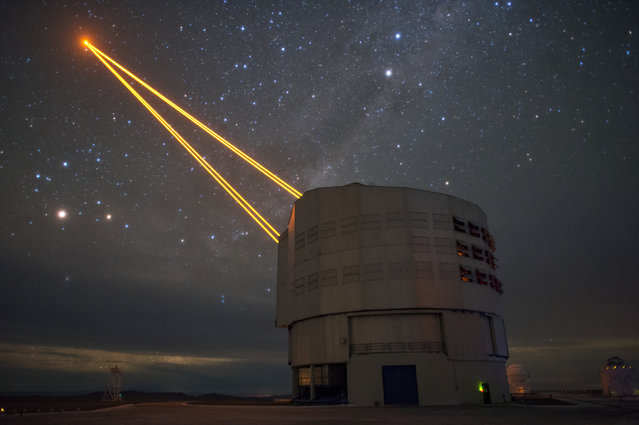
Four pillars of light from the 4 Laser Guide Star Facility on ESO's Very Large Telescope (VLT) are shown reaching into the Chilean night sky in this image from ESO Photo Ambassador Fred Kamphues, on September 2, 2016. The lasers are a key part of the adaptive optics system on the VLT. Adaptive optics allows astronomers to drastically reduce the atmospheric distortion present at even the best sites in the world for astronomy, including Paranal in Chile, the home of the VLT. (Photo by F. Kamphues/ESO)

Four pillars of light from the 4 Laser Guide Star Facility on ESO's Very Large Telescope (VLT) are shown reaching into the Chilean night sky in this image from ESO Photo Ambassador Fred Kamphues, on September 2, 2016. The lasers are a key part of the adaptive optics system on the VLT. Adaptive optics allows astronomers to drastically reduce the atmospheric distortion present at even the best sites in the world for astronomy, including Paranal in Chile, the home of the VLT. (Photo by F. Kamphues/ESO)
Details
23 Feb 2017 00:06:00
Filipino children frolic next to ships taking shelter inside a seaport in Navotas city, north of Manila, Philippines, 27 August 2019. According to the latest advisory from Philippine Atmospheric Geophysical and Astronomical Services Administration (PAGASA), Tropical Storm Podul intensified from a tropical depression into a tropical storm on August 27, while moving toward Central Luzon with a maximum winds of 65 kilometers per hour and gustiness of up to 80 km/h. (Photo by Francis R. Malasig/EPA/EFE)

Filipino children frolic next to ships taking shelter inside a seaport in Navotas city, north of Manila, Philippines, 27 August 2019. According to the latest advisory from Philippine Atmospheric Geophysical and Astronomical Services Administration (PAGASA), Tropical Storm Podul intensified from a tropical depression into a tropical storm on August 27, while moving toward Central Luzon with a maximum winds of 65 kilometers per hour and gustiness of up to 80 km/h. (Photo by Francis R. Malasig/EPA/EFE)
Details
14 Jan 2020 00:01:00
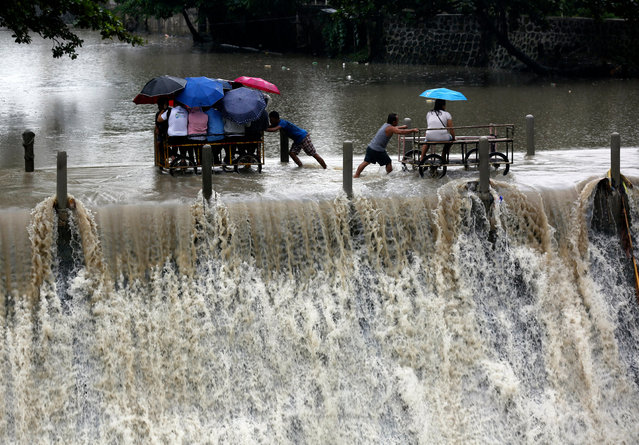
Filipinos riding on makeshift carts cross over an overflowing dam during a downpour in Las Pinas city, south of Manila, Philippines, 05 September 2017. According to the latest forecast from the Philippine Atmospheric Geophysical and Astronomical Services Administration (PAGASA) state weather bureau, typhoon signals were raised over Northern Luzon brought by a tropical storm (local name: Tropical Storm Kiko) and warned fisherfolks and small seacrafts not to venture onto the sea due to big waves. (Photo by Francis R. Malasig/EPA/EFE)

Filipinos riding on makeshift carts cross over an overflowing dam during a downpour in Las Pinas city, south of Manila, Philippines, 05 September 2017. According to the latest forecast from the Philippine Atmospheric Geophysical and Astronomical Services Administration (PAGASA) state weather bureau, typhoon signals were raised over Northern Luzon brought by a tropical storm (local name: Tropical Storm Kiko) and warned fisherfolks and small seacrafts not to venture onto the sea due to big waves. (Photo by Francis R. Malasig/EPA/EFE)
Details
06 Sep 2017 09:06:00
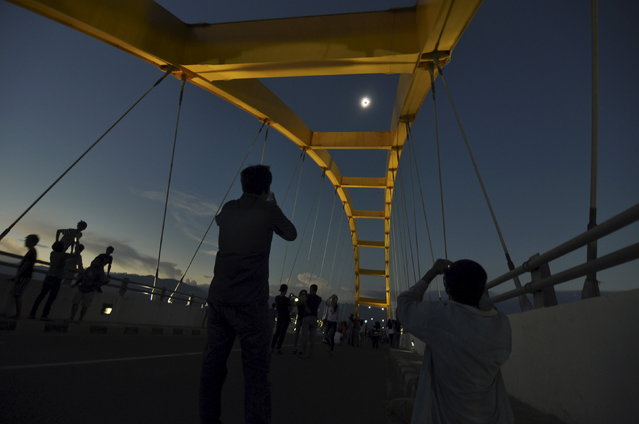
People watch a total solar eclipse from the Bay Bridge in Palu, Central Sulawesi, Indonesia March 9, 2016 in this photo taken by Antara Foto. (Photo by Mohamad Hamzah/Reuters/Antara Foto)

People watch a total solar eclipse from the Bay Bridge in Palu, Central Sulawesi, Indonesia March 9, 2016 in this photo taken by Antara Foto. The rare astronomical event is being witnessed Wednesday along a narrow path that stretches across 12 provinces encompassing three times zones and about 40 million people. (Photo by Mohamad Hamzah/Reuters/Antara Foto)
Details
09 Mar 2016 12:59:00
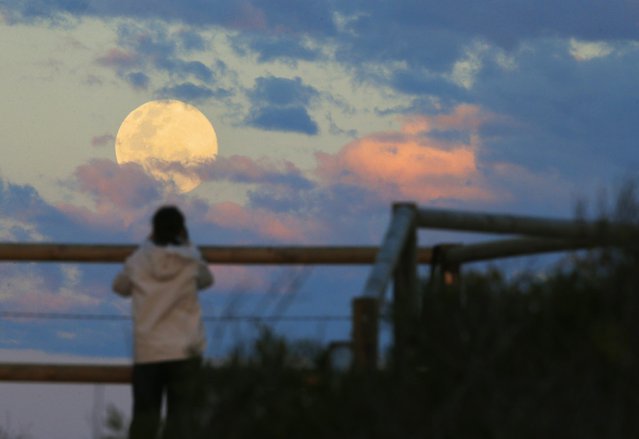
Sydney resident Virginia Maddock watches the supermoon rise off the Sydney beachside suburb of Wanda, August 10, 2014. The astronomical event occurs when the moon is closest to the Earth in its orbit, making it appear much larger and brighter than usual. (Photo by Jason Reed/Reuters)

Sydney resident Virginia Maddock watches the supermoon rise off the Sydney beachside suburb of Wanda, August 10, 2014. Sunday’s moon was at its closest approach to Earth, appearing bigger and brighter than any other moon this year. The moon was 221,765 miles away and looked 16 percent larger and 30 percent brighter than usual. (Photo by Jason Reed/Reuters)
Details
11 Aug 2014 11:50:00
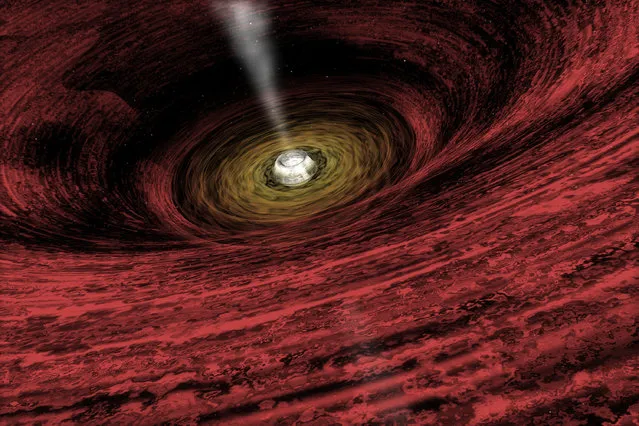
An artist's impression of a growing supermassive black hole located in the early Universe is seen in this NASA handout illustration released on June 15, 2011. Using the deepest X-ray image ever taken, astronomers found the first direct evidence that massive black holes were common in the early universe. This discovery from NASA's Chandra X-Ray Observatory shows that very young black holes grew more aggressively than previously thought, in tandem with the growth of their host galaxies. (Photo by Reuters/NASA/Chandra X-Ray Observatory/A.Hobart)

An artist's impression of a growing supermassive black hole located in the early Universe is seen in this NASA handout illustration released on June 15, 2011. Using the deepest X-ray image ever taken, astronomers found the first direct evidence that massive black holes were common in the early universe. This discovery from NASA's Chandra X-Ray Observatory shows that very young black holes grew more aggressively than previously thought, in tandem with the growth of their host galaxies. (Photo by Reuters/NASA/Chandra X-Ray Observatory/A.Hobart)
Details
11 Feb 2016 12:57:00
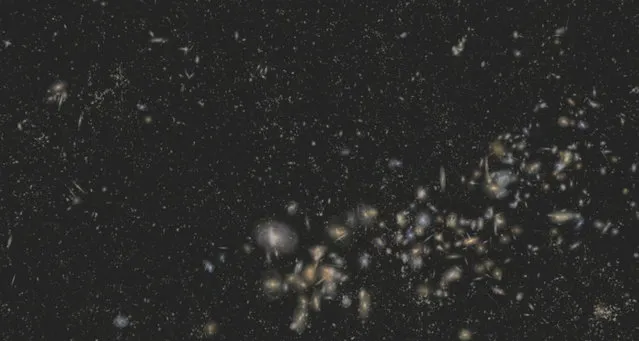
New 3-D Map of Massive Galaxies and Distant Black Holes Offers Clues to Dark Matter and Dark Energy

“The Sloan Digital Sky Survey III (SDSS-III) has released the largest-ever three-dimensional map of massive galaxies and distant black holes, which will help astronomers explain the mysterious “dark matter” and “dark energy” that scientists know makes up 96 percent of the Universe”. – SDSS-III
Details
10 Aug 2012 09:01:00