Loading...
Done
Dancers perform on stage during the Crazy Horse Paris ‘Forever Crazy’ Media Call at The MasterCard Theatres at Marina Bay Sands on October 11, 2017 in Singapore. Forever Crazy consists of a series of highly aesthetic and visual tableaus presented by a classically trained dancers clad only in textured lighting and projection. The show runs from 11 October 2017 till 22 October 2017 in Singapore. (Photo by Suhaimi Abdullah/Getty Images)

Dancers perform on stage during the Crazy Horse Paris “Forever Crazy” Media Call at The MasterCard Theatres at Marina Bay Sands on October 11, 2017 in Singapore. Forever Crazy consists of a series of highly aesthetic and visual tableaus presented by a classically trained dancers clad only in textured lighting and projection. The show runs from 11 October 2017 till 22 October 2017 in Singapore. (Photo by Suhaimi Abdullah/Getty Images)
Details
12 Oct 2017 09:08:00
Aesthetic Movement

A visitor to ''The Cult of Beauty: The Aesthetic Movement 1860-1900'' exhibition at The V&A Museum looks at sculptures by Thornycroft (L) and Watts on March 30, 2011 in London, England. This exhibition brings together for the first time many masterpieces in painting, sculpture, design and furniture as well as fashion and literature and runs from April 2nd to July 17th 2011.
Details
30 Mar 2011 17:10:00
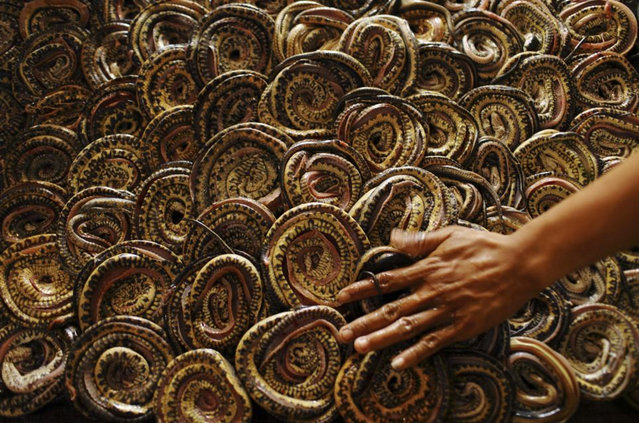
How Snakeskin Handbags Are Made

Images from a snake slaughterhouse at Kapetakan village in Indonesia’s West Java province. Wakira, who is known as “Boss Cobra”, owns the slaughterhouse that produces snake meat and skin. Snake meat is believed by some to be a remedy for skin diseases and asthma, as well as an aid to increase virility. The snake skins, measuring in the hundreds of metres, are sold to bag factories in the West and Central Java provinces on a monthly basis. The price of a bag made from snake skin costs between 150,000 rupiah ($ 15.60) and 300,000 rupiah ($31.20), depending on its size. That snakeskin handbag you’ll buy is costing a hell of a lot more.
Details
20 Feb 2013 12:00:00
Rice Paddy Art

Tanbo Art is the strategic planting of four varieties of rice which have different colored leaves in order to create a giant image in the rice paddy. This type of aesthetic planting began in the Japanese village of Inakadate in 1993 in order to celebrate the village’s over 2000 year history of rice farming. The practice has spread to other rice cultivating communities in Japan and even other countries such as Thailand and South Korea.
Details
13 May 2014 12:53:00
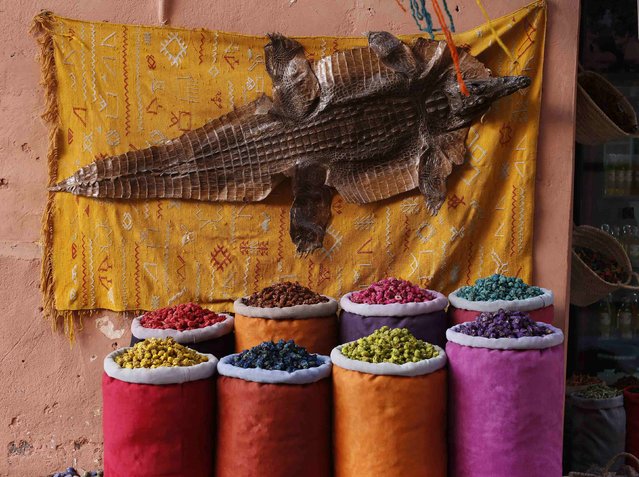
Crocodile skin is seen at a workshop in the old Medina of Marrakesh December 13, 2014. (Photo by Youssef Boudlal/Reuters)

Crocodile skin is seen at a workshop in the old Medina of Marrakesh December 13, 2014. (Photo by Youssef Boudlal/Reuters)
Details
19 Feb 2015 14:48:00
Colombian-American actress Sofia Vergara shows some skin while basking on then beach early December 2024. (Photo by sofiavergara/Instagram)

Colombian-American actress Sofia Vergara shows some skin while basking on then beach early December 2024. (Photo by sofiavergara/Instagram)
Details
17 Dec 2024 04:15:00
Animal rights activist, stained with fake blood, perform during a protest against the use of animal skins in the clothes and fashion industry, in Madrid, Sunday, December 10, 2017. (Photo by Francisco Seco/AP Photo)

Animal rights activist, stained with fake blood, perform during a protest against the use of animal skins in the clothes and fashion industry, in Madrid, Sunday, December 10, 2017. (Photo by Francisco Seco/AP Photo)
Details
11 Dec 2017 09:50:00
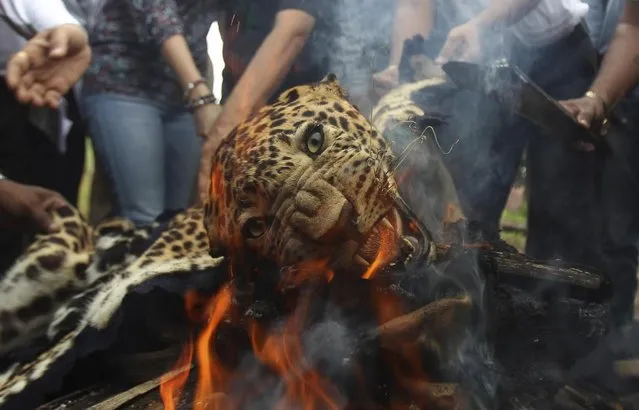
A leopard skin burns as Indian officials and activists burn wildlife contraband including tiger and leopard skins, and bones as part of a campaign to save the tiger in Mumbai, India, Tuesday, July 30, 2013. Despite conservation efforts, tiger numbers in India have declined due to rampant poaching of the cats for their valuable pelts and body parts that are highly prized in traditional Chinese medicine. (Photo by Rafiq Maqbool/AP Photo)

A leopard skin burns as Indian officials and activists burn wildlife contraband including tiger and leopard skins, and bones as part of a campaign to save the tiger in Mumbai, India, Tuesday, July 30, 2013. Despite conservation efforts, tiger numbers in India have declined due to rampant poaching of the cats for their valuable pelts and body parts that are highly prized in traditional Chinese medicine. (Photo by Rafiq Maqbool/AP Photo)
Details
01 Aug 2013 10:50:00