Loading...
Done
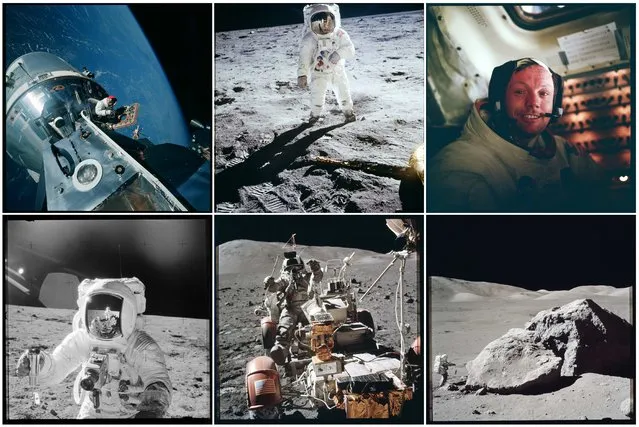
NASA handout photographs from the various Apollo missions are shown in this combination photograph. The photographs are some of more than 12,000 from NASA's archives recently aggregated on the Project Apollo Archive Flickr account. (Photo by Reuters/NASA)

NASA handout photographs from the various Apollo missions are shown in this combination photograph. The photographs are some of more than 12,000 from NASA's archives recently aggregated on the Project Apollo Archive Flickr account. (Top L) David R. Scott, command module pilot, stands in the open hatch of the Command Module during the Apollo 9 mission March 6, 1969. (Top centre) Edwin "Buzz" Aldrin Jr.walks on the surface of the moon during the Apollo 11 mission July 20, 1969. (Top R) Neil Armstrong, Apollo 11 commander, is pictured inside the Lunar Module during the Apollo 11 mission July 20, 1969. (Bottom L) Alan Bean holds a container filled with lunar soil collected during the Apollo 12 mission November 19, 1969. (Bottom centre) Scientist-astronaut Harrison Schmitt rides in the Lunar Roving Vehicle during the Apollo 17 mission December 13, 1972. (Bottom R) Harrison Schmitt stands next to a huge, split boulder during the Apollo 17 mission December 13, 1972. (Photo by Reuters/NASA)
Details
13 Oct 2015 08:02:00
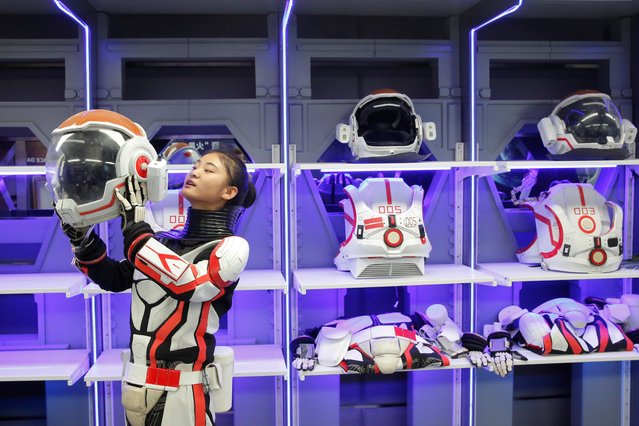
A staff member demonstrates how she puts on the helmet of a mock space suit at the C-Space Project Mars simulation base in the Gobi Desert outside Jinchang, Gansu Province, China, April 17, 2019. The facility – comprising several interconnected modules including a greenhouse and a mock decompression chamber – opened its doors to the public. (Photo by Thomas Peter/Reuters)

A staff member demonstrates how she puts on the helmet of a mock space suit at the C-Space Project Mars simulation base in the Gobi Desert outside Jinchang, Gansu Province, China, April 17, 2019. The facility – comprising several interconnected modules including a greenhouse and a mock decompression chamber – opened its doors to the public. (Photo by Thomas Peter/Reuters)
Details
19 Apr 2019 00:07:00
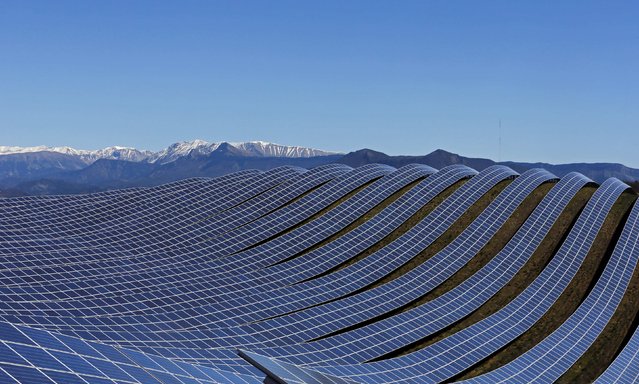
A general view shows solar panels to produce renewable energy at the photovoltaic park in Les Mees, in the department of Alpes-de-Haute-Provence, southern France March 31, 2015. The solar farm of the Colle des Mees, the biggest in France, consists of 112,780 solar modules covering an area of 200 hectares of land and representing 100 MW of power. (Photo by Jean-Paul Pelissier/Reuters)

A general view shows solar panels to produce renewable energy at the photovoltaic park in Les Mees, in the department of Alpes-de-Haute-Provence, southern France March 31, 2015. The solar farm of the Colle des Mees, the biggest in France, consists of 112,780 solar modules covering an area of 200 hectares of land and representing 100 MW of power. (Photo by Jean-Paul Pelissier/Reuters)
Details
01 Apr 2015 12:18:00
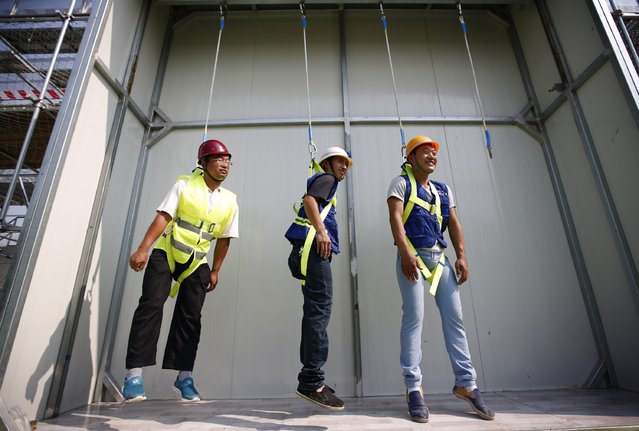
Participants hang from ropes as they learn how to use safety gears at an experience centre for construction safety training in Beijing, September 5, 2014. The centre which opened in June 2014 was established to educate workers about construction safety. According to the centre, about 1,000 construction workers undergo 3-hour classes which comprises of 33 modules every month. (Photo by Kim Kyung-Hoon/Reuters)

Participants hang from ropes as they learn how to use safety gears at an experience centre for construction safety training in Beijing, September 5, 2014. The centre which opened in June 2014 was established to educate workers about construction safety. According to the centre, about 1,000 construction workers undergo 3-hour classes which comprises of 33 modules every month. (Photo by Kim Kyung-Hoon/Reuters)
Details
06 Sep 2014 11:46:00
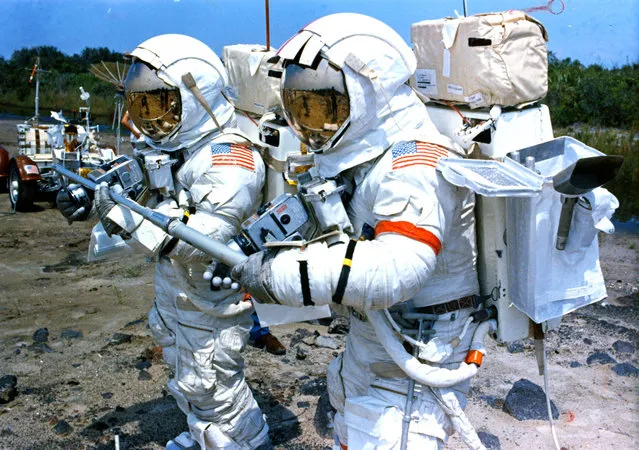
Astronauts Harrison Schmitt (left) and Eugene Andrew Cernan practice taking geological samples at the Kennedy Space Center in Florida, in preparation for NASA's scheduled Apollo 17 lunar landing mission, on August 28, 1972. Schmitt is the Lunar Module Pilot and Cernan is the mission's Commander. They are training for their period of EVA (extravehicular activity) on the Moon. (Photo by Space Frontiers/Getty Images)

Astronauts Harrison Schmitt (left) and Eugene Andrew Cernan practice taking geological samples at the Kennedy Space Center in Florida, in preparation for NASA's scheduled Apollo 17 lunar landing mission, on August 28, 1972. Schmitt is the Lunar Module Pilot and Cernan is the mission's Commander. They are training for their period of EVA (extravehicular activity) on the Moon. (Photo by Space Frontiers/Getty Images)
Details
24 Dec 2022 04:10:00


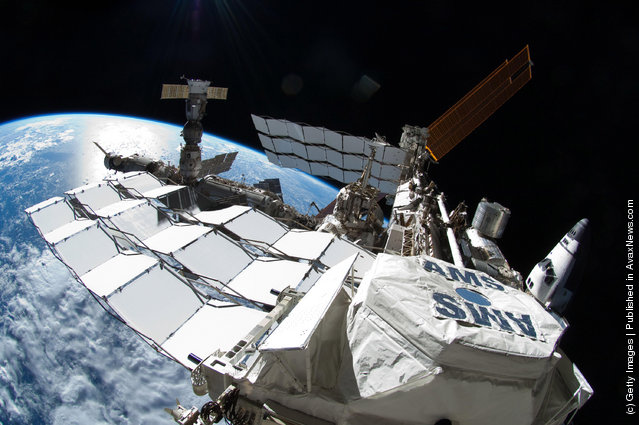
Space shuttle Atlantis (R) remains docked to the International Space Station photographed by NASA astronaut Ronald Garan during a planned six-and-a-half-hour spacewalk July 12, 2011 in space. Space shuttle Atlantis has embarked on a 12-day mission to the International Space Station where it will deliver the Raffaello multi-purpose logistics module packed with supplies and spare parts. This was the final mission of the space shuttle program, which began on April 12, 1981 with the launch of Colombia. (Photo by NASA via Getty Images)
Details
20 Jul 2011 12:23:00


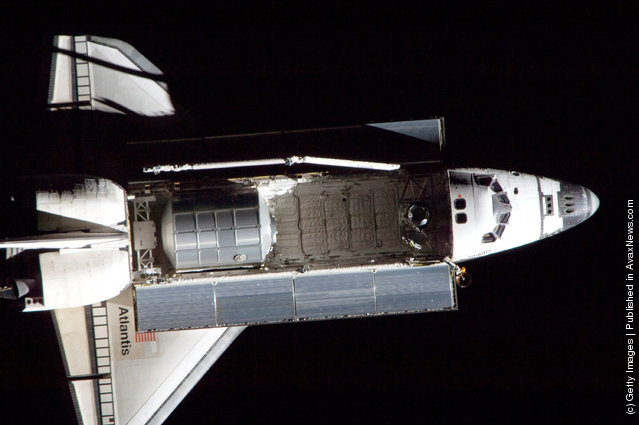
NASA space shuttle Atlantis in Earth orbit is seen during a Rendezvous Pitch Maneuver, or back flip to enable space station crew members to take high resolution digital pictures of the shuttle's heat shield before docking for the last time with the International Space Station July 10, 2011 in space. Atlantis has embarked on a 12-day mission to the International Space Station where it will deliver the Raffaello multi-purpose logistics module packed with supplies and spare parts. This will be the final launch of the space shuttle program, which began on April 12, 1981 with the launch of Colombia. (Photo by NASA via Getty Images)
Details
11 Jul 2011 10:57:00


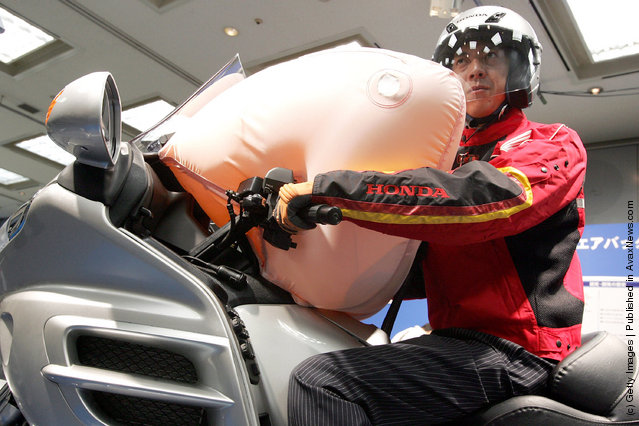
“The technology was designed to address the risk associated with head-on or nearly head-on motorcycle collisions, which account for a large percentage of motorcycle crashes. The airbag was designed to deploy during a severe frontal collision in which a rider could be thrown forward from the motorcycle. Once deployed, the airbag stands upright in front of the rider to help absorb the rider’s kinetic energy prior to leaving the motorcycle”. – Ohio.Honda.com

Photo: Honda Motor Co., Ltd.'s world's first production motorcycle airbag system is introduced at a press conference at Honda's HQ on September 8, 2005 in Tokyo, Japan. The motorcycle airbag system to be installed to lessen the injuries of the rider is comprised of the airbag module that include the airbag and the inflator, crash sensors that monitor acceleration changes and an ECU that performs calculation to determine when a collision is occuring. (Photo by Junko Kimura/Getty Images)
Details
20 Jun 2011 14:29:00