Loading...
Done
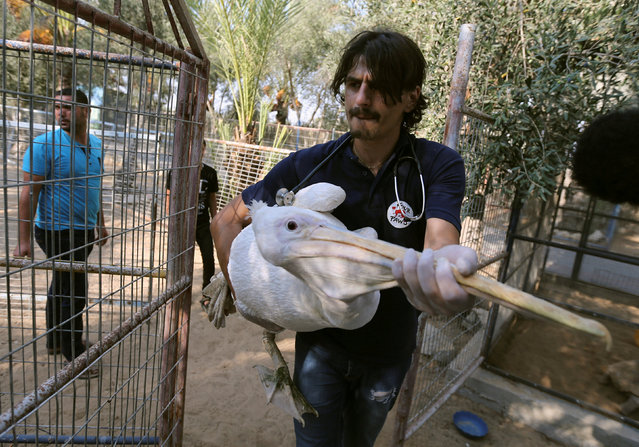
A member of Four Paws International team carries a pelican to be taken out of Gaza, at a zoo in Khan Younis in the southern Gaza Strip August 23, 2016. Fifteen animals including a bengal tiger were removed from “the world’s worst zoo” in the Gaza town of Khan Younis as it was finally closed down. Animal welfare group, Four Paws International, will help bring most of the refugees to a zoo in Jordan, but the tiger will be taken to a refuge in South Africa. Five monkeys, a porcupine, an emu and the tiger, among others, crossed from the occupied territory into Israel after the zoo suffered from years of difficulty. With lack of awareness of animal welfare in Gaza, the densely-populated territory has previously made headlines after another zoo painted donkeys with stripes to resemble zebras in 2009. (Photo by Ibraheem Abu Mustafa/Reuters)

A member of Four Paws International team carries a pelican to be taken out of Gaza, at a zoo in Khan Younis in the southern Gaza Strip August 23, 2016. Fifteen animals including a bengal tiger were removed from “the world’s worst zoo” in the Gaza town of Khan Younis as it was finally closed down. Animal welfare group, Four Paws International, will help bring most of the refugees to a zoo in Jordan, but the tiger will be taken to a refuge in South Africa. (Photo by Ibraheem Abu Mustafa/Reuters)
Details
26 Aug 2016 10:22:00
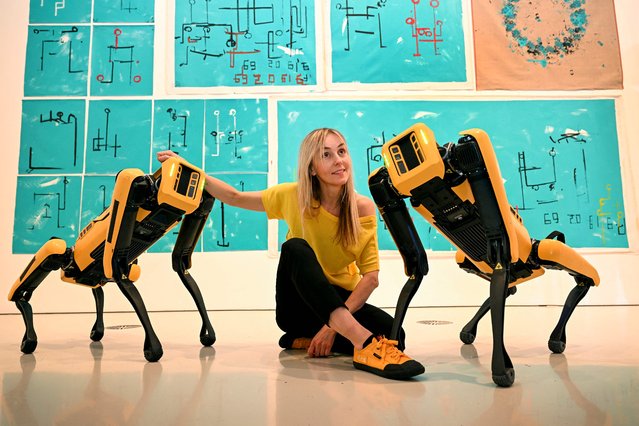
Polish artist Agnieszka Pilat poses with the artwork of her robot painting dogs – Basia Spot and Bunny Spot – who have become artists painting on canvases with their paws, at the launch of the National Gallery of Victoria (NGV) Triennial 2023 in Melbourne on April 5, 2023. Pilat works with the Boston Dynamics dogs, training them to paint autonomously through AI technology individually and collaboratively, and will be part of more than 100 local and international artists, designers and collectives presenting at the exhibition opening in December. (Photo by William West/AFP Photo)

Polish artist Agnieszka Pilat poses with the artwork of her robot painting dogs – Basia Spot and Bunny Spot – who have become artists painting on canvases with their paws, at the launch of the National Gallery of Victoria (NGV) Triennial 2023 in Melbourne on April 5, 2023. Pilat works with the Boston Dynamics dogs, training them to paint autonomously through AI technology individually and collaboratively, and will be part of more than 100 local and international artists, designers and collectives presenting at the exhibition opening in December. (Photo by William West/AFP Photo)
Details
25 May 2023 03:14:00
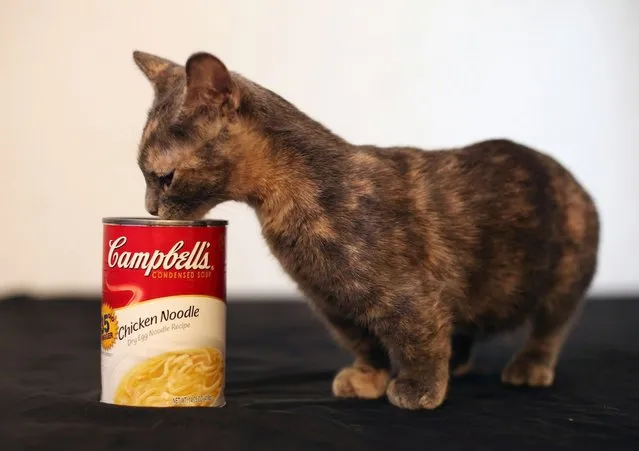
World’s Shortest Cat

Pixel – the cat about to enter the record books as the world's shortest feline. Standing at just five inches from shoulder to paw this compact cat could break the previous record held by her mother Fizz Girl in 2012, who stood at six inches.
Details
12 Sep 2015 11:54:00
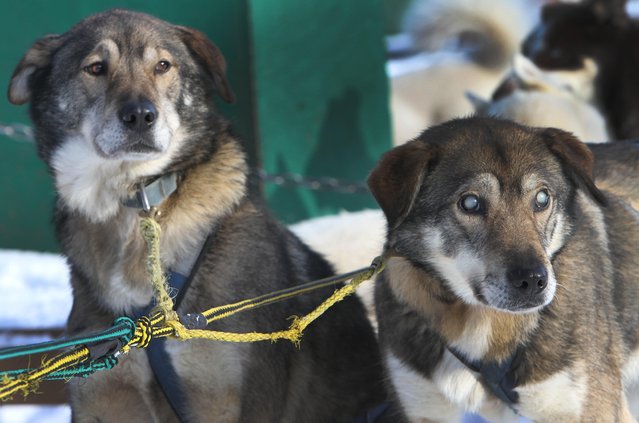
In this photo taken Thursday January 17, 2013, sled dogs Poncho, left, and his blind brother Gonzo are hooked up for a run at the Muddy Paw Sled Dog Kennel,  in Jefferson, N.H. Poncho has taken to helping his blind brother on regular runs. (Photo by Jim Cole/AP Photo)

In this photo taken Thursday January 17, 2013, sled dogs Poncho, left, and his blind brother Gonzo are hooked up for a run at the Muddy Paw Sled Dog Kennel, in Jefferson, N.H. Poncho has taken to helping his blind brother on regular runs. (Photo by Jim Cole/AP Photo)
Details
27 Jan 2013 13:30:00
Men play with an oiled coconut during Myanmar's 73rd Independence Day celebrations amid the spread of the coronavirus disease (COVID-19) in Yangon, Myanmar, January 4, 2021. (Photo by Shwe Paw Mya Tin/Reuters)

Men play with an oiled coconut during Myanmar's 73rd Independence Day celebrations amid the spread of the coronavirus disease (COVID-19) in Yangon, Myanmar, January 4, 2021. (Photo by Shwe Paw Mya Tin/Reuters)
Details
04 Feb 2021 09:14:00
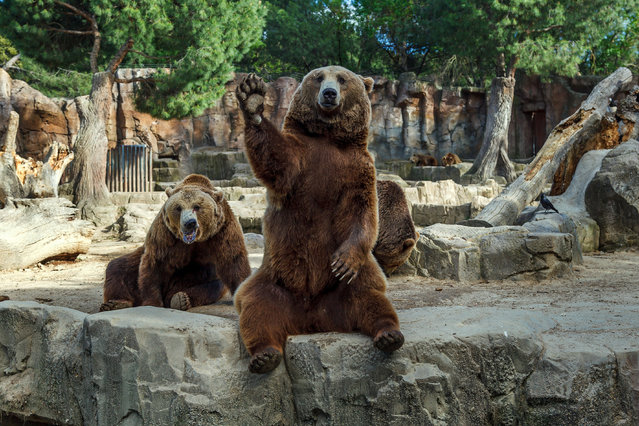
A photographer could bear-ly believe his eyes when a bear started waving at him. The friendly animal wandered to the front of his enclosure before sitting back in full view of zoo guests. He then lifts his powerful paw and excitedly waves in an almost human-like way at his new audience. The hilarious encounter was captured by keen photographer Andrey Slepnev, 31, while on a trip to Madrid Zoo, Spain on March 24, 2016. (Photo by Andrey Slepnev/Caters News)

A photographer could bear-ly believe his eyes when a bear started waving at him. The friendly animal wandered to the front of his enclosure before sitting back in full view of zoo guests. He then lifts his powerful paw and excitedly waves in an almost human-like way at his new audience. The hilarious encounter was captured by keen photographer Andrey Slepnev, 31, while on a trip to Madrid Zoo, Spain on March 24, 2016. (Photo by Andrey Slepnev/Caters News)
Details
11 Oct 2016 11:25:00
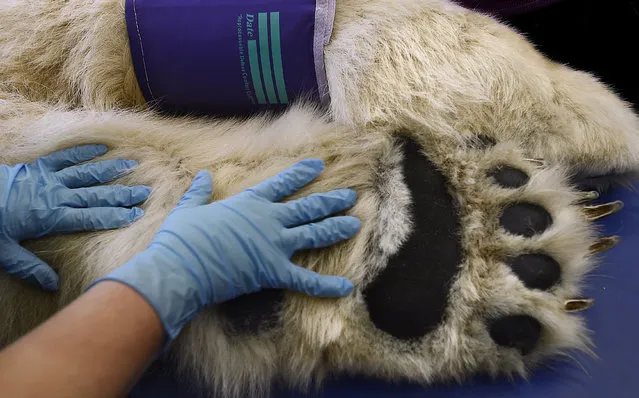
Polar Bear Goes To The Doctor

A pair of gloved hands are dwarfed by the furry paws of Boris the Polar Bear at the Point Defiance Zoo & Aquarium's animal health care hospital Saturday, February 23, 2013 in Tacoma, Washington. (Dean J. Koepfler/Tacoma News Tribune/MCT)
Details
24 Mar 2014 13:17:00
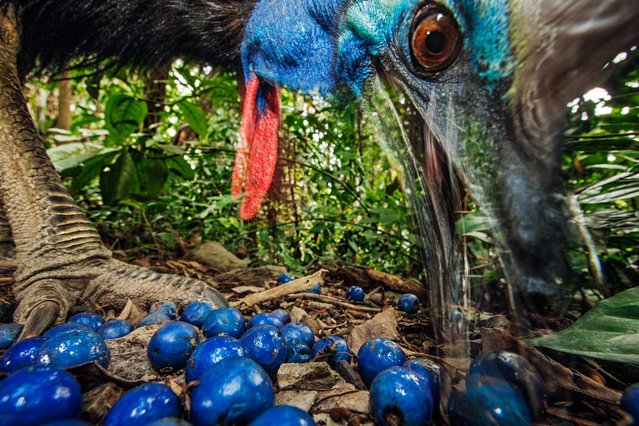
“Cassowaries are large, flightless birds related to emus and (more distantly) to ostriches, rheas, and kiwis”, writes Olivia Judson in the September issue of National Geographic magazine. (Photo by Christian Ziegler/National Geographic)

“Cassowaries are large, flightless birds related to emus and (more distantly) to ostriches, rheas, and kiwis”, writes Olivia Judson in the September issue of National Geographic magazine. How large? People-size: Adult males stand well over five foot five and top 110 pounds. Females are even taller, and can weigh more than 160 pounds. Dangerous when roused, they’re shy and peaceable when left alone. But even birds this big and tough are prey to habitat loss. The dense New Guinea and Australia rain forests where they live have dwindled. Today cassowaries might number 1,500 to 2,000. And because they help shape those same forests – by moving seeds from one place to another – “if they vanish”, Judson writes, “the structure of the forest would gradually change” too. (Photo by Christian Ziegler/National Geographic)
Details
06 Jan 2014 12:21:00