Loading...
Done
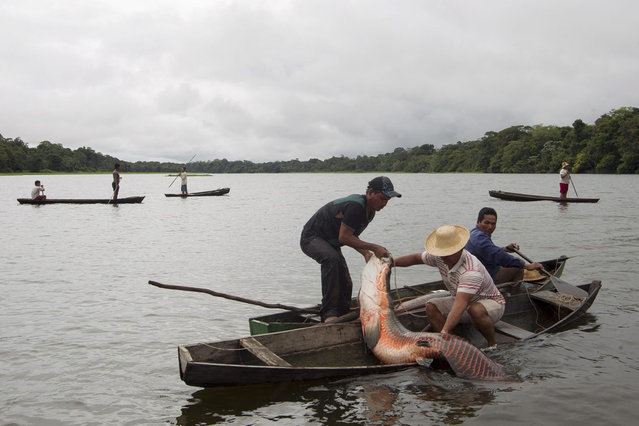
Villagers from the Porto Novo community load into their canoes arapaima or pirarucu, the largest freshwater fish species in South America and one of the largest in the world, while fishing in Poco Fundo lake along a branch of the Solimoes river, one of the main tributaries of the Amazon, in the Mamiraua nature reserve near Fonte Boa about 600 km (373 miles) west of Manaus, November 26, 2013. (Photo by Bruno Kelly/Reuters)

Villagers from the Porto Novo community load into their canoes arapaima or pirarucu, the largest freshwater fish species in South America and one of the largest in the world, while fishing in Poco Fundo lake along a branch of the Solimoes river, one of the main tributaries of the Amazon, in the Mamiraua nature reserve near Fonte Boa about 600 km (373 miles) west of Manaus, November 26, 2013. Catching the arapaima, a fish that is sought after for its meat and is considered by biologists to be a living fossil, is only allowed once a year by Brazil's environmental protection agency. The minimum size allowed for a fisherman to keep an arapaima is 1.5 meters (4.9 feet). (Photo by Bruno Kelly/Reuters)
Details
17 Dec 2013 08:03:00
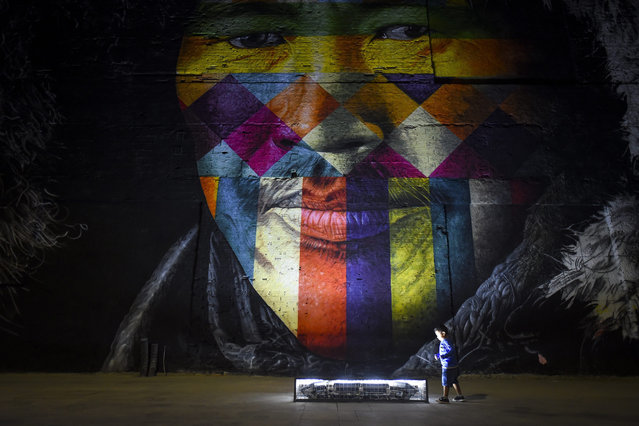
A child plays in front of “Etnias”, a large graffiti wall by Brazilian graffiti artist Eduardo Kobra created ahead of the Rio 2016 Olympic Games at Porto Maravilha in Rio de Janeiro, Brazil, 30 July 2016. The Olympics start on 05 August. Eduardo Kobra hopes to set a Guinness World Record for the largest graffiti created by a single artist. (Photo by Lukas Coch/EPA)

A child plays in front of “Etnias”, a large graffiti wall by Brazilian graffiti artist Eduardo Kobra created ahead of the Rio 2016 Olympic Games at Porto Maravilha in Rio de Janeiro, Brazil, 30 July 2016. The Olympics start on 05 August. Eduardo Kobra hopes to set a Guinness World Record for the largest graffiti created by a single artist. (Photo by Lukas Coch/EPA)
Details
01 Aug 2016 10:35:00
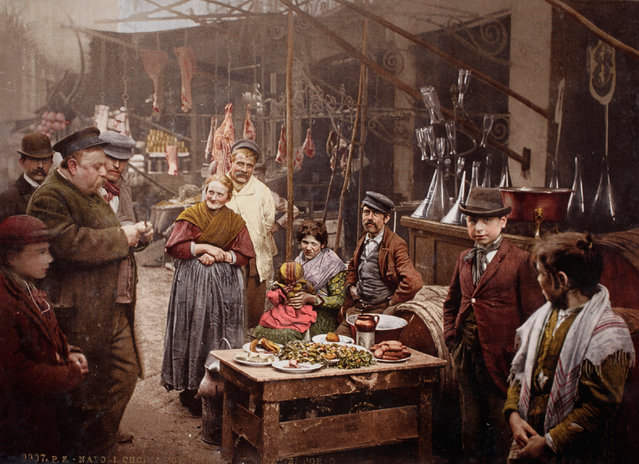
The finished photochromes were produced using at least six different tint stones, although many more were often used. Here: Street food in the Strada del Porto in Naples, Italy, 1899. (Photo by Swiss Camera Museum/The Guardian)

Photochromes are vibrant and nuanced prints hand-coloured from black-and-white negatives. Created using a process pioneered in the 1880s, these images offer a fascinating insight into the world when colour photography was still in its infancy. A Tour of the World in Photochromes is at the Swiss Camera Museum, Vevey, until 21 August. Here: Street food in the Strada del Porto in Naples, Italy, 1899. (Photo by Swiss Camera Museum/The Guardian)
Details
07 Jul 2016 10:56:00
Paolo Guerrero of Brazil's Internacional reacts after missing an opportunity to score during a Copa Libertadores soccer match against Chile's Palestino in Porto Alegre, Brazil, Tuesday, April 9, 2019. (Photo by Diego Vara/Reuters)

Paolo Guerrero of Brazil's Internacional reacts after missing an opportunity to score during a Copa Libertadores soccer match against Chile's Palestino in Porto Alegre, Brazil, Tuesday, April 9, 2019. (Photo by Diego Vara/Reuters)
Details
15 Apr 2019 00:05:00
Models present creations by Portuguese fashion designer Ines Torcato during the Portugal Fashion show in Porto, Portugal, 14 October 2021. Spring/Summer 2022 collections are presented at the 49th Portugal Fashion until 16 October 2021. (Photo by Jose Coelho/EPA/EFE)

Models present creations by Portuguese fashion designer Ines Torcato during the Portugal Fashion show in Porto, Portugal, 14 October 2021. Spring/Summer 2022 collections are presented at the 49th Portugal Fashion until 16 October 2021. (Photo by Jose Coelho/EPA/EFE)
Details
15 Oct 2021 10:16:00
Zurich soccer player Loris Benito tries to catch a marten during the Swiss Super League  match between FC Thun and FC Zurich in Thun, Switzerland. (Marcel Bieri/Keystone)

Zurich soccer player Loris Benito tries to catch a marten during the Swiss Super League match between FC Thun and FC Zurich in Thun, Switzerland, March 10, 2013. (Photo by Marcel Bieri/Keystone)
Details
13 Mar 2013 12:00:00
An aerial view shows the Amazon rainforest at the Bom Futuro National Forest near Rio Pardo in Porto Velho, Rondonia State, Brazil, September 3, 2015. The town of Rio Pardo, a settlement of about 4,000 people in the Amazon rainforest, rises where only jungle stood less than a quarter of a century ago. Loggers first cleared the forest followed by ranchers and farmers, then small merchants and prospectors. (Photo by Nacho Doce/Reuters)

An aerial view shows the Amazon rainforest at the Bom Futuro National Forest near Rio Pardo in Porto Velho, Rondonia State, Brazil, September 3, 2015. The town of Rio Pardo, a settlement of about 4,000 people in the Amazon rainforest, rises where only jungle stood less than a quarter of a century ago. Loggers first cleared the forest followed by ranchers and farmers, then small merchants and prospectors. Brazil's government has stated a goal of eliminating illegal deforestation, but enforcing the law in remote corners like Rio Pardo is far from easy. (Photo by Nacho Doce/Reuters)
Details
08 Nov 2015 08:00:00
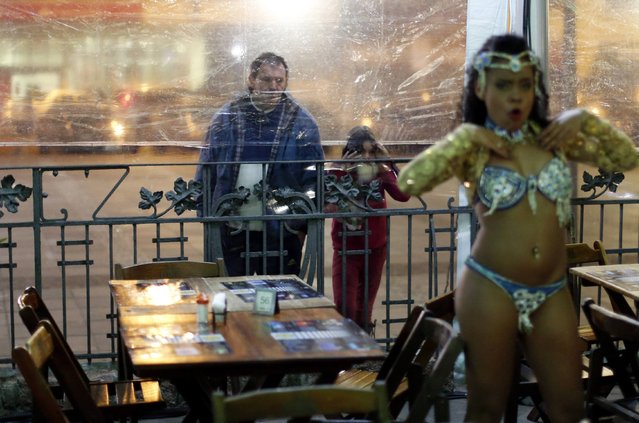
People watch from outside as a dancer performs inside a bar in Porto Alegre June 21, 2014. In a project called “On The Sidelines” Reuters photographers share pictures showing their own quirky and creative view of the 2014 World Cup in Brazil. (Photo by Marko Djurica/Reuters)

As national soccer teams and the photographers who have been covering them start to trickle home from the Brazil World Cup, it’s time to revisit the “On the Sidelines” project. This Reuters Pictures project was billed as a chance for photographers to share “their own quirky and creative view of the World Cup”. Photo: People watch from outside as a dancer performs inside a bar in Porto Alegre June 21, 2014. In a project called “On The Sidelines” Reuters photographers share pictures showing their own quirky and creative view of the 2014 World Cup in Brazil. (Photo by Marko Djurica/Reuters)
Details
09 Jul 2014 13:04:00