Loading...
Done
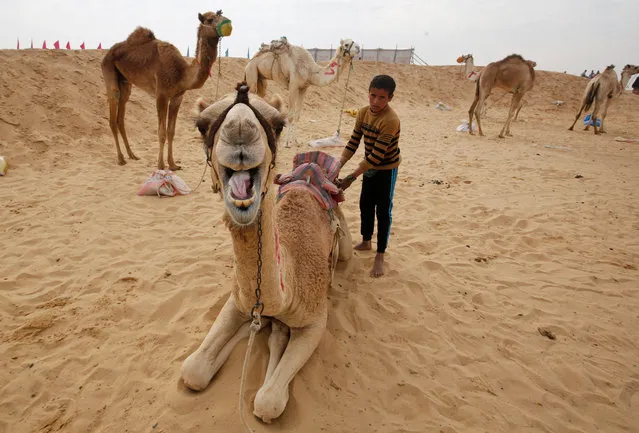
Ahmed, a 10-year-old jockey, looks on during the opening of the International Camel Racing festival at the Sarabium desert in Ismailia, Egypt, March 21, 2017. (Photo by Amr Abdallah Dalsh/Reuters)

Ahmed, a 10-year-old jockey, looks on during the opening of the International Camel Racing festival at the Sarabium desert in Ismailia, Egypt, March 21, 2017. (Photo by Amr Abdallah Dalsh/Reuters)
Details
29 Mar 2017 09:18:00
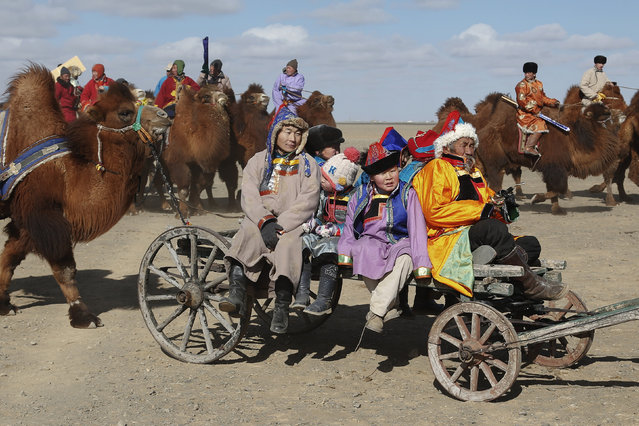
People sit on a cart with a camel tied to it during “Temeenii bayar”, the Camel Festival, in Dalanzadgad, Umnugobi aimag, Mongolia, March 6, 2016. (Photo by B. Rentsendorj/Reuters)

People sit on a cart with a camel tied to it during “Temeenii bayar”, the Camel Festival, in Dalanzadgad, Umnugobi aimag, Mongolia, March 6, 2016. On the steppes of the Gobi Desert, the crowd urges on Bactrian camels laden down with all that's needed to build and live in a traditional Mongolian tent. Guinness World Records classes the 15 km race thatÕs part of the two-day festival as the largest camel race in the world, drawing 1,108 participants. The winning camel romped home in 35 minutes and 12 seconds, according to the records website. (Photo by B. Rentsendorj/Reuters)
Details
30 Mar 2016 11:13:00
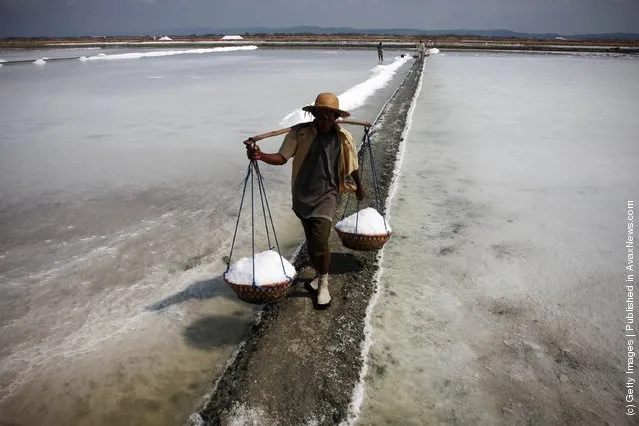
A farmer carries baskets of salt during a harvest in the the salt production process in Sumenep on Madura island, Indonesia

A farmers carries baskets of salt during a harvest in the the salt production process August 13, 2009 in Sumenep on Madura island, Indonesia. (Photo by Ulet Ifansasti/Getty Images)
Details
07 Sep 2011 12:40:00
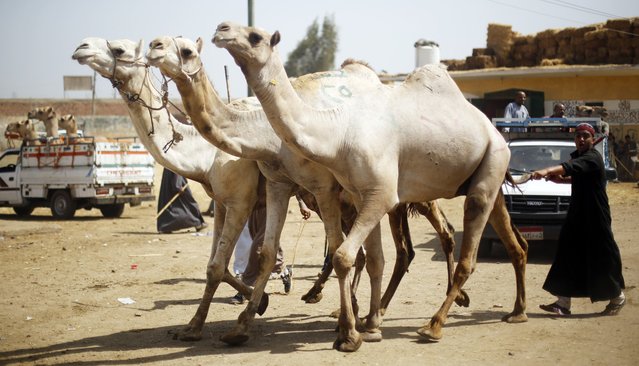
A man walks behind camels at the Birqash Camel Market, ahead of Eid al-Adha or Festival of Sacrifice, on the outskirts of Cairo September 29, 2014. (Photo by Amr Abdallah Dalsh/Reuters)

A man walks behind camels at the Birqash Camel Market, ahead of Eid al-Adha or Festival of Sacrifice, on the outskirts of Cairo September 29, 2014. Birqash Camel Market, one of the biggest markets for camel meat in Africa, draws sellers from Libya, Sudan, Somalia and other regions in Egypt. The camels sold at the market are also used in tourism. Traders say that the selling rate for a camel in 2014 is anywhere between 5,000 and 20,000 Egyptian pounds (700 – 2800 USD). (Photo by Amr Abdallah Dalsh/Reuters)
Details
02 Oct 2014 10:20:00
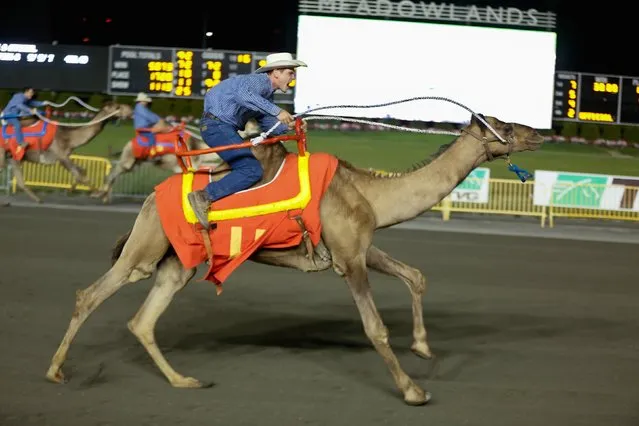
Camelot, with rider Kris Anderson, wins an exhibition race billed as “The Cameltonian” at the Meadowlands Race Track in East Rutherford, New Jersey June 21, 2014. Run by Hedrick's Promotions in Nickerson, Kansas, this is the third year the race has been run at the track, in tandem with an ostrich race. (Photo by Ray Stubblebine/Reuters)

Camelot, with rider Kris Anderson, wins an exhibition race billed as “The Cameltonian” at the Meadowlands Race Track in East Rutherford, New Jersey June 21, 2014. Run by Hedrick's Promotions in Nickerson, Kansas, this is the third year the race has been run at the track, in tandem with an ostrich race. (Photo by Ray Stubblebine/Reuters)
Details
29 Jun 2014 09:14:00
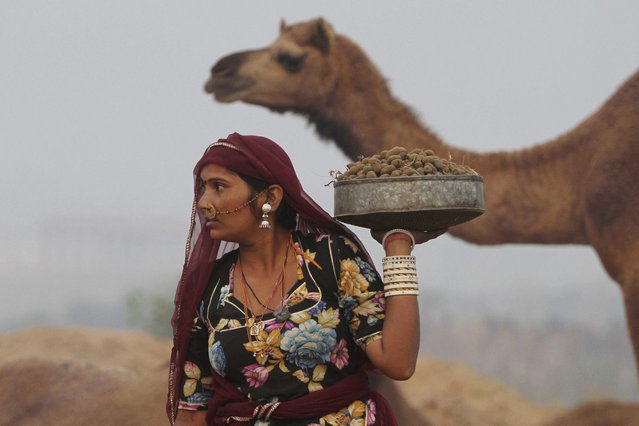
An Indian woman collects camel dung during the annual cattle fair in Pushkar, in the western Indian state of Rajasthan, Sunday, November 10, 2013. Pushkar, located on the banks of Pushkar Lake, is a popular Hindu pilgrimage spot that is also frequented by foreign tourists who come to the town for the annual cattle fair and camel races. (Photo by Ajit Solanki/AP Photo)

An Indian woman collects camel dung during the annual cattle fair in Pushkar, in the western Indian state of Rajasthan, Sunday, November 10, 2013. Pushkar, located on the banks of Pushkar Lake, is a popular Hindu pilgrimage spot that is also frequented by foreign tourists who come to the town for the annual cattle fair and camel races. (Photo by Ajit Solanki/AP Photo)
Details
11 Nov 2013 10:59:00
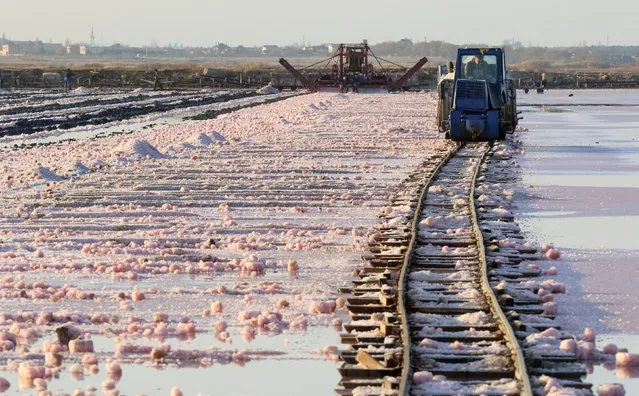
A train drives along a field at a salt production site at the Sasyk-Sivash lake near the city of Yevpatoria, Crimea, November 14, 2017. (Photo by Pavel Rebrov/Reuters)

A train drives along a field at a salt production site at the Sasyk-Sivash lake near the city of Yevpatoria, Crimea, November 14, 2017. A saltwater lagoon known as Lake Sasyk-Sivash on Ukraine's Crimea peninsula is the source of a rare resource: pink salt. The mineral is tinted by tiny algae that produce the pigment beta-carotene. Each autumn, seasonal workers collect thousands of tons of pink salt for processing and export. (Photo by Pavel Rebrov/Reuters)
Details
16 Nov 2017 08:18:00
Boys play basketball in the facilities of Belarus' Republican Clinic of Speleotherapy within a salt mine, as part of their treatment, near the town of Soligorsk, south of Minsk, February 19, 2015. According to the state clinic, more than 7,000 children and adults seek medical treatment for respiratory illness each year in the subsurface chambers of its facilities, located 420 metres underground between layers of potassium and stone salts in an operational salt mine. (Photo by Vasily Fedosenko/Reuters)

Boys play basketball in the facilities of Belarus' Republican Clinic of Speleotherapy within a salt mine, as part of their treatment, near the town of Soligorsk, south of Minsk, February 19, 2015. According to the state clinic, more than 7,000 children and adults seek medical treatment for respiratory illness each year in the subsurface chambers of its facilities, located 420 metres underground between layers of potassium and stone salts in an operational salt mine. (Photo by Vasily Fedosenko/Reuters)
Details
20 Feb 2015 13:17:00