Loading...
Done
How Snakeskin Handbags Are Made

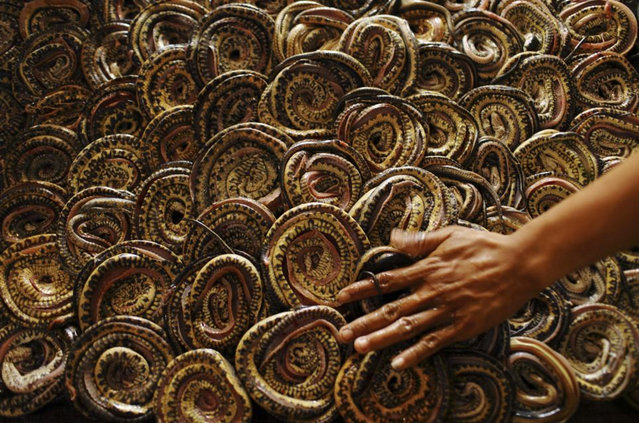
Images from a snake slaughterhouse at Kapetakan village in Indonesia’s West Java province. Wakira, who is known as “Boss Cobra”, owns the slaughterhouse that produces snake meat and skin. Snake meat is believed by some to be a remedy for skin diseases and asthma, as well as an aid to increase virility. The snake skins, measuring in the hundreds of metres, are sold to bag factories in the West and Central Java provinces on a monthly basis. The price of a bag made from snake skin costs between 150,000 rupiah ($ 15.60) and 300,000 rupiah ($31.20), depending on its size. That snakeskin handbag you’ll buy is costing a hell of a lot more.
Details
20 Feb 2013 12:00:00
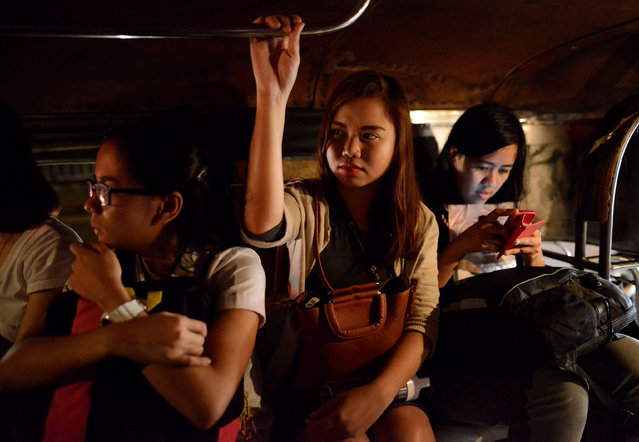
Cristine Angelie Garcia (C), 24, rides a jeepney on her way to work at a call centre for the midnight shift in Taguig city, Metro Manila, Philippines October 3, 2016. “Maybe there is another way where people do not need to die”, she said, adding she felt safer walking the streets at night. “I'm on Duterte's side. Maybe he's just misunderstood because he grew up on the streets”. (Photo by Ezra Acayan/Reuters)

Cristine Angelie Garcia (C), 24, rides a jeepney on her way to work at a call centre for the midnight shift in Taguig city, Metro Manila, Philippines October 3, 2016. “Maybe there is another way where people do not need to die”, she said, adding she felt safer walking the streets at night. “I'm on Duterte's side. Maybe he's just misunderstood because he grew up on the streets”. (Photo by Ezra Acayan/Reuters)
Details
29 Dec 2016 07:48:00
How This Man’s Saved A Duckling

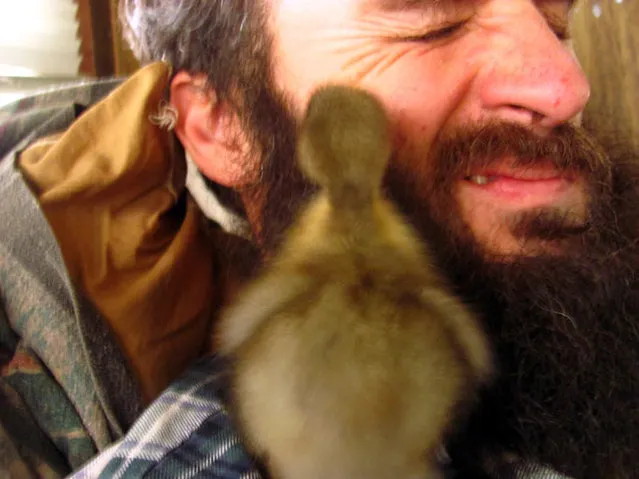
If we asked you to think of your favorite cute animal, you might not immediately list a duck, but when you see this Reddit user and his pet duckling Peeps you may change your mind. Peeps is fuzzy, he’s lovable and he grew up in a beard (really). The man initially bought Peeps as an egg, thinking he was a chicken. He was wrong, but he didn’t care, it turned out to be one of the cutest friendships ever.
Details
27 Jan 2014 11:29:00
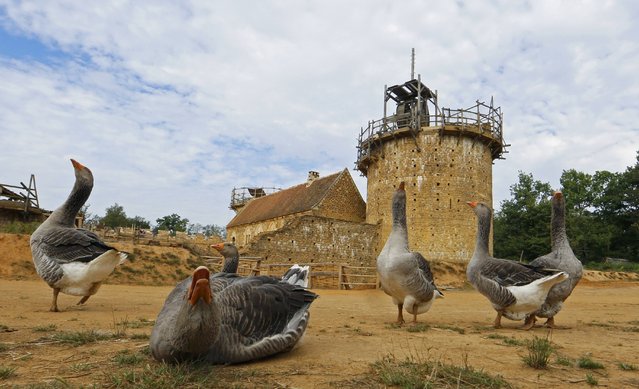
A view of the construction site of the Chateau de Guedelon near Treigny in the Burgundy region of France, September 13, 2016. Blacksmiths, stonemasons and quarry men are hard at work in a Burgundy forest building a 13th-century-style castle using the most basic tools and materials, replicating the methods used hundreds of years ago to better understand them. Forgoing all modern technology, workers use hammers to break stones and forge iron, operate wooden wheels to hoist their materials up to where they are needed, and rely on a quarry for stone, clay and sand as they build up a castle from scratch. Construction on Guedelon Castle in central France began in 1997 after an archaeological survey revealed a medieval fortress hidden inside the walls of nearby Chateau de Saint-Fargeau. Those behind the project hope to answer questions about medieval construction and provide lessons on sustainable building. (Photo by Jacky Naegelen/Reuters)

A view of the construction site of the Chateau de Guedelon near Treigny in the Burgundy region of France, September 13, 2016. Blacksmiths, stonemasons and quarry men are hard at work in a Burgundy forest building a 13th-century-style castle using the most basic tools and materials, replicating the methods used hundreds of years ago to better understand them. (Photo by Jacky Naegelen/Reuters)
Details
15 Sep 2016 09:43:00
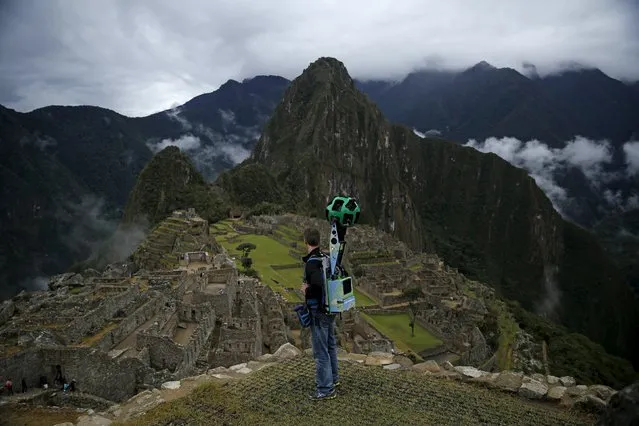
Daniel Filip, Tech Lead Manager for Google Maps, carries the Trekker, a 15-camera device, while mapping the Inca citadel of Machu Picchu for Google Street View in Cuzco, Peru, August 11, 2015. (Photo by Pilar Olivares/Reuters)

Daniel Filip, Tech Lead Manager for Google Maps, carries the Trekker, a 15-camera device, while mapping the Inca citadel of Machu Picchu for Google Street View in Cuzco, Peru, August 11, 2015. (Photo by Pilar Olivares/Reuters)
Details
07 Dec 2015 08:02:00
Construction of the cable road on Broadway in 1891. (Photo by New York Public Library)

Construction of the cable road on Broadway in 1891. (Photo by New York Public Library)
Details
21 Jul 2016 13:44:00
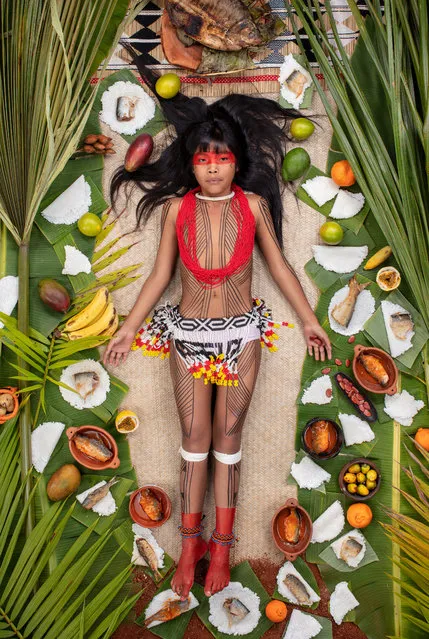
Kawakanih Yawalapiti, 9, Upper Xingu region of Mato Grosso, Brazil, 2018: Kawakanih lives with her tribe, the Yawalapiti, in Xingu national park, a preserve in the Amazon basin of Brazil. The Yawalapiti collect seeds to preserve species unique to their ecosystem, which lies between the rain forest and savannah. Kawakanih’s diet is simple, consisting mainly of fish, cassava, porridge, fruit and nuts. “It takes five minutes to catch dinner”, says Kawakanih. “When you’re hungry, you just go to the river with your net”. (Photo by Gregg Segal/The Guardian)

Photographer Gregg Segal travelled the world to document children and the food they eat in a week. Partly inspired by the increasing problems of childhood obesity, he tracked traditional regional diets as yet unaffected by globalisation, and ironically, found that the healthiest diets were often eaten by the least well off. (Photo by Gregg Segal/The Guardian)
Details
03 Jul 2019 00:03:00
Kinetic Masterpieces By Anthony Howe (Video)

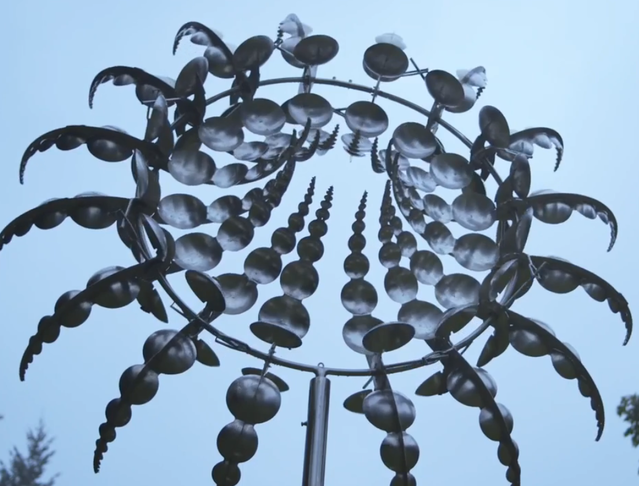
The kinetic sculptures created by Anthony Howe are nothing short of a miracle. You simply cannot wrap your mind around the fact that these creations are real. The magic comes from the fact that all the creations of Anthony Howe were first digitally modeled and only then wrought from metal. The resulting pieces of art are mystifying, entrancing, and sometimes even terrifying. For example, one of the earlier creations of Howe is an installation called “About Face”. It is a human face, pieces of which move from side to side, even if there is just a gentle breeze. However, most of his creations are mesmerizing, capturing your mind, as you marvel at their intricacy.
Details
28 Nov 2014 12:04:00