Loading...
Done
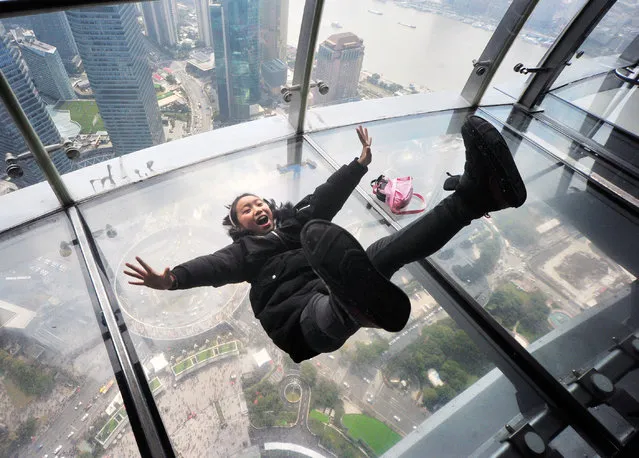
A young girl plays on the glass bottom platform of the Oriental Pear TV Tower as she travels with her family on the second day of the Chinese Lunar New Year holiday, also known as Spring Festival, in Shanghai, China on February 18, 2018. Some 287 million tourists travelled in China during the first four days of the week-long Chinese Lunar New Year holiday, up 11.1 percent from the same period last year, new data showed Sunday (18 February 2018). Tourism revenue rose 11.6 percent to 352.7 billion yuan (55.61 billion U.S. dollars) in the four days, the China National Tourism Administration (CNTA) said. On Sunday alone, some 73 million tourist trips were made across the country, up 15.3 percent, while tourism revenue rose 16.6 percent to 94.4 billion yuan. (Photo by Imaginechina/Rex Features/Shutterstock)

A young girl plays on the glass bottom platform of the Oriental Pear TV Tower as she travels with her family on the second day of the Chinese Lunar New Year holiday, also known as Spring Festival, in Shanghai, China on February 18, 2018. Some 287 million tourists travelled in China during the first four days of the week-long Chinese Lunar New Year holiday, up 11.1 percent from the same period last year, new data showed Sunday. (Photo by Imaginechina/Rex Features/Shutterstock)
Details
21 Feb 2018 00:03:00
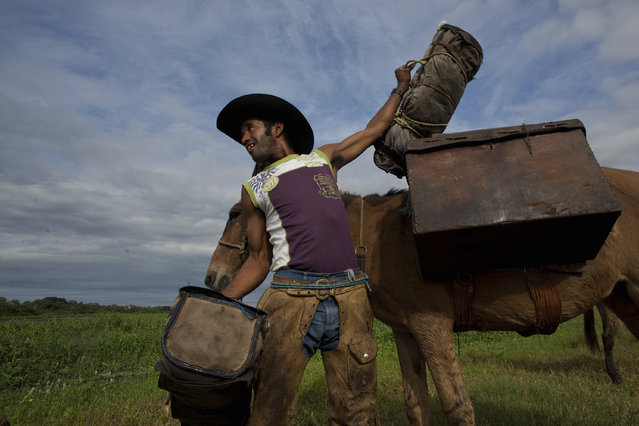
In this May 17, 2017 photo, cowboy cook Odair Batista carries a case with food in Corumba, the Pantanal wetlands of Mato Grosso do Sul state, Brazil. Dressed with leather chaps on top of their jeans, stetson hats and a machete attached to their waists, before setting off, the men finish their breakfast with Terere, an herbal “mate” beverage served ice cold in an ox drinking horn. (Photo by Eraldo Peres/AP Photo)

In this May 17, 2017 photo, cowboy cook Odair Batista carries a case with food in Corumba, the Pantanal wetlands of Mato Grosso do Sul state, Brazil. Dressed with leather chaps on top of their jeans, stetson hats and a machete attached to their waists, before setting off, the men finish their breakfast with Terere, an herbal “mate” beverage served ice cold in an ox drinking horn. (Photo by Eraldo Peres/AP Photo)
Details
12 Jun 2017 09:00:00
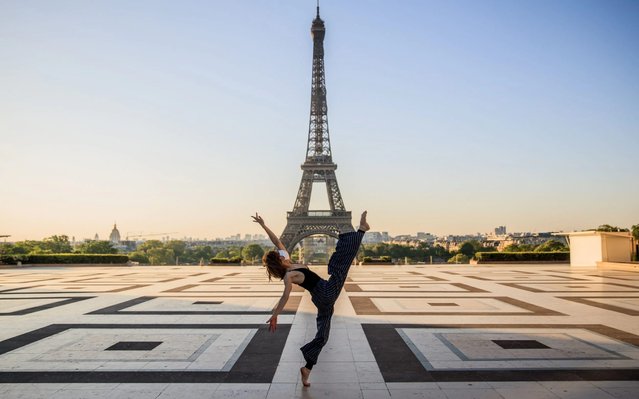
Syrian dancer and choreographer Yara al-Hasbani performs a dance on the empty Trocadero square in front of the Eiffel tower in Paris on April 22, 2020, on the 37th day of a strict lockdown in France to stop the spread of COVID-19 (novel coronavirus). (Photo by Sameer Al-Doumy/AFP Photo)

Syrian dancer and choreographer Yara al-Hasbani performs a dance on the empty Trocadero square in front of the Eiffel tower in Paris on April 22, 2020, on the 37th day of a strict lockdown in France to stop the spread of COVID-19 (novel coronavirus). (Photo by Sameer Al-Doumy/AFP Photo)
Details
26 Apr 2020 00:07:00
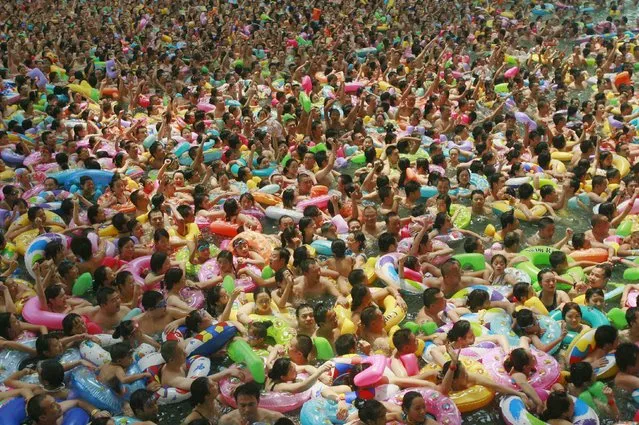
Local residents crowd a swimming pool during a hot weather in Suining, Sichuan province, 27 July 2008. (Photo by Reuters/Stringer)

Local residents crowd a swimming pool during a hot weather in Suining, Sichuan province, 27 July 2008. (Photo by Reuters/Stringer)
Details
19 Sep 2016 08:54:00
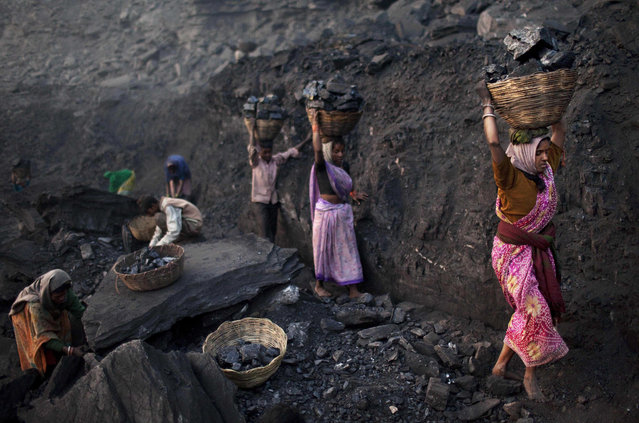
In this Friday, January 7, 2011 photo, people carry baskets of coal scavenged illegally at an open-cast mine in the village of Bokapahari in the eastern Indian state of Jharkhand where a community of coal scavengers live and work. The world's biggest coal users – China, the United States and India – have boosted coal mining in 2017, in an abrupt departure from last year's record global decline for the heavily polluting fuel and a setback to efforts to rein in climate change emissions. (Photo by Kevin Frayer/AP Photo)

In this Friday, January 7, 2011 photo, people carry baskets of coal scavenged illegally at an open-cast mine in the village of Bokapahari in the eastern Indian state of Jharkhand where a community of coal scavengers live and work. The world's biggest coal users – China, the United States and India – have boosted coal mining in 2017, in an abrupt departure from last year's record global decline for the heavily polluting fuel and a setback to efforts to rein in climate change emissions. (Photo by Kevin Frayer/AP Photo)
Details
28 Jun 2017 08:08:00
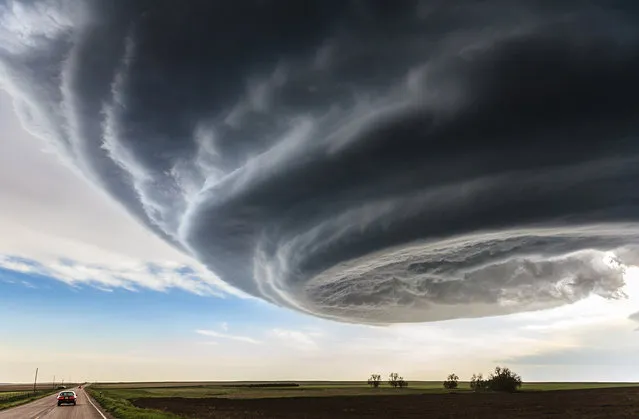
“The Independence day”. While on storm chasing expeditions in the Tornado Alley in USA I have encountered many photogenic supercell storms. This photograph was taken while we were approaching the storm near Julesburg, Colorado on My 28th, 2013. The storm was tornado warned for more than one hour, but stayed an LP storm through all its cycles and never produced a tornado, just occasional brief funnels, large hail and some rain. Photo location: Julesburg, Colorado, USA. (Photo and caption by Marko Korošec/National Geographic Photo Contest)

“The Independence day”. While on storm chasing expeditions in the Tornado Alley in USA I have encountered many photogenic supercell storms. This photograph was taken while we were approaching the storm near Julesburg, Colorado on My 28th, 2013. The storm was tornado warned for more than one hour, but stayed an LP storm through all its cycles and never produced a tornado, just occasional brief funnels, large hail and some rain. Photo location: Julesburg, Colorado, USA. (Photo and caption by Marko Korošec/National Geographic Photo Contest)
Details
24 Jun 2014 12:29:00
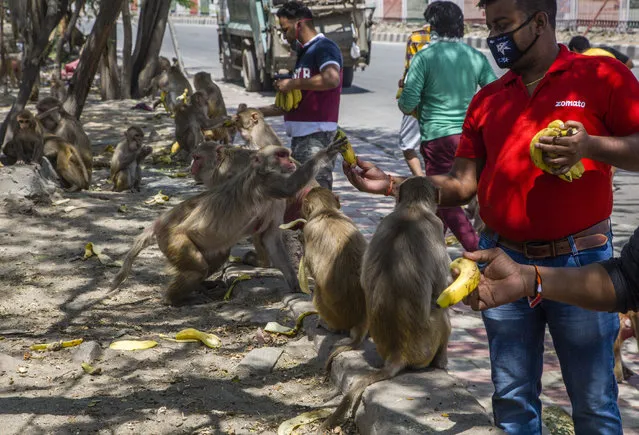
Men give bananas to monkeys gathered on the side of the road as India remains under an unprecedented lockdown over the highly contagious coronavirus (COVID-19) on April 08, 2020 in New Delhi, India. Wild animals, including monkeys, are roaming human settlements in India as people are staying indoors due to the 21-day lockdown. With India's 1.3 billion population and tens of millions of cars off the roads, wildlife is moving towards areas inhabited by humans. Wild animals in many countries have been seen roaming streets. A study says some 60 percent of the new diseases found around the globe every year are zoonotic, meaning they originate in animals and are passed on to humans. COVID-19 is a zoonotic disease that is suspected to have come from the wet markets of Wuhan, China. (Photo by Yawar Nazir/Getty Images)

Men give bananas to monkeys gathered on the side of the road as India remains under an unprecedented lockdown over the highly contagious coronavirus (COVID-19) on April 08, 2020 in New Delhi, India. Wild animals, including monkeys, are roaming human settlements in India as people are staying indoors due to the 21-day lockdown. (Photo by Yawar Nazir/Getty Images)
Details
12 Apr 2020 00:05:00
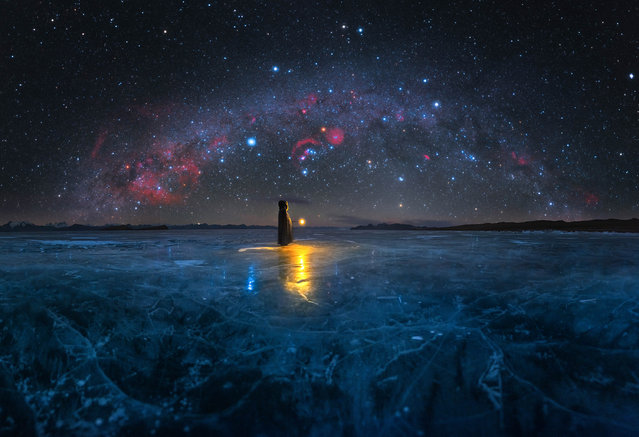
Ice Age – Tibet, China. “This is the Chinese version of the blue ice lake, Pumoungcuo, at an altitude of 5,070 metres (16,600 feet). This lake in Tibet freezes every winter. At night, under the low temperatures of -20C, you can listen to the sound of the ice cracking while capturing the most beautiful winter sky. The blue ice surface and dazzling Orion constellation create a fantasy landscape. I felt so happy to have the stars as my companion on this magical night”. (Photo by Daniel Zafra Portill/Milky Way Photographer of the Year)

Ice Age – Tibet, China. “This is the Chinese version of the blue ice lake, Pumoungcuo, at an altitude of 5,070 metres (16,600 feet). This lake in Tibet freezes every winter. At night, under the low temperatures of -20C, you can listen to the sound of the ice cracking while capturing the most beautiful winter sky. The blue ice surface and dazzling Orion constellation create a fantasy landscape. I felt so happy to have the stars as my companion on this magical night”. (Photo by Daniel Zafra Portill/Milky Way Photographer of the Year)
Details
21 May 2022 05:10:00