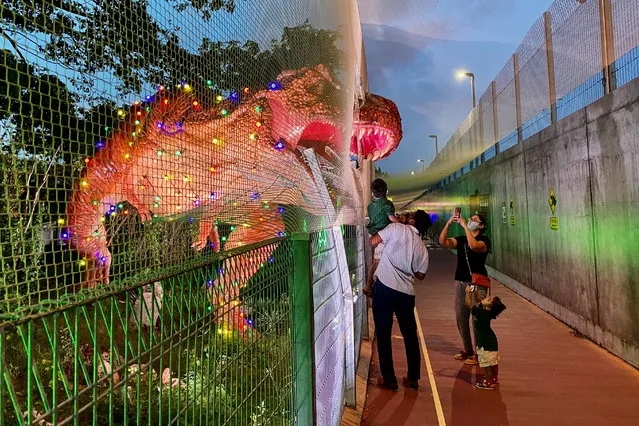
A family poses for photos near a dinosaur exhibits along the Changi Jurassic Mile as it is light up for Christmas near Changi airport in Singapore on December 8, 2020. (Photo by Tim Chong/Reuters)
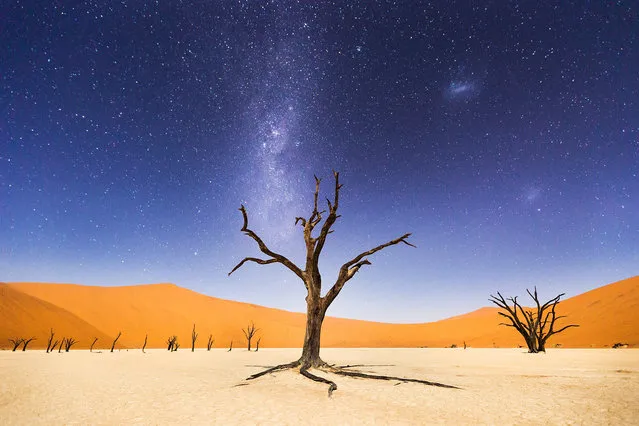
Merit: A Night at Deadvlei. The night before returning to Windhoek, we spent several hours at Deadveli. The moon was bright enough to illuminate the sand dunes in the distance, but the skies were still dark enough to clearly see the milky way and magellanic clouds. Deadveli means “dead marsh. The camelthorn trees are believed to be about 900 years old, but have not decomposed because the environment is so dry. (Photo and caption by Beth McCarley/National Geographic Traveler Photo Contest)
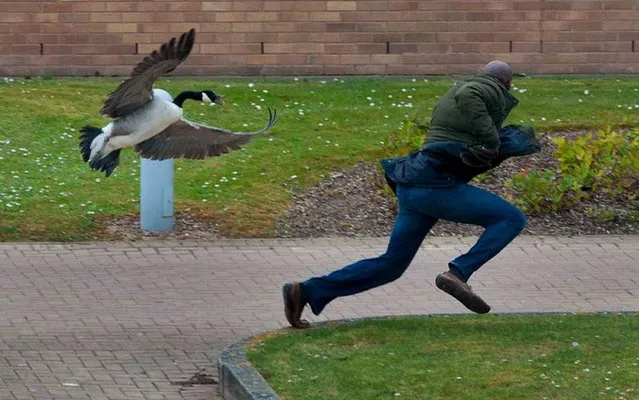
A goose has terrorized students at the University of Warwick, Coventry, UK, on May 22, 2013. The bird built its nest near a block of student apartments and attacks anyone who goes near the nest. (Photo by Caters News/The Grosby Group)
Football Soccer, England vs Wales, EURO 2016, Group B, Stade Bollaert-Delelis, Lens, France on June 16, 2016. Soccer fan Laura Woods from England fixes her makeup near riot police near the Lens stadium before the England vs Wales game. (Photo by Wolfgang Rattay/Reuters)
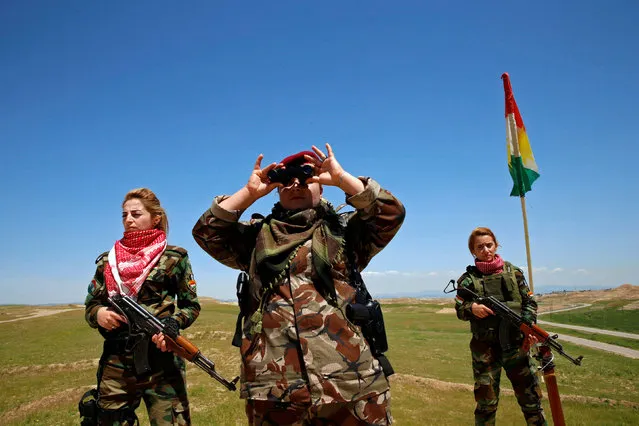
Iraqi Kurdish female fighter Haseba Nauzad looks through a pair of binoculars during a deployment near the frontline of the fight against Islamic State militants in Nawaran near Mosul, Iraq, April 20, 2016. (Photo by Ahmed Jadallah/Reuters)
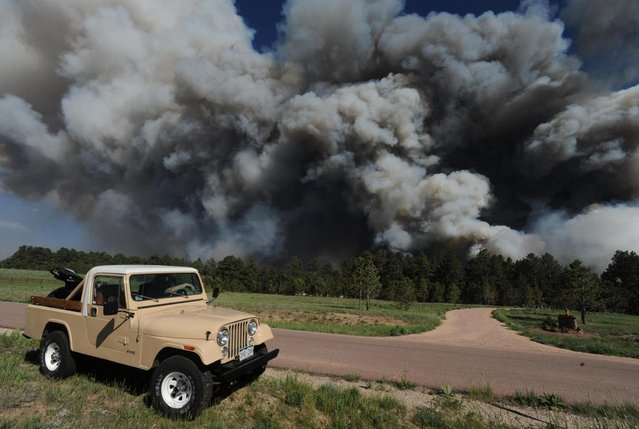
Bill Moreau watches as the Black Forest fire burns near his house near Black Forest Road Tuesday afternoon, June 11, 2013, near Colorado Springs, Colo. The Black Forest Fire was one of at least three significant wildfires burning in Colorado amid gusty winds and record-breaking hot, dry weather. (Photo by Christian Murdock/AP Photo/The Colorado Springs Gazette)
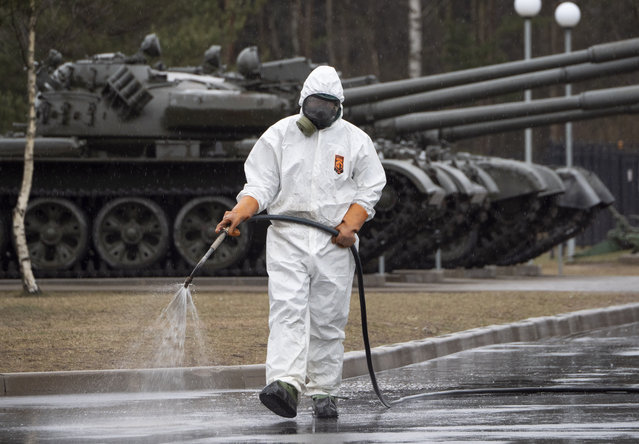
A specialist from a local veterinary service wears a protective suit as sprays disinfectant near Russian tanks displayed at area near Proryv (The Breakthrough) museum dedicated to the breakthrough of the Siege of Leningrad during World WarII near Kirovsk, about 30 kilometres (19 miles) east of St.Petersburg, Russia, Thursday, April 2, 2020. (Photo by Dmitri Lovetsky/AP Photo)
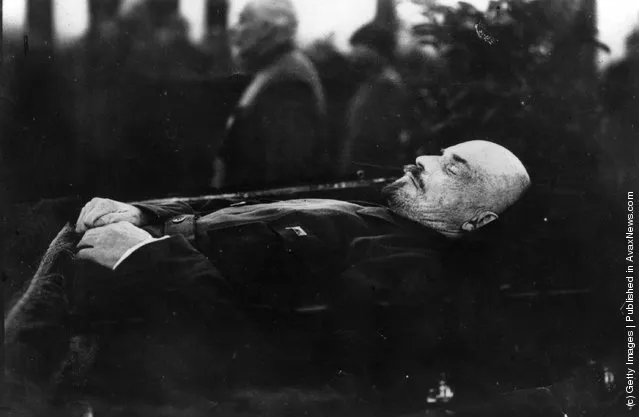
Photo: Vladimir Ilyich Lenin (1870 – 1924) lying in state in the Kremlin. (Photo by Hulton Archive/Getty Images). 1924
Important! For the same article in Russian language click here.
Something quite intriguing is happening within Russian-speaking internet during the last few – should you type a fully academic inquiry (at least, according to Russian academic requirements) in national search engines for "Lenin's mausoleum" – the first thing you get (even in top 10 searches) is website pages talking about black magic and occult. Website authors view this construction differently, but unconditionally agree on one thing: the mausoleum of the "leader of the world proletariat” – the essence of a magical artifact, a sort of “energy vampire”. It was built with a certain purpose: to drain the energy out of miserable Soviet citizens on one hand; and to poison the anthroposphere of one-sixth part of the earth with its vibes (the exact territory that was occupied by the former Soviet Union), depriving the Russian people of will to resist on the other hand. Complete nonsense? No doubt. Nevertheless, an intriguing one. Well, probably because some oddities do exist in mausoleum's history. These oddities are the thing we are going to discuss this time. First, let me refresh you memory on the subject.