Loading...
Done
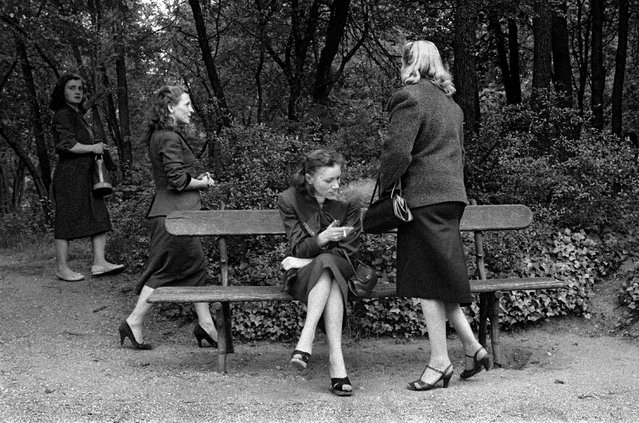
Horvat started out as a photojournalist. Meeting Henri Cartier-Bresson in 1951 proved to be a milestone in his career, leading to a two-year trip to Asia and exhibiting internationally, including in the 1955 show The Family of Man at New York's Museum of Modern Art. Here: Prostitutes, Bois de Boulogne, 1956. (Photo by Frank Horvat/The Guardian)

Born in 1958 in Abbazia, Italy, Frank Horvat is considered one of the founding fathers of French fashion photography. Frank Horvat: Storia di un Fotografo is on at Palazzo Chiablese Musei Reali, Turin, until 16 June. Here: Prostitutes, Bois de Boulogne, 1956. (Photo by Frank Horvat/The Guardian)
Details
01 Jun 2018 00:05:00
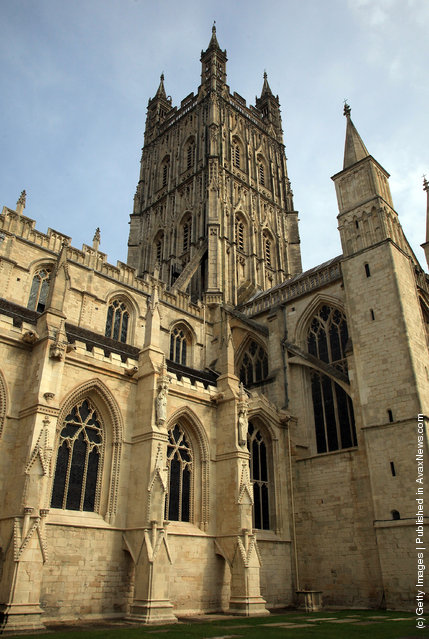
London 2012 – UK Landmarks: Gloucester Cathedral

“Gloucester Cathedral, or the Cathedral Church of St Peter and the Holy and Indivisible Trinity, in Gloucester, England, stands in the north of the city near the river. It originated in 678 or 679 with the foundation of an abbey dedicated to Saint Peter (dissolved by King Henry VIII)”. – Wikipedia

Photo: A general view of Gloucester Cathedral is seen on March 22, 2012 in Gloucester, England. With only a few months to go until the opening ceremony of the London 2012 Olympic games, Britain's tourist industry is hoping to benefit from the influx of athletes, officials and visitors. (Photo by Matt Cardy/Getty Images)
Details
26 Mar 2012 10:30:00
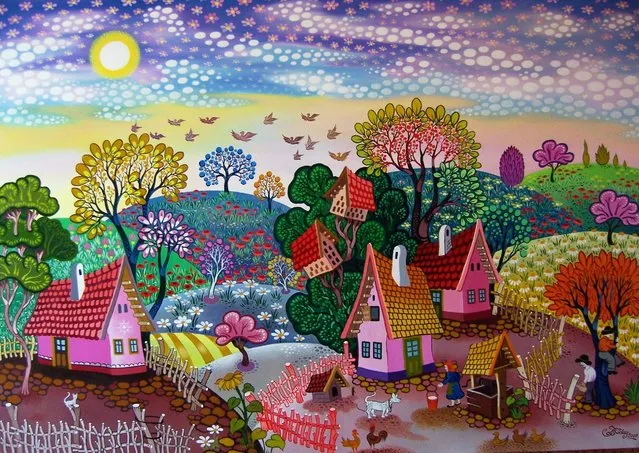
Painting By Koday Laszlo

Laszlo Koday was born in Hungary in 1945. In 1970 he began as a self-tought painter. The life and work of Henri Rousseau made a deep impression on him. His pictures are fairy tales expressed by pictorial means, human, animal and nature are equally important in them. There are bright, with unmixed pure colours, compositions wich spread calmness and gaiety. Kaday's works are know not only in Hungary but in many countries and are included in many private and public collections. His paintings can be found in galleries abroad, for example the GINA Gallery.
Details
23 Jul 2013 09:00:00
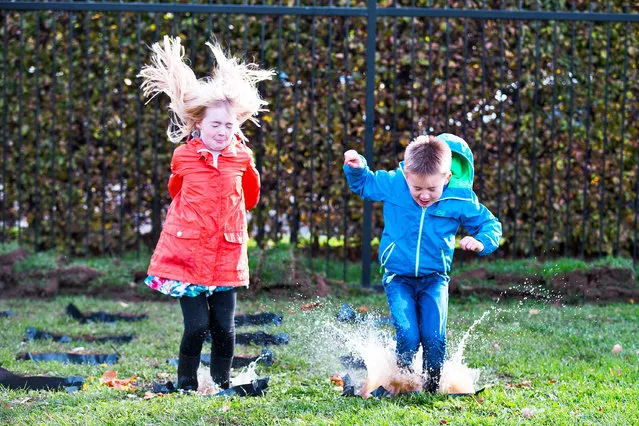
Picture dated October 23rd, 2018 shows brother and sister Henry (7) and Lily Sales (9) getting in some early practice for the World Puddle Jumping Championships at Wicksteed Park in Kettering, Northants, UK. Organisers have made more puddles than ever before in an attempt to make this year's competition the biggest and best yet. They are also hoping competitors will set a new record for the most people jumping in puddles at the same time. Judges will give scores based on the height of the jump, enthusiasm, distance of splash and stickability (the amount of mud which clings to each competitor). (Photo by Geoff Robinson Photography)

Picture dated October 23rd, 2018 shows brother and sister Henry (7) and Lily Sales (9) getting in some early practice for the World Puddle Jumping Championships at Wicksteed Park in Kettering, Northants, UK. Organisers have made more puddles than ever before in an attempt to make this year's competition the biggest and best yet. They are also hoping competitors will set a new record for the most people jumping in puddles at the same time. Judges will give scores based on the height of the jump, enthusiasm, distance of splash and stickability (the amount of mud which clings to each competitor). (Photo by Geoff Robinson Photography)
Details
25 Oct 2018 09:42:00
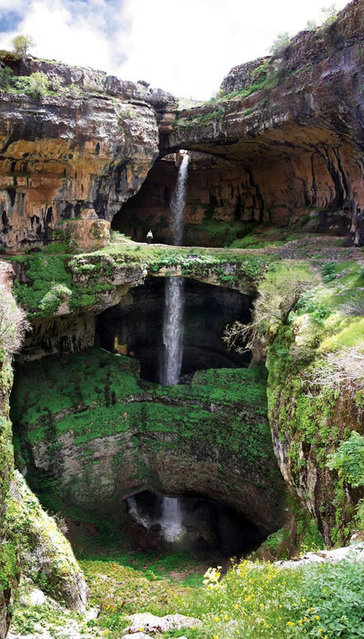
Baatara Gorge Waterfall

Discovered in 1952 by French bio-speleologist Henri Coiffait, the waterfall and accompanying sinkhole were fully mapped in the 1980s by the Spéléo club du Liban. The cave is also known as the "Cave of the Three Bridges." Traveling from Laklouk to Tannourine one passes the village of Balaa, and the "Three Bridges Chasm" (in French "Gouffre des Trois Ponts") is a five-minute journey into the valley below where one sees three natural bridges, rising one above the other and overhanging a chasm descending into Mount Lebanon. During the spring melt, a 90–100-metre (300–330 ft) cascade falls behind the three bridges and then down into the 250-metre (820 ft) chasm. A 1988 fluorescent dye test demonstrated that the water emerged at the spring of Dalleh in Mgharet al-Ghaouaghir.
Details
31 Aug 2013 11:27:00
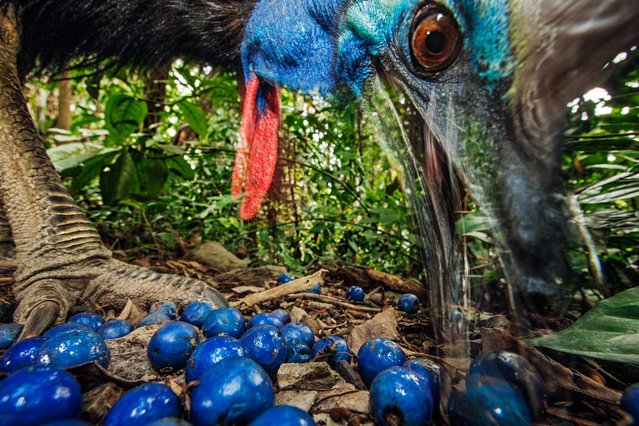
“Cassowaries are large, flightless birds related to emus and (more distantly) to ostriches, rheas, and kiwis”, writes Olivia Judson in the September issue of National Geographic magazine. (Photo by Christian Ziegler/National Geographic)

“Cassowaries are large, flightless birds related to emus and (more distantly) to ostriches, rheas, and kiwis”, writes Olivia Judson in the September issue of National Geographic magazine. How large? People-size: Adult males stand well over five foot five and top 110 pounds. Females are even taller, and can weigh more than 160 pounds. Dangerous when roused, they’re shy and peaceable when left alone. But even birds this big and tough are prey to habitat loss. The dense New Guinea and Australia rain forests where they live have dwindled. Today cassowaries might number 1,500 to 2,000. And because they help shape those same forests – by moving seeds from one place to another – “if they vanish”, Judson writes, “the structure of the forest would gradually change” too. (Photo by Christian Ziegler/National Geographic)

Details
06 Jan 2014 12:21:00
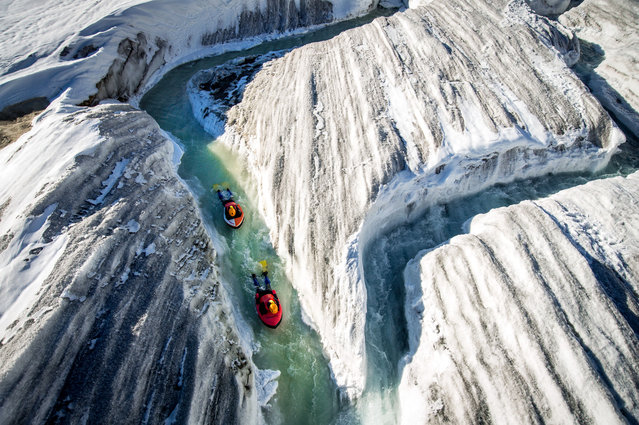
Water way to go. These incredible images show the moment two brave adventurers decided to body board down Europes longest glacier. Seen carving their way through the icy rivers of the Aletsch Glacier in Switzerland, the pair are seen risking their lives for an adrenalin rush of a whole new kind. (Photo by David Carlier/Caters News)

Water way to go. These incredible images show the moment two brave adventurers decided to body board down Europes longest glacier. Seen carving their way through the icy rivers of the Aletsch Glacier in Switzerland, the pair are seen risking their lives for an adrenalin rush of a whole new kind. Pictured mounted on their body boards as part of a sport known as hydrospeeding, the daredevils risked being carried away by strong currents and even drowning in hidden crevices to complete the winding seven mile journey. But if that wasnt dangerous enough, the duo also ran the risk of being overwhelmed by collapsing glacial lakes that could be released into the river at any moment. (Photo by David Carlier/Caters News)
Details
17 Dec 2014 11:36:00
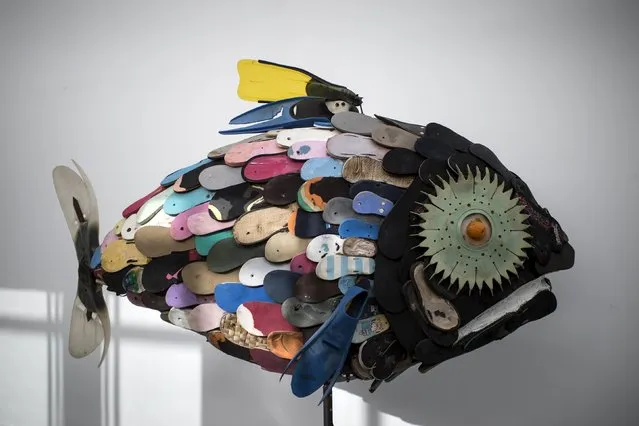
A sculpture of a fish made from waste products collected from the sea is displayed during the exhibition Keep The Oceans Clean by art collective Skeleton Sea, at the Torre Madariaga Biodiversity Centre in Busturia, Spain, May 17, 2015. (Photo by Vincent West/Reuters)

A sculpture of a fish made from waste products collected from the sea is displayed during the exhibition Keep The Oceans Clean by art collective Skeleton Sea, at the Torre Madariaga Biodiversity Centre in Busturia, Spain, May 17, 2015. Skeleton Sea, a group of surfers and artists, recycle waste collected from the world's oceans to create artworks and draw attention to the dangers faced from overfishing, pollution and oil spills. (Photo by Vincent West/Reuters)
Details
19 May 2015 11:16:00