A man walks around while praying in front of lotus lanterns attached to prayer petitions at Jogye temple in Seoul, South Korea, on May 8, 2024. (Photo by Kim Hong-Ji/Reuters)
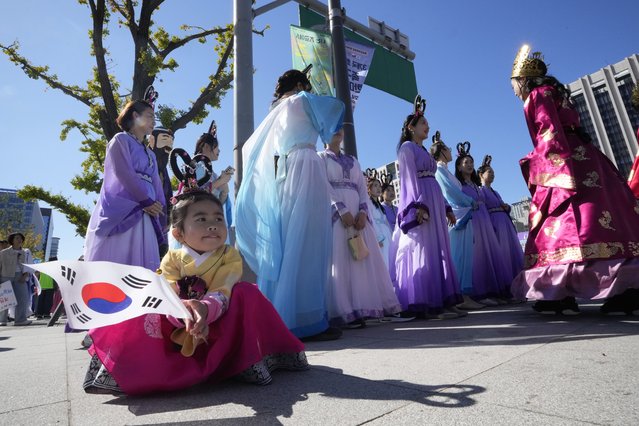
Kim Tae-yeon holds a national flag while waiting for a parade to celebrate the country's National Foundation Day in Seoul, South Korea, Thursday, October 3, 2024. (Photo by Ahn Young-joon/AP Photo)
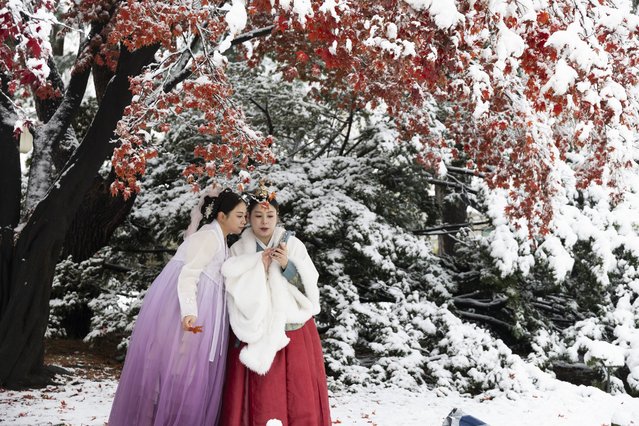
Macao tourists wearing Korean traditional Hanbok dresses take pictures amid snowfall at the Gyeongbokgung Palace in Seoul, South Korea, 27 November 2024. (Photo by Jeon Heon-Kyun/EPA/EFE)
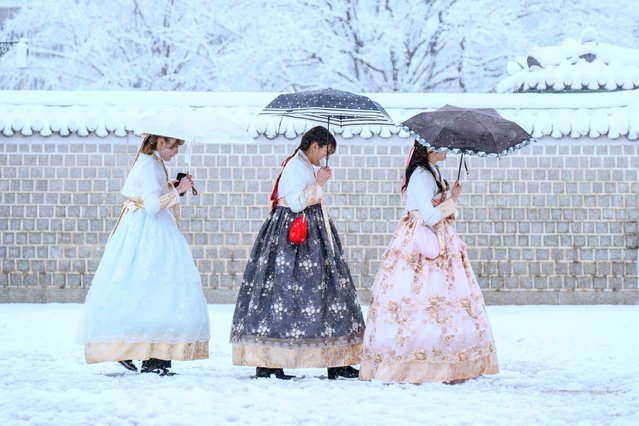
Visitors wearing traditional hanbok dresses are seen on the grounds of Gyeongbokgung Palace amid heavy snowfall in central Seoul on November 27, 2024. South Korea's capital was blanketed on November 27 by the heaviest November snowfall since records began over a century ago, the weather agency said. (Photo by Anthony Wallace/AFP Photo)
The night view of the National Assembly Building and Yeouido in Yeongdeungpo District, Seoul taken on the December 27, 2024. The lights shine in a cross shape thanks to the cross filter used. (Photo by Koh Woon-ho)
Citizens are enjoying the festival by shooting hot spring water guns at the Yuseong Hot Spring Festival held on Oncheon-ro in Yuseong-gu, Daejeon in the first decade of May 2025. (Photo by Shin Hyeon-jong)
In this Friday, March 28, 2014 photo, singers of the Moranbong Band, Jong Su Hyang, foreground, and Pak Mi Kyong, left perform on their stage in Pyongyang, North Korea. Step aside, Sea of Blood Opera. North Korean leader Kim Jong Un's favorite guitar-slinging, miniskirt-sporting girl group, the Moranbong Band, is back. And these ladies know how to shimmy. (Photo by Jon Chol Jin/AP Photo)
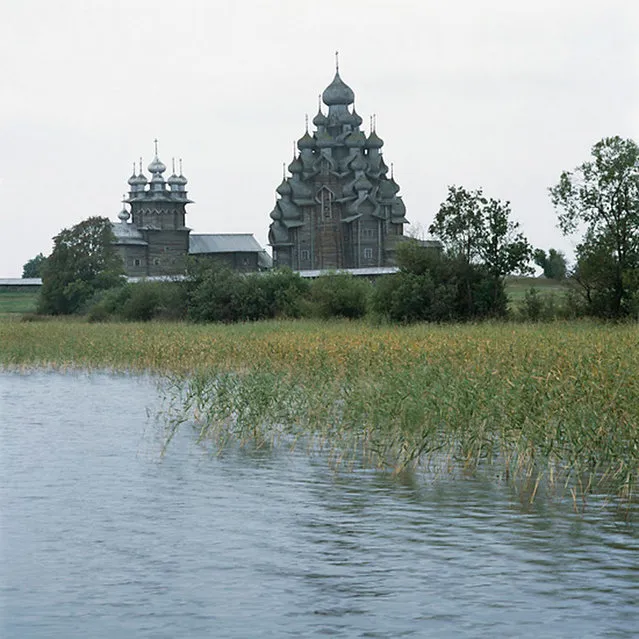
While communism, collectivism, worms, dry rot and casual looting failed to destroy the majestic wooden churches of Russia, it may be ordinary neglect that finally does them in. Dwindled now to several hundred remaining examples, these glories of vernacular architecture lie scattered amid the vastness of the world’s largest country. Just over a decade ago, Richard Davies, a British architectural photographer, struck out on a mission to record the fragile and poetic structures. Austerely beautiful and haunting, “Wooden Churches: Traveling in the Russian North” (White Sea Publishing; $132) is the result. Covering thousands of miles, Mr. Davies described how he and the writer Matilda Moreton tracked down the survivors from among the thousands of onion-domed structures built after Prince Vladimir converted to Christianity in 988.