Loading...
Done
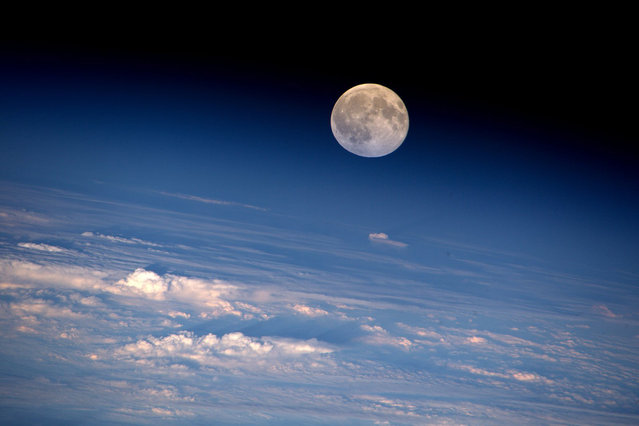
This week's full Moon as photographed from on board the International Space Station by NASA astronaut Jeff Williams on August 19, 2016. Jeff is currently Commander of the Space Station for the Expedition 48 crew. (Photo by Jeff Williams/NASA)

This week's full Moon as photographed from on board the International Space Station by NASA astronaut Jeff Williams on August 19, 2016. Jeff is currently Commander of the Space Station for the Expedition 48 crew. (Photo by Jeff Williams/NASA)
Details
13 Oct 2016 11:48:00
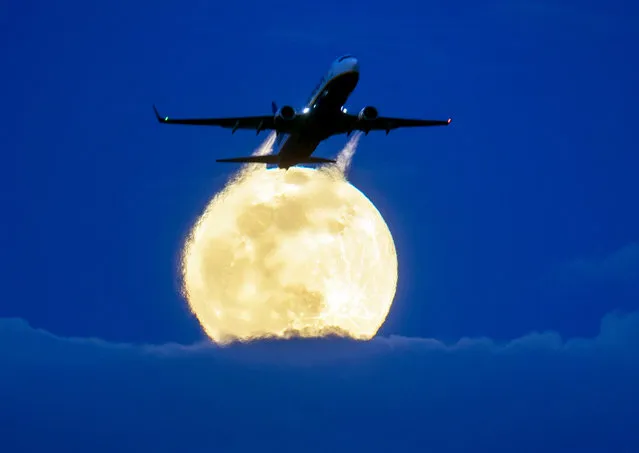
An aircraft passes the rising full moon that breaks through the clouds at the airport in Frankfurt, Germany, Monday, March 9, 2020. (Photo by Michael Probst/AP Photo)

An aircraft passes the rising full moon that breaks through the clouds at the airport in Frankfurt, Germany, Monday, March 9, 2020. (Photo by Michael Probst/AP Photo)
Details
07 Nov 2020 00:03:00
Romain de Tirtoff (Erte) – Symphony In Black

“Romain de Tirtoff (23 November 1892 – 21 April 1990) was a Russian-born French artist and designer known by the pseudonym Erté, the French pronunciation of his initials, R.T. He was a diversely talented 20th-century artist and designer who flourished in an array of fields, including fashion, jewellery, graphic arts, costume and set design for film, theatre, and opera, and interior decor”. – Wikipedia. Photo: Romain de Tirtoff (Erte) – “Symphony In Black” (please click to enlarge).
Details
29 Jan 2014 13:34:00
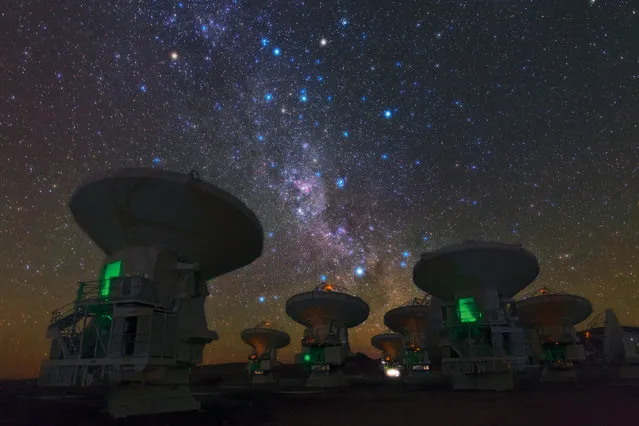
The antennas of the European Southern Observatory's Atacama Large Millimeter/Submillimeter Array, also known as ALMA, are set against the splendor of the Milky Way in this picture by Babak Tafreshi

The antennas of the European Southern Observatory's Atacama Large Millimeter/Submillimeter Array, also known as ALMA, are set against the splendor of the Milky Way in this picture by Babak Tafreshi. Construction of the full ALMA array is due to be completed in Chile's Atacama Desert in 2013, but the facility is already making scientific observations with a partial array of antennas. (Photo by ESO/B. Tafreshi/TWAN)
Details
03 Jun 2012 11:57:00
Panda keepers hold cubs while posing for photos ahead of the new year at the Chengdu Research Base of Giant Panda Breeding in Chengdu, China's southwestern Sichuan province on December 29, 2022. (Photo by AFP Photo/China Stringer Network)

Panda keepers hold cubs while posing for photos ahead of the new year at the Chengdu Research Base of Giant Panda Breeding in Chengdu, China's southwestern Sichuan province on December 29, 2022. (Photo by AFP Photo/China Stringer Network)
Details
03 Jan 2023 02:54:00
A Tibetan man stands nearby as a young tourist poses for photos on a white yak at the shore of the lake in Namtso in western China’s Tibet Autonomous Region, as seen during a government organized visit for foreign journalists, Wednesday, June 2, 2021. (Photo by Mark Schiefelbein/AP Photo)

A Tibetan man stands nearby as a young tourist poses for photos on a white yak at the shore of the lake in Namtso in western China’s Tibet Autonomous Region, as seen during a government organized visit for foreign journalists, Wednesday, June 2, 2021. (Photo by Mark Schiefelbein/AP Photo)
Details
16 Jun 2021 10:25:00
Models present a creations by Maggie Ma collection during the SS2026 China Fashion Week, in Beijing, China, Tuesday, September 9, 2025. (Photo by Andy Wong/AP Photo)

Models present a creations by Maggie Ma collection during the SS2026 China Fashion Week, in Beijing, China, Tuesday, September 9, 2025. (Photo by Andy Wong/AP Photo)
Details
26 Sep 2025 03:41:00
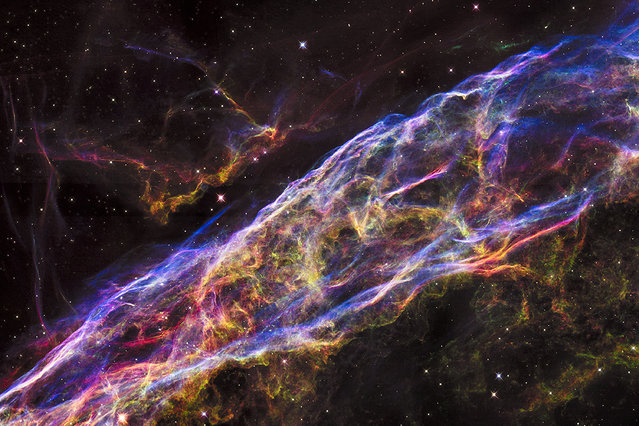
A small section of the expanding remains of the Veil Nebula, a massive star that exploded about 8,000 years ago. The entire nebula is 110 light-years across, covering six full moons on the sky as seen from Earth, and resides about 2,100 light-years away in the constellation Cygnus, the Swan. Image taken by NASA's Hubble Space Telescope. Released September 24, 2015. (Photo by Reuters/NASA/ESA/Hubble Heritage Team)

A small section of the expanding remains of the Veil Nebula, a massive star that exploded about 8,000 years ago. The entire nebula is 110 light-years across, covering six full moons on the sky as seen from Earth, and resides about 2,100 light-years away in the constellation Cygnus, the Swan. Image taken by NASA's Hubble Space Telescope. Released September 24, 2015. (Photo by Reuters/NASA/ESA/Hubble Heritage Team)
Details
10 Dec 2015 08:01:00