Loading...
Done
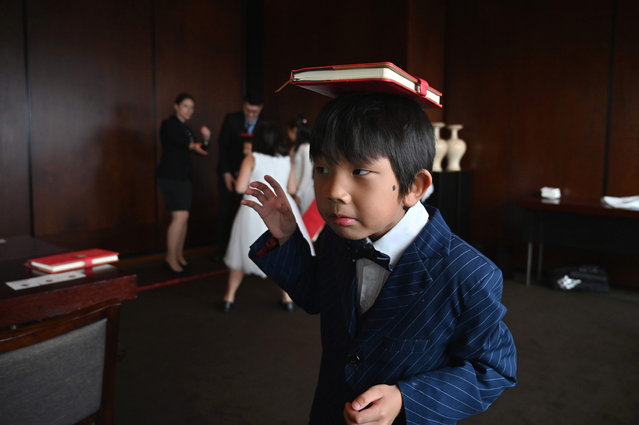
This picture taken on June 1, 2019 shows Alex Gao trying to balance a book on his head during an etiquette and manners class in central Shanghai. (Photo by Hector Retamal/AFP Photo)

This picture taken on June 1, 2019 shows Alex Gao trying to balance a book on his head during an etiquette and manners class in central Shanghai. Against a soundtrack of classical music, children learn social skills, dining manners and deportment in the class, which costs $390 for four hours of practical instruction per student. (Photo by Hector Retamal/AFP Photo)
Details
02 Jul 2019 00:01:00
American model Lori Harvey attends the Tiffany & Co. Celebration of the launch of Blue Book 2024: Tiffany Céleste at The Beverly Estate on April 25, 2024 in Beverly Hills, California. (Photo by Stefanie Keenan/Getty Images for Tiffany & Co.)

American model Lori Harvey attends the Tiffany & Co. Celebration of the launch of Blue Book 2024: Tiffany Céleste at The Beverly Estate on April 25, 2024 in Beverly Hills, California. (Photo by Stefanie Keenan/Getty Images for Tiffany & Co.)
Details
16 May 2024 05:35:00
Tim Tadder’s Water Wigs

Art and science collide in photographer Tim Tadder’s series “Water Wigs” and “Water Wigs Women”. In these perfectly timed photographs, Tadder captures his models wearing hair that’s made out of water. He achieves the process with water balloons, tacks, a creative vision that defies ordinary poses, and, no doubt, extreme patience. (Photo by Tim Tadder)
Details
13 Mar 2014 12:20:00
Dogs and Children

It’s the topic of one never-ending conundrum — do dogs look like their owners? If this is indeed true, do dogs grow to mimic their owners, or do owners choose a dog in their own image? It’s great when science confirms something we already instinctively know. According to a U.S. study, it’s official — dogs do look like their owners.
Details
25 Aug 2012 12:33:00
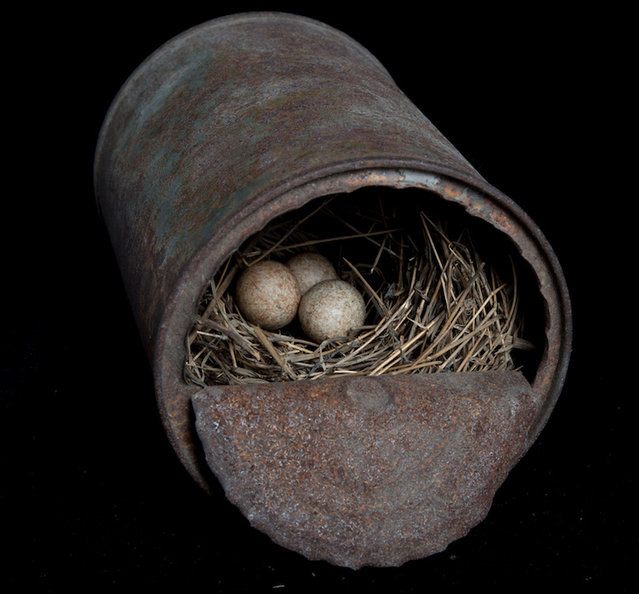
Bird Nest By Sharon Beals Part2

Sharon Beals is a San Francisco based photographer who has photographed nest and eggs specimens collected over the last two centuries at The California Academy of Sciences, The Museum of Vertebrate Zoology, and The Western Foundation of Vertebrate Zoology. While few nests are collected today, these nests and eggs are used for research, providing important information about their builder’s habitats, DNA, diseases and other survival issues.
Details
21 Aug 2013 11:34:00
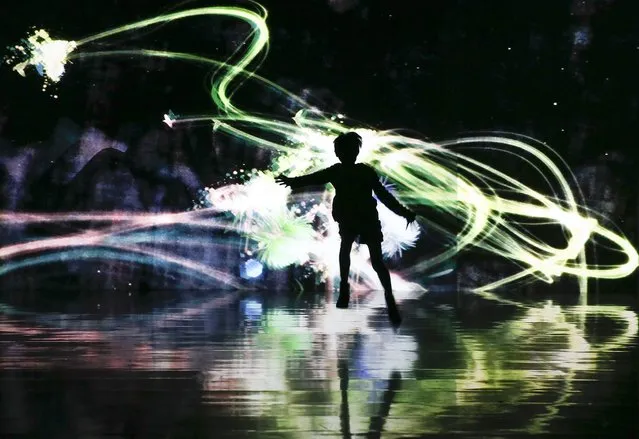
A girl dances in front of the digital art installation “Light in Dark” created by teamLab, a collaborative of Japanese digital artists, during a special exhibition of “Shake! Art Exhibition! and Learn and Play! teamLab Future Park” at National Museum of Emerging Science and Innovation (or Miraikan) in Tokyo, Japan, 19 January 2015. The exhibition is held through 01 March 2015. (Photo by Kimimasa Mayama/EPA)

A girl dances in front of the digital art installation “Light in Dark” created by teamLab, a collaborative of Japanese digital artists, during a special exhibition of “Shake! Art Exhibition! and Learn and Play! teamLab Future Park” at National Museum of Emerging Science and Innovation (or Miraikan) in Tokyo, Japan, 19 January 2015. The exhibition is held through 01 March 2015. (Photo by Kimimasa Mayama/EPA)
Details
06 Feb 2015 12:51:00
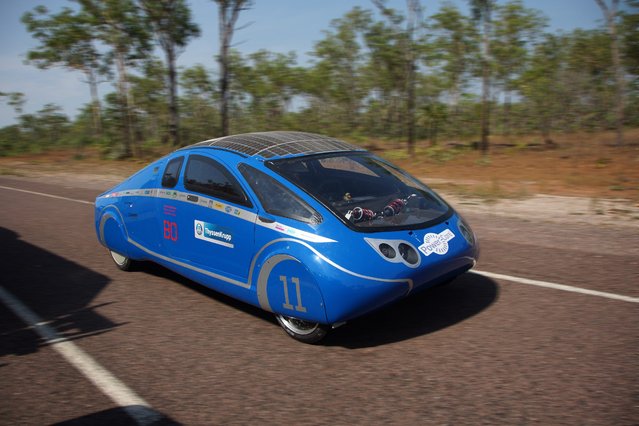
A undated handout image provided by the Bochum University of Applied Sciences (Hochschule Bochum) on 04 October 2013 shows the German team Bochum's Cruiser class solar car during a test drive in the Northern Territoty, Australia, 16 September 2013. The Dutch vehicle is competing in the World Solar Challenge, driving from Darwin to Adelaide starting on 06 October 2013. (Photo by Hochschule Bochum/EPA)

A undated handout image provided by the Bochum University of Applied Sciences (Hochschule Bochum) on 04 October 2013 shows the German team Bochum's Cruiser class solar car during a test drive in the Northern Territoty, Australia, 16 September 2013. The Dutch vehicle is competing in the World Solar Challenge, driving from Darwin to Adelaide starting on 06 October 2013. (Photo by Hochschule Bochum/EPA)
Details
29 Oct 2013 12:37:00
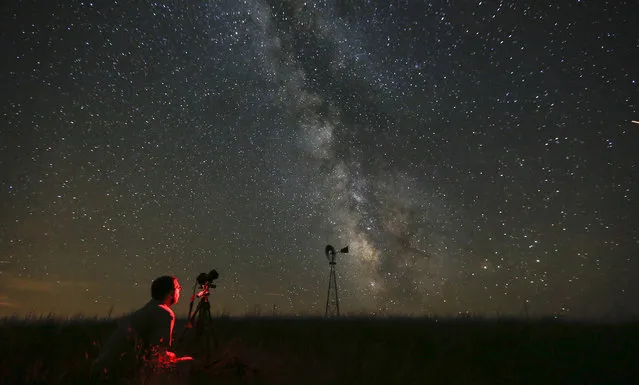
In this Wednesday, July 23, 2014 file photo, Omaha photographer Lane Hickenbottom photographs the night sky in a pasture near Callaway, Neb. With no moon in the sky, the Milky Way was visible to the naked eye. More than one-third of the world’s population can no longer see the Milky Way because of man-made lights, according to a scientific paper by Light Pollution Science and Technology Institute's Fabio Falchi and his team members, published on Friday, June 10, 2016. (Photo by Travis Heying/The Wichita Eagle via AP Photo)

In this Wednesday, July 23, 2014 file photo, Omaha photographer Lane Hickenbottom photographs the night sky in a pasture near Callaway, Neb. With no moon in the sky, the Milky Way was visible to the naked eye. More than one-third of the world’s population can no longer see the Milky Way because of man-made lights, according to a scientific paper by Light Pollution Science and Technology Institute's Fabio Falchi and his team members, published on Friday, June 10, 2016. (Photo by Travis Heying/The Wichita Eagle via AP Photo)
Details
11 Jun 2016 12:37:00