Loading...
Done
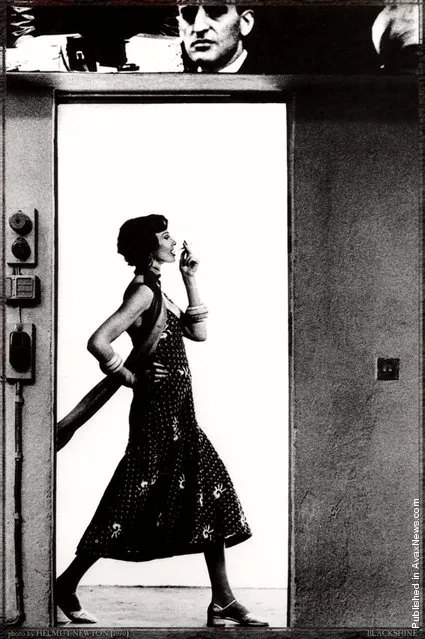
Photographers: Helmut Newton

“Newton was born in Berlin, the son of Klara “Claire” (Marquis) and Max Neustädter, a button factory owner. His family was Jewish. Newton attended the Heinrich-von-Treitschke-Realgymnasium and the American School in Berlin. Interested in photography from the age of 12 when he purchased his first camera, he worked for the German photographer Yva (Elsie Neulander Simon) from 1936. The increasingly oppressive restrictions placed on Jews by the Nuremberg laws meant that his father lost control of the factory in which he manufactured buttons and buckles; he was briefly interned in a concentration camp on “Kristallnacht”, November 9, 1938, which finally compelled the family to leave Germany. Newton's parents fled to South America. He was issued with a passport just after turning 18, and left Germany on December 5, 1938. At Trieste he boarded the “Conte Rosso” (along with about 200 others escaping the Nazis) intending to journey to China. After arriving in Singapore he found he was able to remain there, first and briefly as a photographer for the Straits Times and then as a portrait photographer”. – Wikipedia

Photo: Sigourney Weaver by Helmut Newton, 1995.
Details
08 Apr 2012 13:49:00


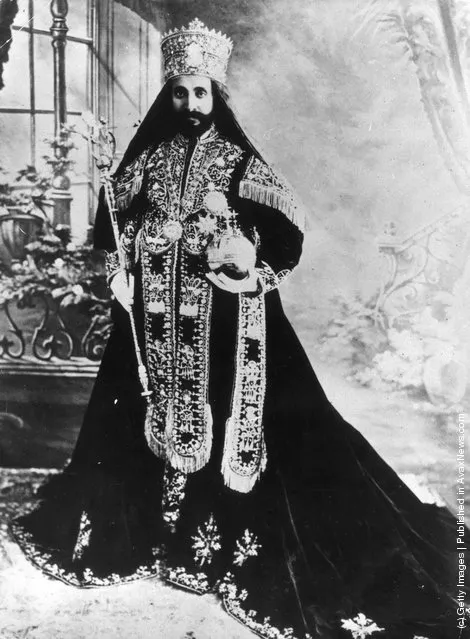
“Haile Selassie I (23 July 1892 – 27 August 1975), born Tafari Makonnen, was Ethiopia's regent from 1916 to 1930 and Emperor of Ethiopia from 1930 to 1974. The heir to a dynasty that traced its origins to the 13th century, and from there by tradition back to King Solomon and Queen Makeda, Empress of Axum, known in the Abrahamic tradition as the Queen of Sheba. Haile Selassie is a defining figure in both Ethiopian and African history.

Haile Selassie is revered as the returned Messiah of the Bible, God incarnate, among the Rastafari movement, the number of followers of which is estimated between 200,000 and 800,000. Begun in Jamaica in the 1930s, the Rastafari movement perceives Haile Selassie as a messianic figure who will lead a future golden age of eternal peace, righteousness, and prosperity. He himself remained an Ethiopian Orthodox Christian throughout his life”. – Wikipedia

Photo: Negusa Negasti, Emperor of Ethiopia Haile Selassie I, known as “Lord of Lords”, “The Conquering Lion of the tribe of Judah”, “Light of the world”, “Elect of God”, in full ceremonial regalia following his coronation. (Photo by Hulton Archive/Getty Images)
Details
21 Jun 2011 11:04:00
Model Daisy Lowe has been camouflaged into a wall of daisies by world-leading body paint artist Carolyn Roper, to showcase the Samsung QLED TV's Ambient Mode feature in London, United Kingdom on August 2, 2018. The work took eight hours to complete. (Photo by Matt Alexander/PA Wire)

Model Daisy Lowe has been camouflaged into a wall of daisies by world-leading body paint artist Carolyn Roper, to showcase the Samsung QLED TV's Ambient Mode feature in London, United Kingdom on August 2, 2018. The work took eight hours to complete. (Photo by Matt Alexander/PA Wire)
Details
03 Aug 2018 09:21:00
Portuguese firefighters and Spanish military personnel work together to battle a forest fire in the parish of Bouses, Oimbra, Ourense, Galicia, Spain on August 18, 2025. (Photo by Pedro Pascual/Anadolu Agency)

Portuguese firefighters and Spanish military personnel work together to battle a forest fire in the parish of Bouses, Oimbra, Ourense, Galicia, Spain on August 18, 2025. (Photo by Pedro Pascual/Anadolu Agency)
Details
22 Sep 2025 03:35:00
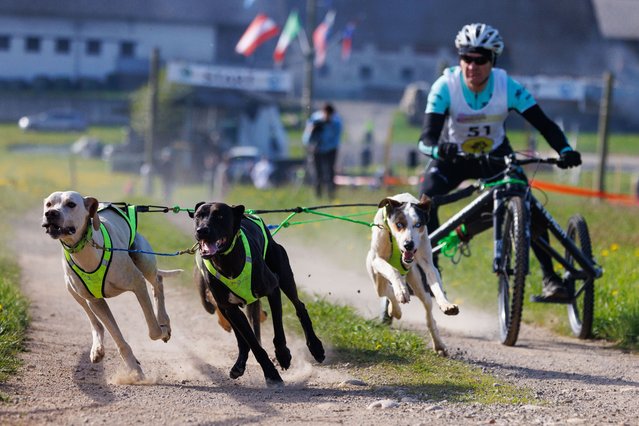
A competitor in the carting category of the Henrik Sečnik dog mushing race in Hraše, Slovenia on April 8, 2024. Over 100 dogs and their owners from Slovenia and abroad competed in the 10th edition of this international race. (Photo by Luka Dakskobler/SOPA Images/Rex Features/Shutterstock)

A competitor in the carting category of the Henrik Sečnik dog mushing race in Hraše, Slovenia on April 8, 2024. Over 100 dogs and their owners from Slovenia and abroad competed in the 10th edition of this international race. (Photo by Luka Dakskobler/SOPA Images/Rex Features/Shutterstock)
Details
16 Aug 2025 03:22:00
A farmer harvests broccoli in the town of al-Ansariyeh south of Sidon, Lebanon March 15, 2016. (Photo by Ali Hashisho/Reuters)

A farmer harvests broccoli in the town of al-Ansariyeh south of Sidon, Lebanon March 15, 2016. (Photo by Ali Hashisho/Reuters)
Details
04 Apr 2016 11:11:00
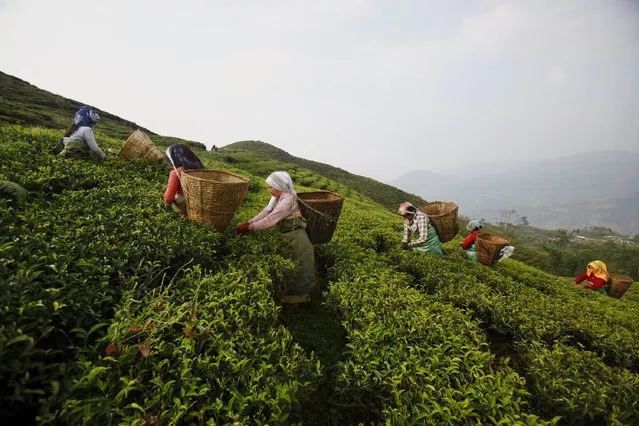
In this Sunday, November 16, 2014 photo, Nepalese women pick tea at a tea garden of Kanyam in Illam district, around 500 kilometers (310 miles) from Katmandu, Nepal. Illam is a hilly district of tea gardens and estates in eastern Nepal's Himalayan region with one of its largest and most productive tea estate being Kanyam estates. (Photo by Niranjan Shrestha/AP Photo)

In this Sunday, November 16, 2014 photo, Nepalese women pick tea at a tea garden of Kanyam in Illam district, around 500 kilometers (310 miles) from Katmandu, Nepal. Illam is a hilly district of tea gardens and estates in eastern Nepal's Himalayan region with one of its largest and most productive tea estate being Kanyam estates. The district produces orthodox tea, hand-processed or machine rolled, which is generally exported to international markets, specially Europe and the United States. Most of the tea pickers here are paid 186 Nepalese Rupees (US $ 2) for 8 hours of work everyday. (Photo by Niranjan Shrestha/AP Photo)
Details
19 Nov 2014 14:28:00
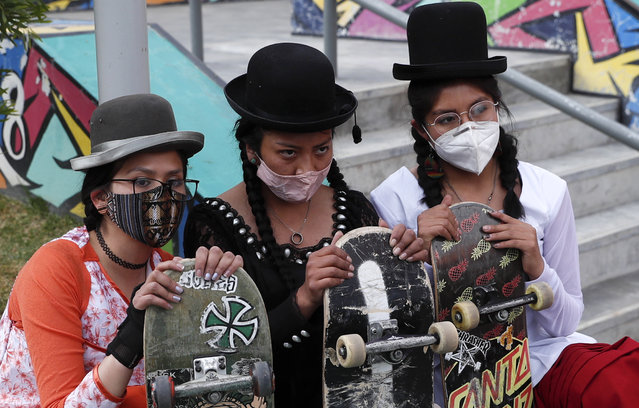
Yanira Villarreal, left, Ayde Choque, center, and Milenda Limachi, wearings masks amid the COVID-19 pandemic and dressed as a “Cholita” pose for a photo with their skateboards during a youth talent show in La Paz, Bolivia, Wednesday, September 30, 2020. Young women called “Skates Imillas”, using the Aymara word for girl Imilla, use traditional Indigenous clothing as a statement of pride of their Indigenous culture while playing riding their skateboards. (Photo by Juan Karita/AP Photo)

Yanira Villarreal, left, Ayde Choque, center, and Milenda Limachi, wearings masks amid the COVID-19 pandemic and dressed as a “Cholita” pose for a photo with their skateboards during a youth talent show in La Paz, Bolivia, Wednesday, September 30, 2020. Young women called “Skates Imillas”, using the Aymara word for girl Imilla, use traditional Indigenous clothing as a statement of pride of their Indigenous culture while playing riding their skateboards. (Photo by Juan Karita/AP Photo)
Details
02 Oct 2020 00:07:00