Loading...
Done
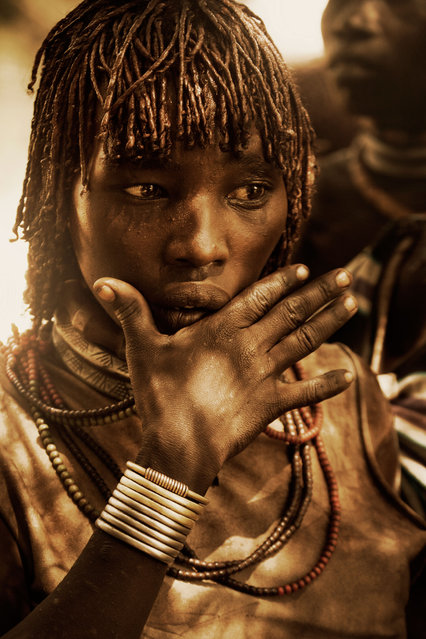
The Hamar people traditionally use red ocher clay to braid the hair of their women. (Photo by Diego Arroyo)

During his time in Ethiopia, New York-based art director and photographer Diego Arroyo spent time with the Hamar, Mursi, Dassanech, and Arbore Tribes. They, along with several others tribes, make up the 200,000 people situated in Africa’s Great Rift Valley. The people of the Omo Valley are still primarily herders and farmers, living an isolated and simple life. While they have yet to be truly touched by globalization, they could soon disappear. Their way of life is being threatened by a massive hydroelectric dam. (Photo by Diego Arroyo)
Details
13 Aug 2014 10:00:00
Participants wait backstage during the Miss Wheelchair India beauty pageant in Mumbai November 26, 2014. (Photo by Danish Siddiqui/Reuters)

Participants wait backstage during the Miss Wheelchair India beauty pageant in Mumbai November 26, 2014. Seven women from across India participated in the country's second wheelchair beauty pageant, which aims to open doors for the wheelchair-bound in modelling, film and television, according to organisers. (Photo by Danish Siddiqui/Reuters)
Details
28 Nov 2014 12:11:00
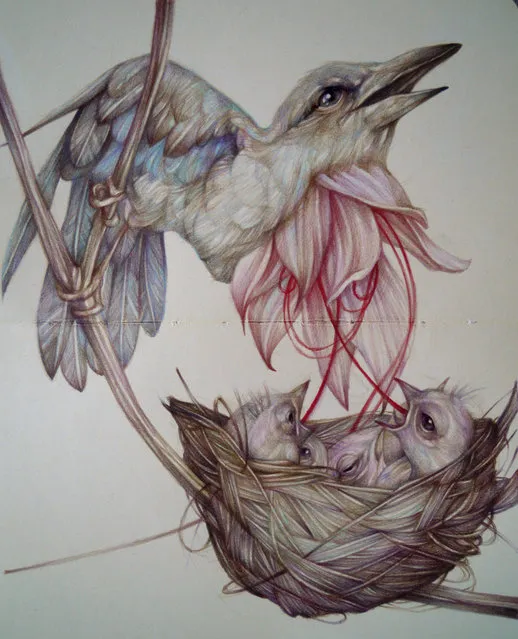
Surrealistic Animal By Marco Mazzoni

Italian pencil artist Marco Mazzoni‘s work goes far beyond technical perfection. His representation of historical healing women is enigmatic and sublime. Often leaving the eyes blank or covered with an abundance of birds, butterflies and flowers, he gives the impression of a deeper inward focused sight, as well as obscuring the identity of the individual. Many female healers in the past – both medicine woman and midwives – were brutally persecuted by religion, some even burnt as witches… Mazzoni’s work captures their deep connection with nature and their innate power and femininity with delicacy and beautiful detail.
Details
01 Apr 2015 07:43:00
Ethiopian Airlines female pilots prepare the plane before takeoff at Bole international airport in the capital Addis Ababa, November 19, 2015. (Photo by Tiksa Negeri/Reuters)

Ethiopian Airlines female pilots prepare the plane before takeoff at Bole international airport in the capital Addis Ababa, November 19, 2015. Ethiopia Airlines on Thursday, dispatched its first ever all-female operated flight. Every aspect of the journey was handled by women, from the ground crew, aircraft maintenance to traffic controllers. Gualu and her co-pilot were charged with flying the crew and passengers to Bangkok, Thailand. (Photo by Tiksa Negeri/Reuters)
Details
21 Nov 2015 08:00:00
Huangguoshu Waterfall

“Huangguoshu Waterfall, also known as Yellow Fruit Tree Waterfall, is one of the largest waterfalls in China and East Asia located on the Baihe River in Anshun, Guizhou Province. It is 77.8 m (255 ft) high and 101 m (331 ft) wide. The main waterfall is 67 m (220 ft) high and 83.3 m (273 ft) wide”. – Wikipedia

Photo: The Miao ethnic minority women rest in front of Huangguoshu Cataract, Asia's largest waterfall, on September 13, 2011 in Anshun city of Guizhou Province, China. (Photo by Feng Li/Getty Images)
Details
14 Sep 2011 12:11:00
Dancers  by artist Fernando Botero

“Fernando Botero Angulo (born April 19, 1932) is a Colombian figurative artist. His works feature a figurative style, called by some “Boterismo”, which gives them an unmistakable identity. Botero depicts women, men, daily life, historical events and characters, milestones of art, still-life, animals and the natural world in general, with exaggerated and disproportionate volumetry, accompanied by fine details of scathing criticism, irony, humor, and ingenuity”. – Wikipedia

Photo: The Duke and Duchess of Devonshire view “Dancers” by artist Fernando Botero in the gardens of their home Chatsworth House on September 10, 2009, Chatsworth, England. (Photo by Christopher Furlong/Getty Images)
Details
29 Nov 2011 10:02:00
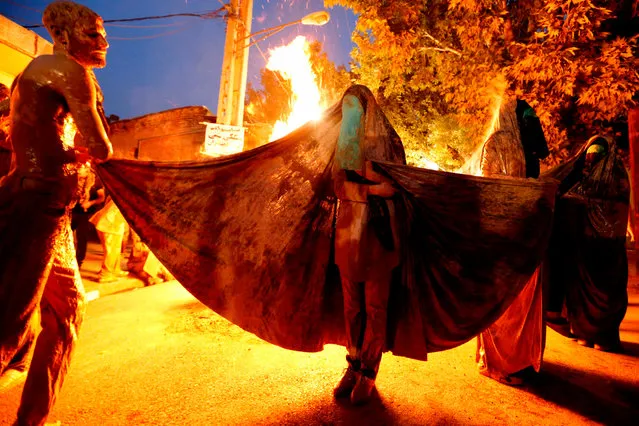
Iranian Shiite Muslim women gather around a bonfire after rubbing mud on their body during the “Kharrah Mali” (Mud Rubbing) ritual to mark the Ashura religious ceremony in the city of Khorramabad, some 470 kms southwest of Tehran, early in the morning on October 1, 2017. “Khrreh Mali” or “Mud Rubbing” is a ritual that is held in the city of Khorramabad every year to commemorate the seventh century slaying of Prophet Mohammed' s grandson Imam Hussein, in which Iranian men roll over in mud and dry themselves by gathering around the bonfires before flagellating themselves. (Photo by Atta Kenare/AFP Photo)

Iranian Shiite Muslim women gather around a bonfire after rubbing mud on their body during the “Kharrah Mali” (Mud Rubbing) ritual to mark the Ashura religious ceremony in the city of Khorramabad, some 470 kms southwest of Tehran, early in the morning on October 1, 2017. “Khrreh Mali” or “Mud Rubbing” is a ritual that is held in the city of Khorramabad every year to commemorate the seventh century slaying of Prophet Mohammed' s grandson Imam Hussein, in which Iranian men roll over in mud and dry themselves by gathering around the bonfires before flagellating themselves. (Photo by Atta Kenare/AFP Photo)
Details
02 Oct 2017 08:38:00
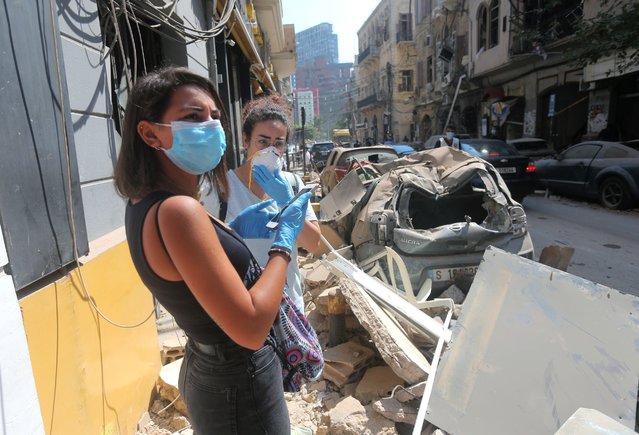
Young Lebanese women wearing protective masks and gloves against the coronavirus pandemic, stand on August 5, 2020 amid the rubble in Beirut's Gimmayzeh commercial district which was heavily damaged by the previous day's powerful explosion that tore through Lebanon's capital, resulting from the ignition of a huge depot of ammonium nitrate at the city's main port. Rescuers searched for survivors in Beirut after a cataclysmic explosion at the port sowed devastation across entire neighbourhoods, killing more than 100 people, wounding thousands and plunging Lebanon deeper into crisis. The blast, which appeared to have been caused by a fire igniting 2,750 tonnes of ammonium nitrate left unsecured in a warehouse, was felt as far away as Cyprus, some 150 miles (240 kilometres) to the northwest. (Photo by AFP Photo/Stringer)

Young Lebanese women wearing protective masks and gloves against the coronavirus pandemic, stand on August 5, 2020 amid the rubble in Beirut's Gimmayzeh commercial district which was heavily damaged by the previous day's powerful explosion that tore through Lebanon's capital, resulting from the ignition of a huge depot of ammonium nitrate at the city's main port. Rescuers searched for survivors in Beirut after a cataclysmic explosion at the port sowed devastation across entire neighbourhoods, killing more than 100 people, wounding thousands and plunging Lebanon deeper into crisis. The blast, which appeared to have been caused by a fire igniting 2,750 tonnes of ammonium nitrate left unsecured in a warehouse, was felt as far away as Cyprus, some 150 miles (240 kilometres) to the northwest. (Photo by AFP Photo/Stringer)
Details
10 Aug 2020 00:05:00