Loading...
Done
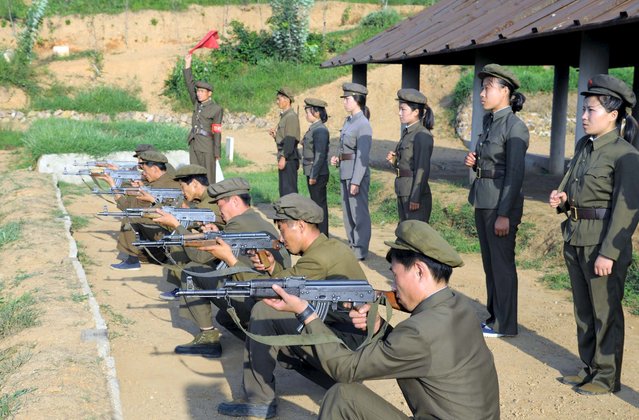
North Koreans who signed up to join the army train in the midst of political tension with South Korea, in this undated photo released by North Korea's Korean Central News Agency (KCNA) in Pyongyang August 23, 2015. (Photo by Reuters/KCNA)

North Koreans who signed up to join the army train in the midst of political tension with South Korea, in this undated photo released by North Korea's Korean Central News Agency (KCNA) in Pyongyang August 23, 2015. Top aides to the leaders of North and South Korea resumed talks on Sunday after negotiating through the night in a bid to ease tensions involving an exchange of artillery fire that brought the peninsula to the brink of armed conflict. (Photo by Reuters/KCNA)
Details
25 Aug 2015 10:08:00
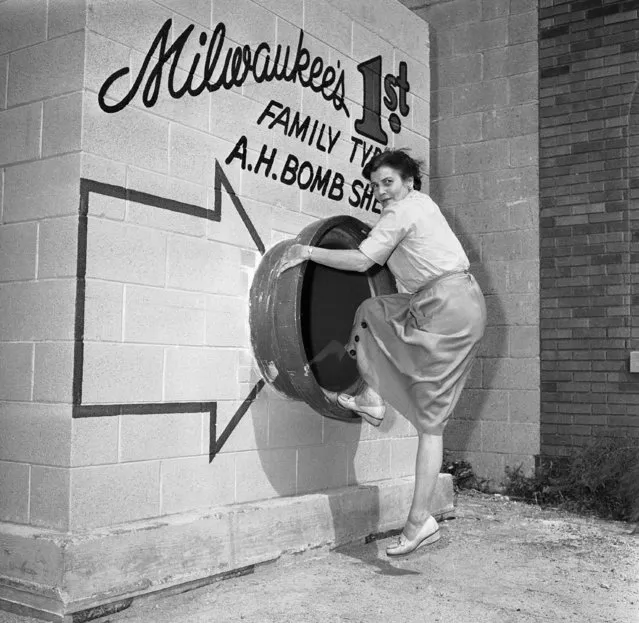
Mrs. Marie Graskamp of Milwaukee shows the different positions one might assume when entering the bomb shelter in Milwaukee  September 3, 1958. This circular entrance is about three feet in diameter. This is the entrance (according to the builders) that would connect to the cellar of a home assuming the shelter was in the ground for added protection. (Photo by AP Photo)

Mrs. Marie Graskamp of Milwaukee shows the different positions one might assume when entering the bomb shelter in Milwaukee September 3, 1958. This circular entrance is about three feet in diameter. This is the entrance (according to the builders) that would connect to the cellar of a home assuming the shelter was in the ground for added protection. If a bombing should occur, all members of family would proceed to the cellar and then through the circular port into the shelter. (Photo by AP Photo)
Details
04 Sep 2015 12:44:00
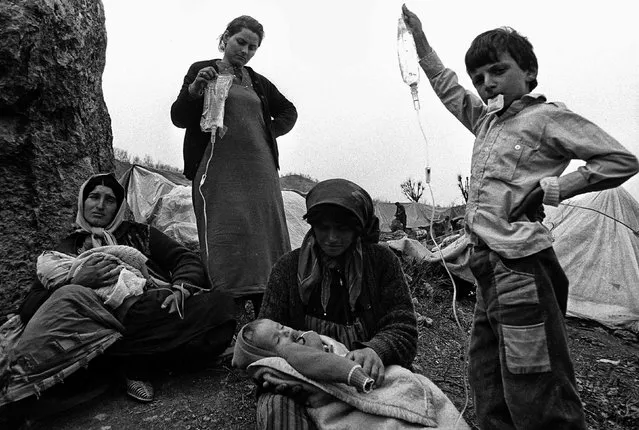
Iraqi Kurdish refugees wait with children in Cukurca refugee camp in Turkey April 8, 1991. Reuters photographers have chronicled Kurdish refugee crises over the years. In 1991 Srdjan Zivulovic documented refugees in Cukurca who had escaped a military operation by Saddam Hussein's government in Iraq aimed at “Arabising” Kurdish areas in the north. (Photo by Srdjan Zivulovic/Reuters)

Iraqi Kurdish refugees wait with children in Cukurca refugee camp in Turkey April 8, 1991. Reuters photographers have chronicled Kurdish refugee crises over the years. In 1991 Srdjan Zivulovic documented refugees in Cukurca who had escaped a military operation by Saddam Hussein's government in Iraq aimed at “Arabising” Kurdish areas in the north. Hundreds of thousands fled into Turkey and Iran. Images shot in recent months show familiar scenes as crowds of people flee Islamic State militants in Syria. There are as many as 30 million Kurds, spread through Turkey, Iraq, Syria and Iran. Most Kurds are Sunni Muslims, but tend to feel more loyalty to their Kurdishness, rather than their religion. (Photo by Srdjan Zivulovic/Reuters)
Details
14 Nov 2014 14:09:00
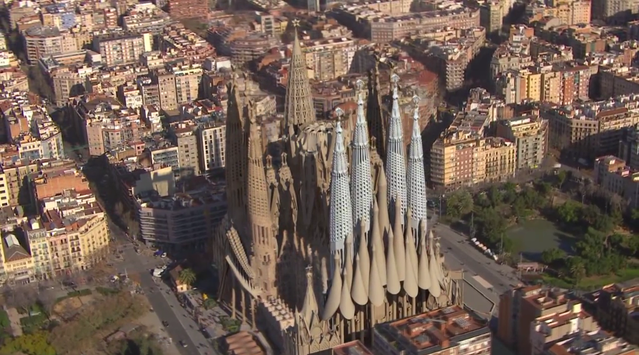
We Build Tomorrow – Sagrada Familia 2026 ( VIDEO )

For more than a century, the Barcelona skyline has been graced (or marred, depending on who’s talking) by the spectacle of the Basilica designed by Anton Gaudi, first started in 1882. If you want to know what it’ll look like when finished, don’t fret — 2026 is right around the corner. Or you can watch this video, released last week on YouTube by Basílica de la Sagrada Família and titled simply “2026 We Build Tomorrow,” a 3-D artists’ rendering of the building stages through completion.
(If 144 years sounds like a long time to finish a cathedral, keep in mind that there were decades that they didn’t work on it — and that Notre Dame de Paris took 182 years, although the 13th century Parisians didn’t have diesel-powered industrial cranes.) Now, if only the video could show us what the admission and hours will be in 2026 (and how to avoid the inevitable long lines).
Details
11 Jan 2014 10:59:00
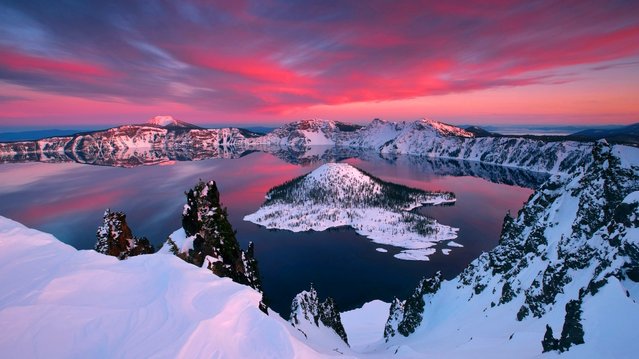
Crater Lake In Oregon

As you look at the majestic Crater Lake, located in south-central Oregon, United States, it is hard to imagine that thousands of years ago this place was one giant crater with scorching hot lava spilling over the sides. Those were the times of turmoil. Now, however, this place is the essence of tranquility. The lake that was formed, after the volcano died down, is amazingly clear due to the fact that the water isn’t moving at all. No rivers go in or out of the Crater Lake, and the water lost through evaporation is compensated by the rain and snowfall. This lake is also frighteningly deep – 1,943 feet (592 m) at its deepest point – making it the deepest lake in the United States. If you love nature and if you ever come to Oregon, this is truly a sight to behold.
Details
19 Nov 2014 14:14:00
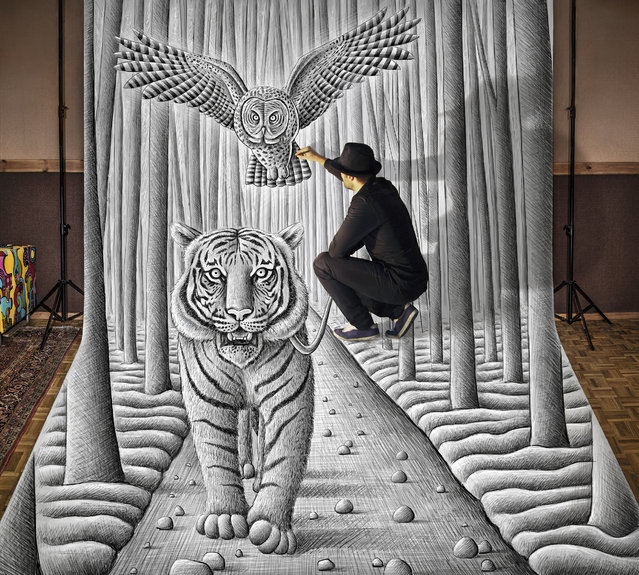
Visual artist Ben Heine at work in his studio while he creates one of his “anamorphic illusions” in Rochefort, Belgium

An arm holding a giant gun appears to explode through a wall, while elsewhere a man walks a tiger on a leash. These breathtaking pencil drawings are the work of 31-year-old artist Ben Heine, who lives and works in Rochefort, Belgium. The “anamorphic illusions”, part of the artist's “Pencil Vs Camera” series, appear slightly distorted unless viewed from the exact same perspective in which they were created. Photo: Visual artist Ben Heine at work in his studio while he creates one of his “anamorphic illusions” in Rochefort, Belgium. (Photo by Ben Heine/Barcroft Media)
Details
23 Mar 2014 11:00:00
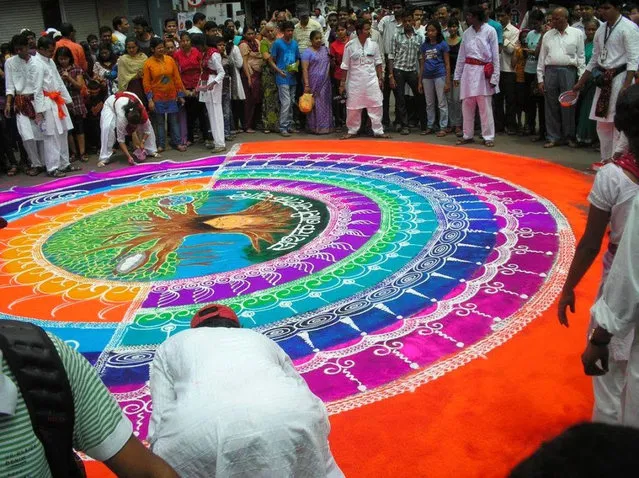
Rangoli Folk Art From India

Rangoli, also known as kolam or Muggu, is a folk art from India in which patterns are created on the floor in living rooms or courtyards using materials such as colored rice, dry flour, colored sand or flower petals. It is usually made during Diwali, Onam, Pongal and other Indian festivals. They are meant to be sacred welcoming areas for the Hindu deities. The ancient symbols have been passed down through the ages, from each generation to the next, keeping both the art form and the tradition alive. Similar practices are followed in different Indian states: in Tamil Nadu, there is Kolam in Tamil Nadu; Mandana in Rajasthan; Chaookpurna in Chhattisgarh; Alpana in West Bengal; Aripana in Bihar; Chowk pujan in Uttar Pradesh; Muggu in Andhra Pradesh and others.
Details
16 Jun 2014 10:37:00
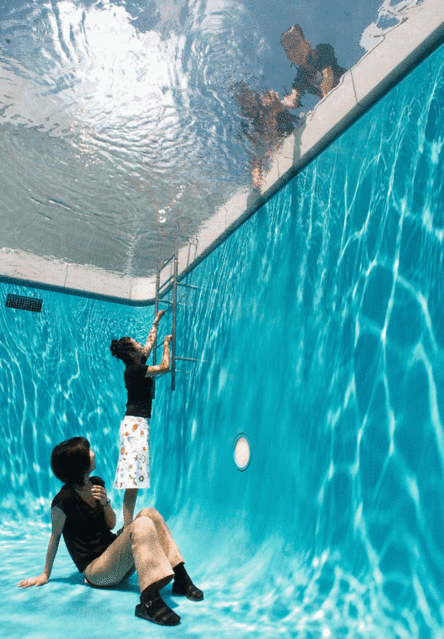
Swimming Pool Art Installation by Leandro Erlich

In one of the Museum’s courtyards is a swimming pool framed by a limestone deck. When seen from the deck, the pool appears to be filled with deep, shimmering water. In fact, however, a layer of water only some 10 centimeters deep is suspended over transparent glass. Below the glass is an empty space with aquamarine walls that viewers can enter. The work sets up an unfolding sequence of experiences—we view the pool through the glass wall enclosing the courtyard; from the deck, looking down into the pool; and from the interior of the pool, looking up. The Swimming Pool might hence be considered a place where, slowly, with time, different perspectives and perceptions of self and others all come to intersect.
Details
25 Aug 2012 07:31:00