Loading...
Done
U.S. Marines, left, and South Korean Marines, wearing blue headbands on their helmets, take positions after landing on the beach during the joint military combined amphibious exercise, called Ssangyong, part of the Key Resolve and Foal Eagle military exercises, in Pohang, South Korea, Saturday, March 12, 2016. North Korea said Saturday its military is ready to pre-emptively attack and “liberate” the South in its latest outburst against the annual joint military drills by the United States and South Korea. (Photo by Kim Jun-bum/Yonhap via AP Photo)

U.S. Marines, left, and South Korean Marines, wearing blue headbands on their helmets, take positions after landing on the beach during the joint military combined amphibious exercise, called Ssangyong, part of the Key Resolve and Foal Eagle military exercises, in Pohang, South Korea, Saturday, March 12, 2016. North Korea said Saturday its military is ready to pre-emptively attack and “liberate” the South in its latest outburst against the annual joint military drills by the United States and South Korea. (Photo by Kim Jun-bum/Yonhap via AP Photo)
Details
12 Mar 2016 15:17:00
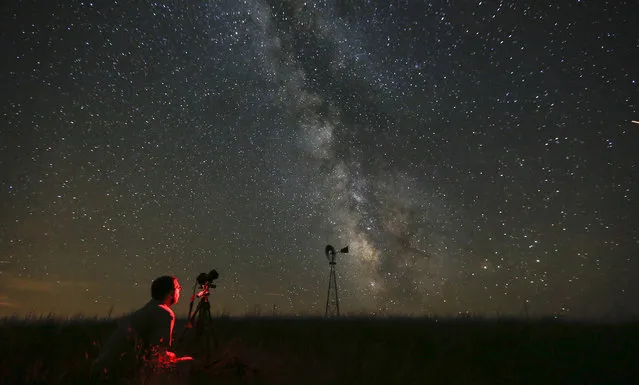
In this Wednesday, July 23, 2014 file photo, Omaha photographer Lane Hickenbottom photographs the night sky in a pasture near Callaway, Neb. With no moon in the sky, the Milky Way was visible to the naked eye. More than one-third of the world’s population can no longer see the Milky Way because of man-made lights, according to a scientific paper by Light Pollution Science and Technology Institute's Fabio Falchi and his team members, published on Friday, June 10, 2016. (Photo by Travis Heying/The Wichita Eagle via AP Photo)

In this Wednesday, July 23, 2014 file photo, Omaha photographer Lane Hickenbottom photographs the night sky in a pasture near Callaway, Neb. With no moon in the sky, the Milky Way was visible to the naked eye. More than one-third of the world’s population can no longer see the Milky Way because of man-made lights, according to a scientific paper by Light Pollution Science and Technology Institute's Fabio Falchi and his team members, published on Friday, June 10, 2016. (Photo by Travis Heying/The Wichita Eagle via AP Photo)
Details
11 Jun 2016 12:37:00
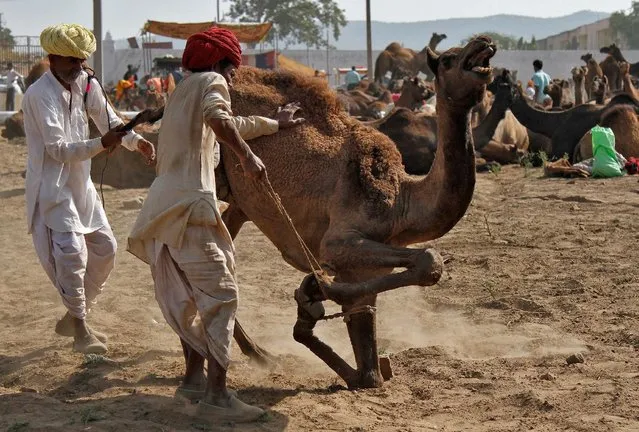
Traders try to control a camel at Pushkar Fair where animals, mainly camels, are brought to be sold and traded in the desert Indian state of Rajasthan November 6, 2016. (Photo by Himanshu Sharma/Reuters)

Traders try to control a camel at Pushkar Fair where animals, mainly camels, are brought to be sold and traded in the desert Indian state of Rajasthan November 6, 2016. (Photo by Himanshu Sharma/Reuters)
Details
07 Nov 2016 12:04:00
An Indian woman dressed as Hindu Goddess Kali participates in a “Shivratri” procession in Allahabad, India, Thursday, Feb. 27, 2014. “Shivaratri”, or the night of Shiva, is dedicated to the worship of Lord Shiva, the Hindu god of death and destruction. (Photo by Rajesh Kumar SinghAP Photo)

An Indian woman dressed as Hindu Goddess Kali participates in a “Shivratri” procession in Allahabad, India, Thursday, Feb. 27, 2014. “Shivaratri”, or the night of Shiva, is dedicated to the worship of Lord Shiva, the Hindu god of death and destruction. (Photo by Rajesh Kumar SinghAP Photo)
Details
01 Mar 2014 12:58:00
Visitors run away as waves caused by a tidal bore surge past a barrier on the banks of Qiantang River, in Hangzhou, Zhejiang province August 13, 2014. (Photo by Reuters/Stringer)

Visitors run away as waves caused by a tidal bore surge past a barrier on the banks of Qiantang River, in Hangzhou, Zhejiang province August 13, 2014. (Photo by Reuters/Stringer)
Details
16 Aug 2014 10:46:00
Visitors look on as a man (front) inserts two live snakes through his nose and mouth during a performance at an amusement park to celebrate the 65th anniversary of the founding of the People's Republic of China and the 7-day national day holiday, in Jinhua, Zhejiang province October 1, 2014. (Photo by Reuters/Stringer)

Visitors look on as a man (front) inserts two live snakes through his nose and mouth during a performance at an amusement park to celebrate the 65th anniversary of the founding of the People's Republic of China and the 7-day national day holiday, in Jinhua, Zhejiang province October 1, 2014. (Photo by Reuters/Stringer)
Details
04 Oct 2014 11:22:00
Workers from the South Florida Science Center and Aquarium and Imagine Exhibitions put together an animatronic spinosaurus outside the science center in West Palm Beach, Fla., Tuesday, October 27, 2015. The giant spinosaurus is part of the Dinosaurs Around the World exhibit, set to open on Nov. 1. (Photo by Maria Lorenzino/South Florida Sun-Sentinel via AP Photo)

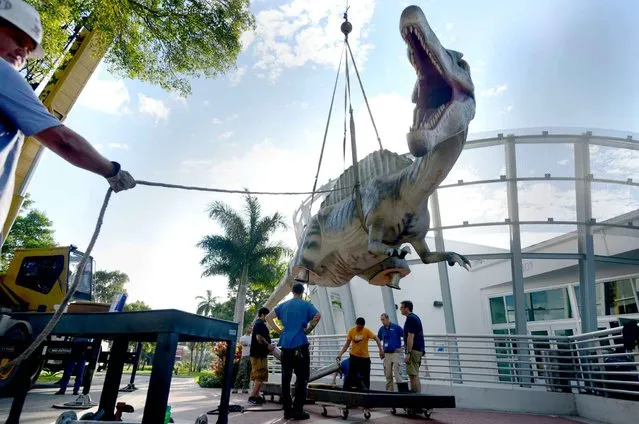
Workers from the South Florida Science Center and Aquarium and Imagine Exhibitions put together an animatronic spinosaurus outside the science center in West Palm Beach, Fla., Tuesday, October 27, 2015. The giant spinosaurus is part of the Dinosaurs Around the World exhibit, set to open on November 1. (Photo by Maria Lorenzino/South Florida Sun-Sentinel via AP Photo)
Details
29 Oct 2015 08:07:00
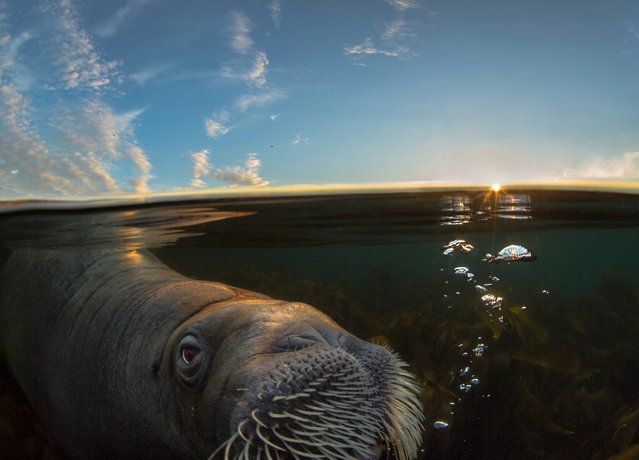
The Wildscreen festival is the world’s biggest celebration of screen-based natural history storytelling which takes place every two years in Bristol. Here: “Walrus in Midnight Sun”. Walrus feed mostly on bivalves in productive, shallow and often sandy habitats in the Arctic. This individual, though, arrived on a beach outside Tromsø, northern Norway, and found comfort on a stranded dead sperm whale. After two weeks he approached Audun, and only half a metre away he stretched his tusk forward and touched his hand gently. “This was one of the most memorable moments of my life”, Rikardsen says. He named the 500kg male Buddy. After two months, the dead whale was decomposed and Buddy suddenly disappeared. (Photo by Audun Rikardsen/Wildscreen 2016)

The Wildscreen festival is the world’s biggest celebration of screen-based natural history storytelling which takes place every two years in Bristol. Here: “Walrus in Midnight Sun”. Walrus feed mostly on bivalves in productive, shallow and often sandy habitats in the Arctic. This individual, though, arrived on a beach outside Tromsø, northern Norway, and found comfort on a stranded dead sperm whale. After two weeks he approached Audun, and only half a metre away he stretched his tusk forward and touched his hand gently. “This was one of the most memorable moments of my life”, Rikardsen says. He named the 500kg male Buddy. After two months, the dead whale was decomposed and Buddy suddenly disappeared. (Photo by Audun Rikardsen/Wildscreen 2016)
Details
07 Oct 2016 10:02:00