Loading...
Done
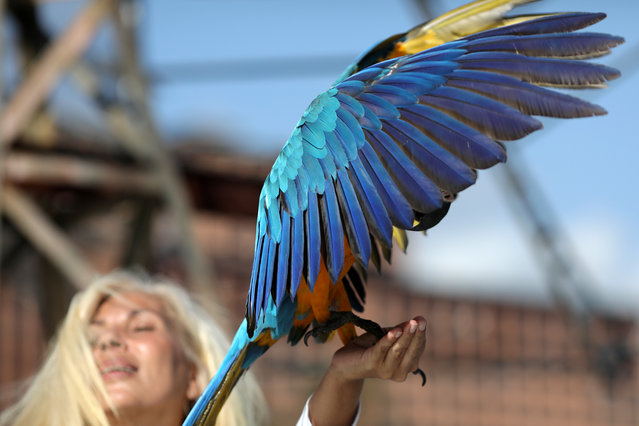
A macaw lands in Carmen Borges' hand while she stays at a rooftop of a building in Caracas, Venezuela, June 12, 2019. (Photo by Manaure Quintero/Reuters)

Looking for an escape from the daily realities of crisis-ridden Venezuela, Carmen Gomez finds solace receiving visitors on the roof of her Caracas apartment building every morning: groups of blue and gold macaws that arrive at daybreak. Here: A macaw lands in Carmen Borges' hand while she stays at a rooftop of a building in Caracas, Venezuela, June 12, 2019. (Photo by Manaure Quintero/Reuters)
Details
24 Jul 2019 00:03:00
“Lofoten Glow”. I was desperately searching a good sunrise spot this particular morning. Normally Storvatnet Lake is completely covered in snow, so you can only imagine my surprise when I saw these crazy ice formations almost being shot out of the frozen lake. I put my crampons on and took a big risk walking out. Photo location: Storvatnet, Lofoten Islands in Northern Norway. (Photo and caption by Stian Klo/National Geographic Photo Contest)

“Lofoten Glow”. I was desperately searching a good sunrise spot this particular morning. Normally Storvatnet Lake is completely covered in snow, so you can only imagine my surprise when I saw these crazy ice formations almost being shot out of the frozen lake. I put my crampons on and took a big risk walking out. I could hear the ice cracking underneath my feet, and when you’re all alone in a fjord/canyon like this – the cracks are echoed and sound really frightening. Was it worth it? I sure think so! Photo location: Storvatnet, Lofoten Islands in Northern Norway. (Photo and caption by Stian Klo/National Geographic Photo Contest)
Details
08 Apr 2014 09:40:00
In this Tuesday, September 12, 2017 photo, Amornrat Simapsaisan, a local shop manager, watches before she ate watermelon salad with bamboo worms, at Inspects in the Backyard restaurant, Bangkok, Thailand. Tucking into insects is nothing new in Thailand, where street vendors pushing carts of fried crickets and buttery silkworms have long fed locals and adventurous tourists alike. But bugs are now fine-dining at the Bangkok bistro aiming to revolutionize views of nature’s least-loved creatures and what you can do with them. She tucked in quite happily to her watermelon and cricket salad on a recent evening.  “It’s tasty. It’s munchy”, she said. (Photo by Sakchai Lalit/AP Photo)

In this Tuesday, September 12, 2017 photo, Amornrat Simapsaisan, a local shop manager, watches before she ate watermelon salad with bamboo worms, at Inspects in the Backyard restaurant, Bangkok, Thailand. Tucking into insects is nothing new in Thailand, where street vendors pushing carts of fried crickets and buttery silkworms have long fed locals and adventurous tourists alike. But bugs are now fine-dining at the Bangkok bistro aiming to revolutionize views of nature’s least-loved creatures and what you can do with them. She tucked in quite happily to her watermelon and cricket salad on a recent evening. “It’s tasty. It’s munchy”, she said. (Photo by Sakchai Lalit/AP Photo)
Details
04 Oct 2017 06:54:00
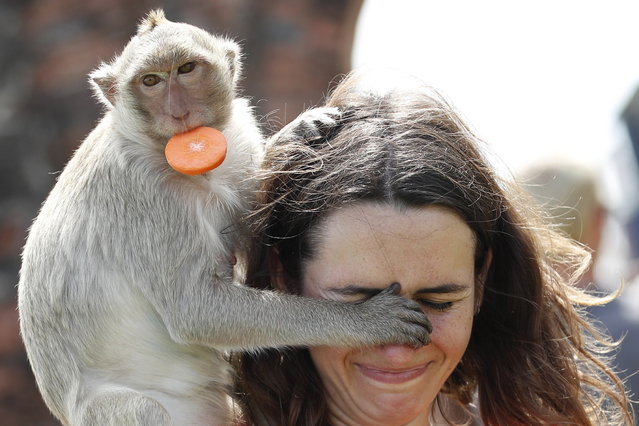
A monkey is being fed by a foreign tourist during the annual Monkey Banquet at Phra Prang Sam Yod ancient temple in Lopburi, some 180km from Bangkok, central Thailand, 24 November 2024. The annual gala has been organized since 1989 by Lopburi's entrepreneur Yongyuth Kitwatananusont, offering all-you-can-eat fruits, vegetables, and desserts for monkeys to honor the long-tailed macaques to attract tourists to visit the town to promote tourism. According to the Wildlife Department, more than 2,000 urban monkeys were captured in 2024 by authorities to control the monkey population after the growing complaints of residents that the macaques maraud food, frequently confront residents, causing accidents as well as their properties, assets, and the ancient city to be overrun and damaged by the monkeys. (Photo by Rungroj Yongrit/EPA)

A monkey is being fed by a foreign tourist during the annual Monkey Banquet at Phra Prang Sam Yod ancient temple in Lopburi, some 180km from Bangkok, central Thailand, 24 November 2024. The annual gala has been organized since 1989 by Lopburi's entrepreneur Yongyuth Kitwatananusont, offering all-you-can-eat fruits, vegetables, and desserts for monkeys to honor the long-tailed macaques to attract tourists to visit the town to promote tourism. (Photo by Rungroj Yongrit/EPA)
Details
08 Dec 2024 04:22:00
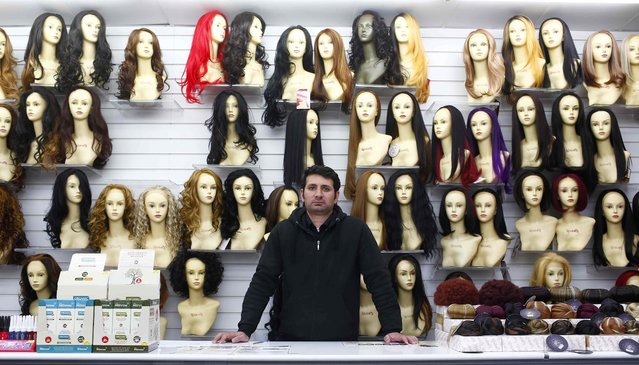
Kashir Mir, 34, poses for a photograph at his workplace, Juliet Wig Shop, in the London constituency of Brent Central, Britain, April 13, 2015. Mir, who was born in Pakistan, said: “I will vote but it's a secret. I also hope they can manage immigration better as I have been stopped and interviewed for hours returning from Pakistan. I'm an honest man, working here and paying my tax”. (Photo by Eddie Keogh/Reuters)

Kashir Mir, 34, poses for a photograph at his workplace, Juliet Wig Shop, in the London constituency of Brent Central, Britain, April 13, 2015. Mir, who was born in Pakistan, said: “I will vote but it's a secret. I also hope they can manage immigration better as I have been stopped and interviewed for hours returning from Pakistan. I'm an honest man, working here and paying my tax”. Brent, a northwest London neighbourhood that's home to Wembley football stadium, is among the most ethnically diverse areas in the United Kingdom. As the country approaches a closely fought election on May 7, Reuters photographer Eddie Keogh visited shopkeepers to get their views on the poll. (Photo by Eddie Keogh/Reuters)
Details
29 Apr 2015 06:30:00
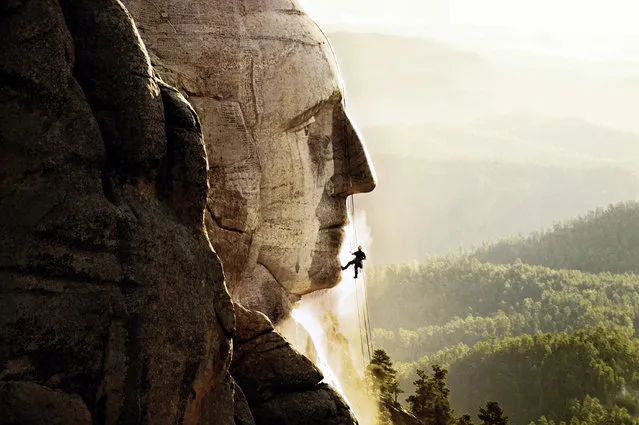
Thorsten Mowes has a more intimate knowledge of the worlds most famous monuments than perhaps anyone else on the planet – because hes spent his entire career cleaning them. As a cultural cleaning expert with nearly 25 years experience, he has been commissioned to make wonders all over the world shine like new - from the London Eye to Christ the Redeemer. The places he has been to, stood on top of, or even hung halfway down include Mount Rushmore and the Space Needle in America, the London Eye, the Statue of Christ in Brazil and the Forbidden City in China. Here: A man cleans a part of Mount Rushmore. (Photo by Caters News Agency)

Thorsten Mowes has a more intimate knowledge of the worlds most famous monuments than perhaps anyone else on the planet – because hes spent his entire career cleaning them. As a cultural cleaning expert with nearly 25 years experience, he has been commissioned to make wonders all over the world shine like new – from the London Eye to Christ the Redeemer. The places he has been to, stood on top of, or even hung halfway down include Mount Rushmore and the Space Needle in America, the London Eye, the Statue of Christ in Brazil and the Forbidden City in China. Here: A man cleans a part of Mount Rushmore. (Photo by Caters News Agency)
Details
29 Jul 2016 12:24:00
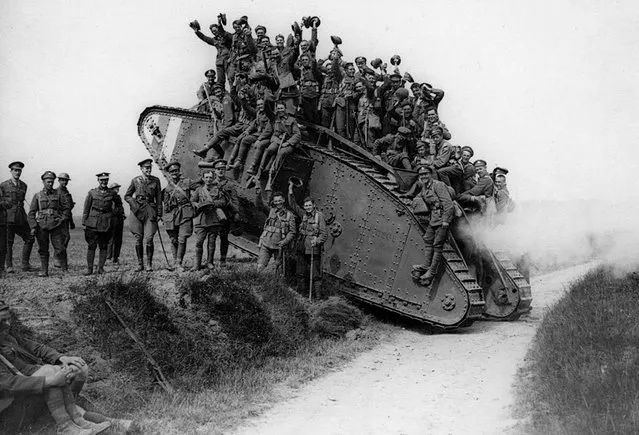
These black-and-white photos are taken from the new book “Armoured Warfare in the First World War 1916 – 1918” by Anthony Tucker-Jones and published by Pen & Sword Military. “Interestingly the British, French and Germans took completely different approaches with varying results”. The British military produced “Little Willie” in Autumn 1915 weighing 18 tonnes, which had a crew of two plus four gunners. “Inspired by a tracked artillery tractor “Little Willie” was referred to as a water tank – hence the name tank – to ensure secrecy”, said Anthony. “This led to the strange looking Mark I with its peculiar rhomboid shape, designed to cross trenches with guns in sponsons on either side. The Germans saw the tank as unchivalrous and were slow to grasp its utility. They favoured the Stormtrooper (specialist soldiers used to infiltrate enemy trenches) and artillery, not the tank”, said Anthony. “However, they didn’t hesitate to make use of captured British tanks. Although the tank helped secure victory and German soldiers dubbed it “Germany’s Downfall” the country was ultimately brought to its knees by the Allies blockade”. Here: British troops hitch a ride on a Mark IV after the massed tank fleet spearheading attack at Cambrai on November 20, 1917. (Photo by Anthony Tucker-Jones/Mediadrumworld.com)

These black-and-white photos are taken from the new book “Armoured Warfare in the First World War 1916 – 1918” by Anthony Tucker-Jones and published by Pen & Sword Military. Here: British troops hitch a ride on a Mark IV after the massed tank fleet spearheading attack at Cambrai on November 20, 1917. (Photo by Anthony Tucker-Jones/Mediadrumworld.com)
Details
23 Feb 2017 00:02:00
The National Geographic Photo Ark is a travelling exhibition of photographer Joel Sartore’s quest to create a photo archive of biodiversity around the world. So far, Sartore has captured studio portraits of more than 6,000 species – a number that he hopes to double. On 1 July, the ark will open at Melbourne zoo – the first time it has been exhibited in the southern hemisphere. More than 50 portraits will be on display, including many of Australian endangered animals being protected by programs at the zoo itself. These captions have been edited from text supplied by Melbourne zoo. Here: Barking owl. So-named because its call sounds like a barking dog, these birds are native to Australia, Indonesia and Papua New Guinea. In Victoria they are listed as an endangered species, and in 2003 there were estimated to be fewer than 50 breeding pairs. The main threat to the species in Victoria is loss of habitat, especially large trees with hollows in which they can nest and on which many of their prey depend. Apart from a bark, they may utter a chilling scream when they feel threatened. (Photo by Joel Sartore/National Geographic Photo Ark/The Guardian)

The National Geographic Photo Ark is a travelling exhibition of photographer Joel Sartore’s quest to create a photo archive of biodiversity around the world. So far, Sartore has captured studio portraits of more than 6,000 species – a number that he hopes to double. On 1 July, the ark will open at Melbourne zoo – the first time it has been exhibited in the southern hemisphere. More than 50 portraits will be on display, including many of Australian endangered animals being protected by programs at the zoo itself. These captions have been edited from text supplied by Melbourne zoo. Here: Barking owl. (Photo by Joel Sartore/National Geographic Photo Ark/The Guardian)
Details
01 Jul 2017 07:45:00