Loading...
Done
The incredible, gravity-defying Konjowoch Troupe. (Photo by Tom Pilston/The Guardian)

Giffords Circus’s show is touring the UK. Established in 2000, Giffords Circus is a small circus company that delivers circus / theatre fusion to the villages and market towns of the south west. It combines dance, comedy, horses and live music in a two-hour show, located on village greens in a small white tent surrounded by handmade burgundy and gold showman’s wagons. Photographer Tom Pilston goes behind the scenes to meet the performers. Here: The incredible, gravity-defying Konjowoch Troupe. (Photo by Tom Pilston/The Guardian)
Details
27 Jun 2016 12:07:00
Acid attack survivors wait in the back stage prior to participate in a fashion show titled “Beauty Redefined” organized by ActionAid Bangladesh in Dhaka, Bangladesh, March 7, 2017. (Photo by Mohammad Ponir Hossain/Reuters)

Acid attack survivors wait in the back stage prior to participate in a fashion show titled “Beauty Redefined” organized by ActionAid Bangladesh in Dhaka, Bangladesh, March 7, 2017. Such horrific violence across South Asia is often prompted by insufficient dowries, rejection of advances or land disputes, disfiguring victims for life and ruining their prospects. (Photo by Mohammad Ponir Hossain/Reuters)
Details
10 Mar 2017 00:01:00
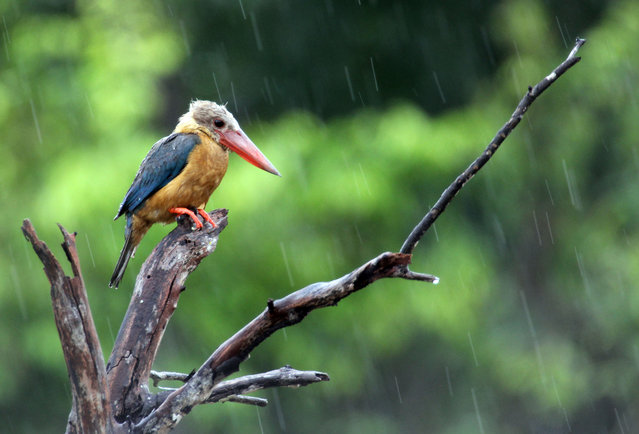
Stork-billed kingfisher during rain in Bintan, Indonesia. The tree species is sparsely distributed in the tropical Indian subcontinent and south-east Asia, from India to Indonesia. (Photo by Sijori Images/Barcroft Images)

A stork-billed kingfisher (Pelargopsis capensis) is seen perched on a tree during monsoon rain on July 25, 2016 in Bintan, Indonesia. The stork-billed kingfisher is a tree species which is widely but sparsely distributed in the tropical Indian subcontinent and Southeast Asia, from India to Indonesia. This kingfisher is resident throughout its range. It is very large, measuring 35 to 38 cm (14 to 15 in) in length. The adult has a green back, blue wings and tail, and grey head. (Photo by Sijori Images/Barcroft Images)
Details
27 May 2017 07:47:00
Caroline de Guitaut, Curator of Royal Collections, holds the Cullinan III and IV Broach and the Cullinan VII Delhi Durbar Necklace and Cullinan Pendant at The Queen's Gallery, Buckingham Palace

“A dazzling exhibition featuring jewelry made with the world’s largest diamond will be part of the celebrations marking the 60th anniversary of Queen Elizabeth II’s reign. The jewelry was made with a 3,106-carat diamond discovered in 1905 at the Cullinan Diamond Mine near Pretoria, the capital of South Africa. The diamond was so large that miners initially thought it was a worthless crystal and almost threw it away”... – Vidya Kauri via News.nationalpost.com

Photo: Caroline de Guitaut, Curator of Royal Collections, holds the Cullinan III and IV Broach and the Cullinan VII Delhi Durbar Necklace and Cullinan Pendant at The Queen's Gallery, Buckingham Palace on May 15, 2012 in London, England. (Photo by Peter Macdiarmid)
Details
17 May 2012 10:59:00


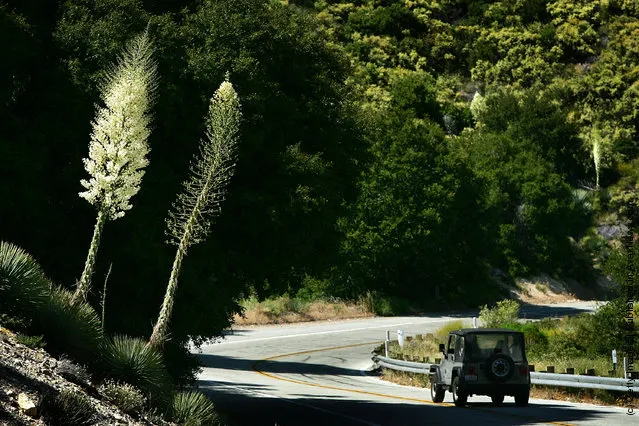
“Yucca is a genus of perennial shrubs and trees in the agave family, Agavaceae. Its 40-50 species are notable for their rosettes of evergreen, tough, sword-shaped leaves and large terminal panicles of white or whitish flowers. They are native to the hot and dry (arid) parts of North America, Central America, South America, and the Caribbean. Early reports of the species were confused with the cassava (Manihot esculenta). Consequently, Linnaeus mistakenly derived the generic name from the Carib word for the latter, yuca. It is also colloquially known in the midwest United States as “Ghosts in the graveyard”, as it is commonly found growing in rural graveyards and when in bloom the flowers appear as an apparition floating.” – Wikipedia

Photo: A yucca standing among flowers bursts forth a very large stalk of flowers as a heavy wildflower bloom on June 21, 2005 in the Angeles National Forest northwest of La Canada, California. (Photo by David McNew/Getty Images)
Details
29 Mar 2011 07:31:00
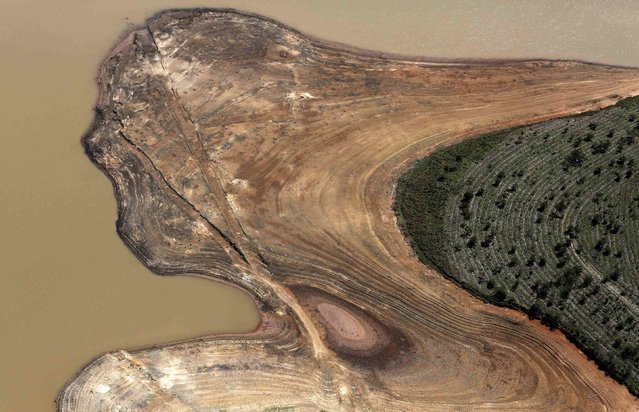
An aerial view of the Atibainha dam, part of the Cantareira reservoir, during a drought in Nazare Paulista, Sao Paulo state November 18, 2014. (Photo by Nacho Doce/Reuters)

An aerial view of the Atibainha dam, part of the Cantareira reservoir, during a drought in Nazare Paulista, Sao Paulo state November 18, 2014. Brazil's worst drought in 80 years has left the Cantareira system, that provides greater Sao Paulo with most of its water, with the lowest water level on record, with daily rationing becoming common in the region's smaller cities, according to the state authorities and the two main reservoirs serving metropolitan Sao Paulo, South America's largest city, could dry out by February if relief does not arrive in the upcoming rainy season. (Photo by Nacho Doce/Reuters)
Details
20 Nov 2014 12:19:00
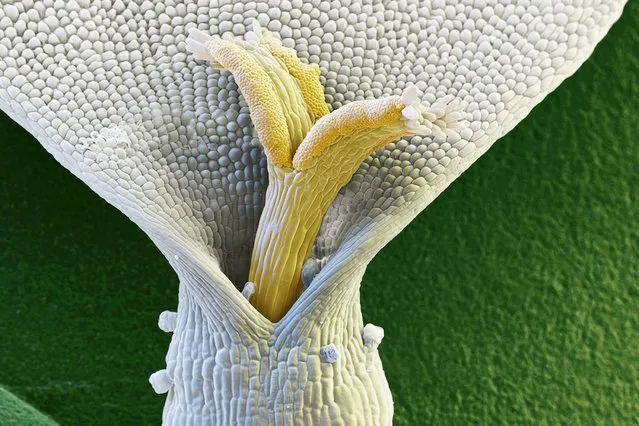
The floret of a Chamomile flower up close and personal. (Photo by Oliver Meckes/Barcroft Media)

These images have been created using a colour scanning electron microscope (SEM) by the award-winning Eye of Science, comprised of snapper Oliver Meckes and biologist Nicole Ottawa. For a decade the pair, based in Reutlingen in the south of Germany, worked with an old SEM they saved from the scrapheap, but for the last five years they have used a £250,000 FEI Quanta Series Field Emission SEM. Oliver said: “Flowers are beautiful in 'normal' view, but when you look closer, some parts get very bizarre and unexpected structures appear – flowers within flowers, worlds within worlds”. Photo: The floret of a Chamomile flower up close and personal. (Photo by Oliver Meckes/Barcroft Media)
Details
26 May 2014 13:51:00
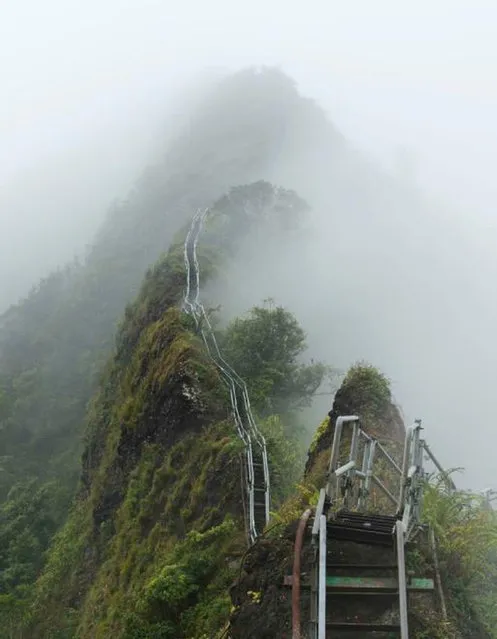
Stairway To Heaven In Hawaii

The Haʻikū Stairs, also known as the Stairway to Heaven or Haʻikū Ladder, is a steep hiking trail on the island of Oʻahu. The trail began as a wooden ladder spiked to the cliff on the south side of the Haʻikū Valley. It was installed in 1942 to enable antenna cables to be strung from one side of the cliffs above Haʻikū Valley to the other. A building to provide a continuous communication link between Wahiawā and Haʻikū Valley Naval Radio Station was constructed at the peak of Puʻukeahiakahoe, elevation about 2,800 feet (850 m). The antennae transmitted very low frequency radio signals from a 200,000-watt Alexanderson alternator in the center of Haʻikū valley. The signals could reach US Navy submarines as far away as Tokyo Bay while the submarines were submerged.
Details
30 Nov 2013 12:47:00