Loading...
Done
A real life Robinson Crusoe – David Glasheen

David Glasheen faces eviction from his remote tropical paradise after losing a Supreme Court legal case.
Details
08 Nov 2012 17:42:00


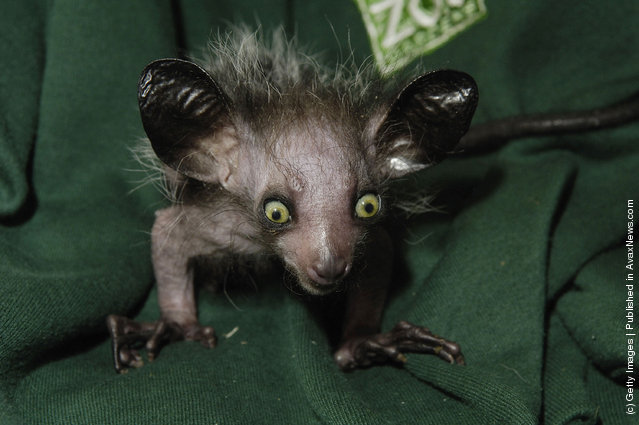
“The aye-aye (Daubentonia madagascariensis) is a lemur, a strepsirrhine primate native to Madagascar that combines rodent-like teeth and a special thin middle finger to fill the same ecological niche as a woodpecker. It is the world's largest nocturnal primate, and is characterized by its unusual method of finding food; it taps on trees to find grubs, then gnaws holes in the wood and inserts its narrow middle finger to pull the grubs out. The only other animal species known to find food in this way is the striped possum. From an ecological point of view the aye-aye fills the niche of a woodpecker as it is capable of penetrating wood to extract the invertebrates within”. – Wikipedia

Photo: In this handout image from Bristol Zoo is seen the first captive bred aye-aye in the UK named “Kintana” (meaning star in Malagasy) April 15, 2005 at Bristol Zoo Gardens, England. The zoo announced today only the second baby aye-aye to be hand-reared in the world (the first was in Jersey Zoo) and has now made his first public appearance since his birth on 11 February 2005. (Photo by Rob Cousins/Bristol Zoo via Getty Images)
Details
13 Apr 2011 13:33:00


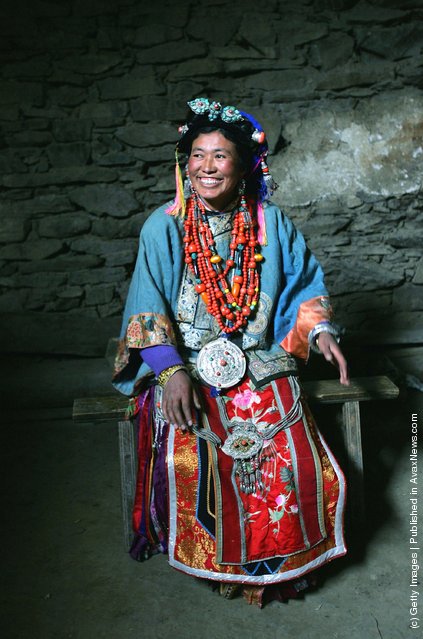
A Tibetan woman displays her Qing Dynasty family dress in Zhailong Village on April 24, 2005 in Danba County of Ganzi Tibetan Autonomous Prefecture, Sichuan Province, China. (Photo by China Photos/Getty Images)
Details
28 Jun 2011 11:20:00
Baby Fennec Fox

“The fennec fox is a small nocturnal fox found in the Sahara of North Africa. Its most distinctive feature is unusually large ears. The name “fennec” comes from the Arabic word for fox, and the species name zerda has a Greek origin that refers to its habitat. The fennec is the smallest species of canid in the world; coat, ears and kidney functions have adapted to a high-temperature, low-water, desert environment. In addition, its hearing is sensitive enough to hear prey moving underground”. – Wikipedia

Photo: A Baby Fennec is seen at Sunshine International Aquarium on June 24, 2009 in Tokyo, Japan. The small nocturnal fox babies were born on May 17 2009. (Photo by Junko Kimura/Getty Images)
Details
16 Sep 2011 12:02:00
Clashes In Qalandia Ahead Of Mahmoud Abbas' UN Address

A masked Palestinian uses a board to protect himself during clashes with Israeli forces which occurred shortly before Palestinian leader Mahmoud Abbas' speech to the the United Nations General Assembly, on September 23, 2011 in Qalandia, West Bank. (Photo by Ilia Yefimovich/Getty Images)
Details
25 Sep 2011 10:55:00
People walk during a polluted day in Shenyang, Liaoning province, March 31, 2016. (Photo by Reuters/Stringer)

People walk during a polluted day in Shenyang, Liaoning province, March 31, 2016. (Photo by Reuters/Stringer)
Details
18 Apr 2016 10:12:00
A man carries his wife over an obstacle while competing in the Wife Carrying Championship to mark City Day in Krasnoyarsk, Siberia, Russia, June 25, 2016. (Photo by Ilya Naymushin/Reuters)

A man carries his wife over an obstacle while competing in the Wife Carrying Championship to mark City Day in Krasnoyarsk, Siberia, Russia, June 25, 2016. (Photo by Ilya Naymushin/Reuters)
Details
26 Jun 2016 13:11:00
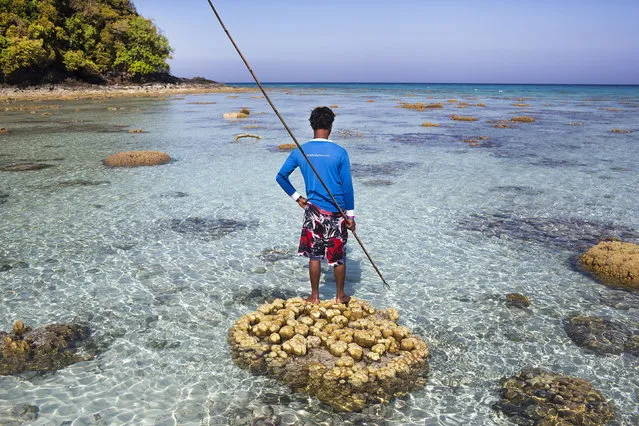
Hook, an indigenous Moken man, holds a three-pronged throwing spear and searches for fish in the waters of Ko Surin National Park. March 1, 2013 – Ko Surin, Thailand. (Photo by Taylor Weidman/zReportage via ZUMA Press)


“For centuries, the Moken sea nomads have traveled the islands between Thailand and Myanmar fishing and foraging for food on the sea floor. Throughout the Mergui Archipelago, Moken migrate in flotillas of Kabangs (traditional boat of the Moken people), stopping at different islands and beaches. Expert freedivers, the Moken have adapted physically to an aquatic life, developing unique characteristics that let them see better and hold their breath longer while underwater”. – Taylor Weidman. Photo: Hook, an indigenous Moken man, holds a three-pronged throwing spear and searches for fish in the waters of Ko Surin National Park. March 1, 2013 – Ko Surin, Thailand. (Photo by Taylor Weidman/zReportage via ZUMA Press)
Details
24 Mar 2014 06:45:00