Loading...
Done
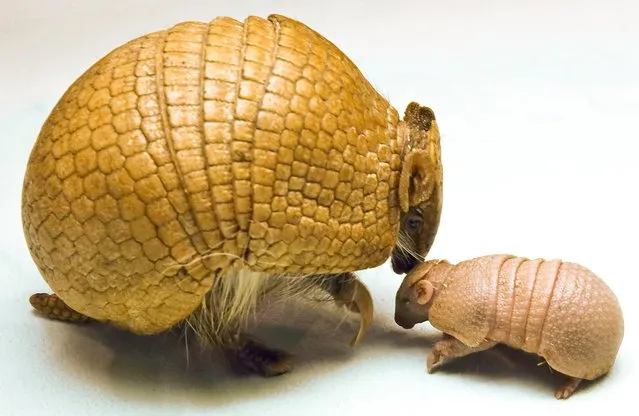
In this Sunday, April 27, 2014 handout photo provided by Busch Gardens Tampa, mother armadillo Zowie, left, welcomes her newborn Southern three-banded armadillo baby at the Animal Ambassador Team, in Tampa, Fla. The baby was able to walk and roll into a ball within moments of its birth. Southern three-banded armadillos are the only species of armadillo that can fully roll up into a ball. The baby armadillo currently weighs 118 grams, which is about the weight equivalent to an average cell phone. (Photo by AP Photo/Busch Gardens Tampa)

In this Sunday, April 27, 2014 handout photo provided by Busch Gardens Tampa, mother armadillo Zowie, left, welcomes her newborn Southern three-banded armadillo baby at the Animal Ambassador Team, in Tampa, Fla. The baby was able to walk and roll into a ball within moments of its birth. Southern three-banded armadillos are the only species of armadillo that can fully roll up into a ball. (Photo by AP Photo/Busch Gardens Tampa)
Details
03 May 2014 16:16:00
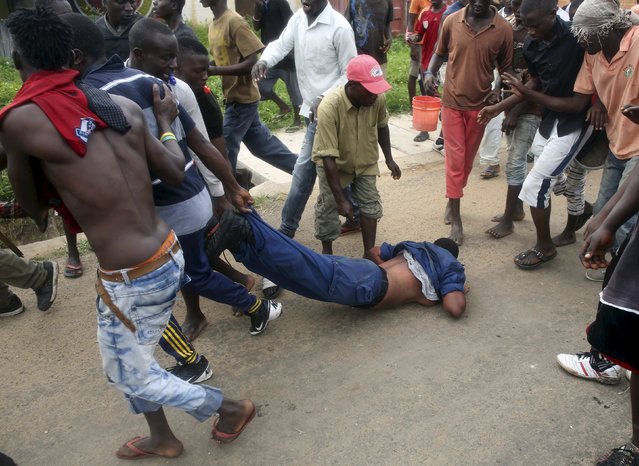
Protesters drag a female police officer accused of shooting a protester in the Buterere neighbourhood of Bujumbura, Burundi, May 12, 2015. (Photo by Goran Tomasevic/Reuters)

From house breaking in Johannesburg to hippos on the loose in Tbilisi to rioters attacking a policewoman in Burundi, Reuters photographers tell the story behind some of the most iconic pictures of the year. Here: Protesters drag a female police officer accused of shooting a protester in the Buterere neighbourhood of Bujumbura, Burundi, May 12, 2015. Goran Tomasevic: Protesters started throwing stones at a group of police, who then started to run away. The policewoman in the photo, Medikintos Inabeza, 33, got left behind and then some protesters started to push her, saying that she had shot a female protestor in the stomach with an AK47 rifle. I didn't see anything of that. There were 5 or 10 protesters pushing the policewoman at first, then others came and joined in. Up to 20 or 30 protesters were surrounding her at one point. The protesters kicked and beat her very badly; I also saw a couple of knives. I thought they were going to kill her... (Photo by Goran Tomasevic/Reuters)

Details
11 Dec 2015 08:06:00
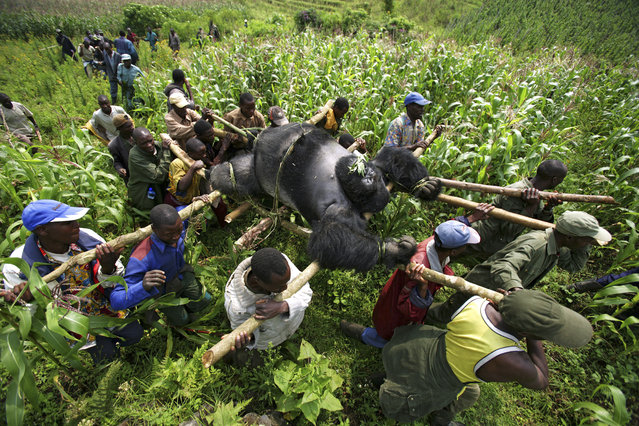
2008 Visa d'or Feature: Brent Stirton. Conservation Rangers from an Anti-Poaching unit work with locals to evacuate the bodies of four Mountain Gorrillas killed in mysterious circumstances in the park,  July 24, 2007, Virunga National Park, Eastern Congo. (Photo by Brent Stirton/Exclusive by Getty Images)

Jean-François Leroy launched Visa Pour l’Image, the international photojournalism festival, in Perpignan in 1989. Before heading up the festival, Leroy was shooting reportage for the agency Sipa Press and also working for Photo-Reporter, Le Photographe, Photo-Revue and Photo Magazine. He is the chairman of the company Images Evidence. Photo: 2008 Visa d'or Feature: Brent Stirton. Conservation Rangers from an Anti-Poaching unit work with locals to evacuate the bodies of four Mountain Gorrillas killed in mysterious circumstances in the park, July 24, 2007, Virunga National Park, Eastern Congo. (Photo by Brent Stirton/Exclusive by Getty Images)
Details
27 Aug 2013 10:42:00
In this undated photo provided by LittleFriendsPhoto.com via Six Flags Discovery Kingdom, Kai, a 17-year-old male California sea lion at Six Flags Discovery Kingdom in Valejo, Calif. peers into the lens of photographer Seth Casteel, known for his “Underwater Dogs” photo series. (Photo by Seth Casteel/AP Photo/LittleFriendsPhoto.com via Six Flags Discovery Kingdom)

In this undated photo provided by LittleFriendsPhoto.com via Six Flags Discovery Kingdom, Kai, a 17-year-old male California sea lion at Six Flags Discovery Kingdom in Valejo, Calif. peers into the lens of photographer Seth Casteel, known for his “Underwater Dogs” photo series. ... (Photo by Seth Casteel/AP Photo/LittleFriendsPhoto.com via Six Flags Discovery Kingdom)
Details
11 May 2013 12:47:00
“Don't look at me, I'm not ready!!!!” (Photo and caption by Yves Lecoq)

“Don't look at me, I'm not ready!!!!” (Photo and caption by Yves Lecoq)
Details
11 Apr 2015 09:25:00
In this March 17, 2015 photo, Ashaninka Indian men, identified by locals as illegal loggers, tie tree trunks together to move them along the Putaya River near the hamlet of Saweto, Peru. Illegal logging persists unabated in this remote Amazon community where four indigenous leaders who resisted it were slain in September. The Putaya River is the waterway that transports felled trees, cut both legally and illegally, to the city of Pucallpa. (Photo by Martin Mejia/AP Photo)

In this March 17, 2015 photo, Ashaninka Indian men, identified by locals as illegal loggers, tie tree trunks together to move them along the Putaya River near the hamlet of Saweto, Peru. Illegal logging persists unabated in this remote Amazon community where four indigenous leaders who resisted it were slain in September. The Putaya River is the waterway that transports felled trees, cut both legally and illegally, to the city of Pucallpa. (Photo by Martin Mejia/AP Photo)
Details
27 Mar 2015 12:40:00
Kea are the only true alpine parrots in the world and thrive as cunning opportunists in the freezing conditions of the Southern Alps. Kea are thought to have developed their wide array of food-finding strategies during the last great ice age, where they learned to adapt using their unusual powers of curiosity. (Photo by Tom Walker/BBC Pictures/The Guardian)

Kea are the only true alpine parrots in the world and thrive as cunning opportunists in the freezing conditions of the Southern Alps. Kea are thought to have developed their wide array of food-finding strategies during the last great ice age, where they learned to adapt using their unusual powers of curiosity. (Photo by Tom Walker/BBC Pictures/The Guardian)
Details
19 Jul 2016 13:03:00
Hook, an indigenous Moken man, holds a three-pronged throwing spear and searches for fish in the waters of Ko Surin National Park. March 1, 2013 – Ko Surin, Thailand. (Photo by Taylor Weidman/zReportage via ZUMA Press)

“For centuries, the Moken sea nomads have traveled the islands between Thailand and Myanmar fishing and foraging for food on the sea floor. Throughout the Mergui Archipelago, Moken migrate in flotillas of Kabangs (traditional boat of the Moken people), stopping at different islands and beaches. Expert freedivers, the Moken have adapted physically to an aquatic life, developing unique characteristics that let them see better and hold their breath longer while underwater”. – Taylor Weidman. Photo: Hook, an indigenous Moken man, holds a three-pronged throwing spear and searches for fish in the waters of Ko Surin National Park. March 1, 2013 – Ko Surin, Thailand. (Photo by Taylor Weidman/zReportage via ZUMA Press)
Details
24 Mar 2014 06:45:00