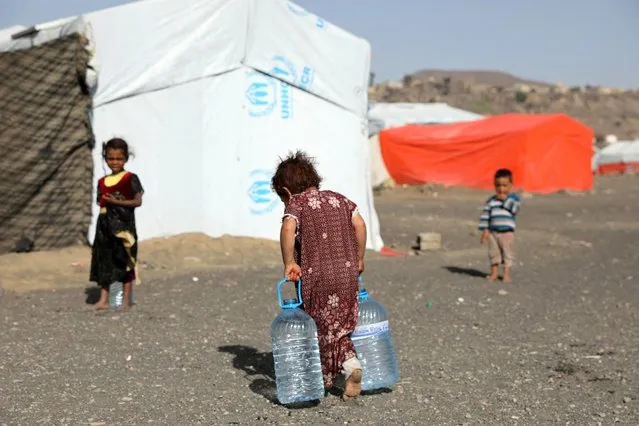
A girl carries bottles of water filled from a charity tank at a camp for internally displaced people (IDPs) near Sanaa, Yemen on March 25, 2022. (Photo by Khaled Abdullah/Reuters)
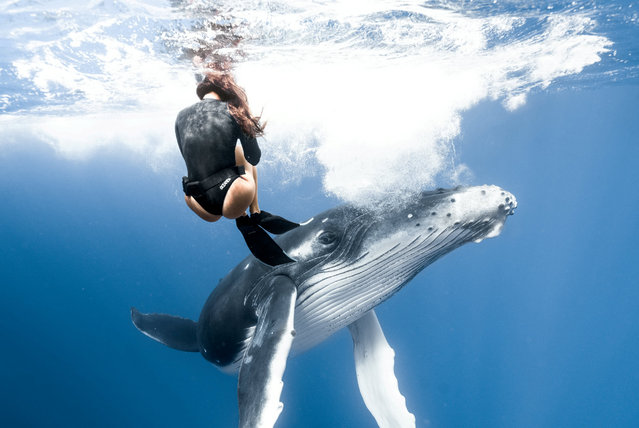
Yanna Xian, 24, and her boyfriend Mitch Brown, 27, were swimming while on a boat tour off Honolulu, Hawaii last year, when a curious two-week-old humpback approached them. (Photo by South West News Service)
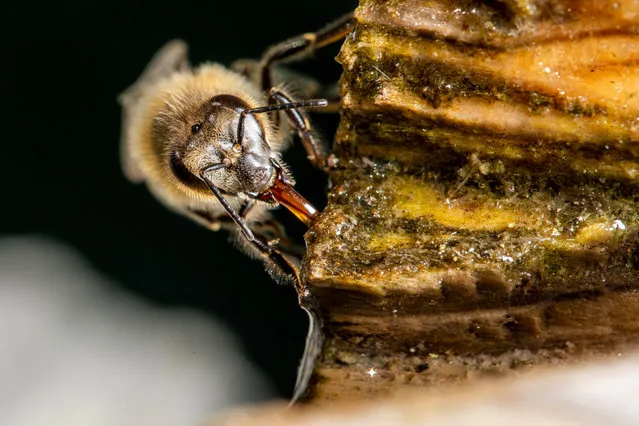
A Western honey bee feeds off acacia pollen at an apiary in Nagyszenas, eastern Hungary, 25 April 2020. The preparation of the bees for the acacia bloom began two weeks later than usual this year; due to the late frosts, this season's yield of Hungaricum acacia honey is expected to be lower. (Photo by Tibor Rosta/EPA/EFE)
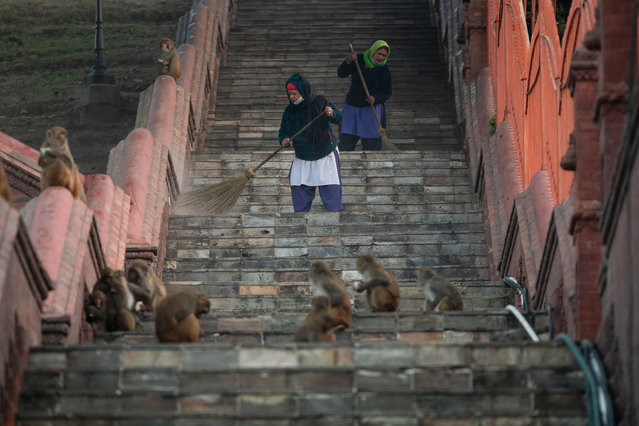
Workers clean the premises of Pashupatinath temple in Kathmandu, Nepal, December 16, 2020. The Pashupatinath Temple in Nepal reopened for devotees on Wednesday morning, almost eight months after it was shut due to the COVID-19 pandemic. (Photo by Xinhua News Agency/Rex Features/Shutterstock)
A Australian green tree frog wearing a small turtle as a hat, keeping its head dry during its swim in Padang West Sumatra, Indonesia in May 2023. The Australian green tree frog grows up to 11 centimetres tall, the males being smaller that the females. They can live to the age of 25 and their colour alters between green, brown and blue depending on their mood. (Photo by Yan Hidayat/Media Drum Images)
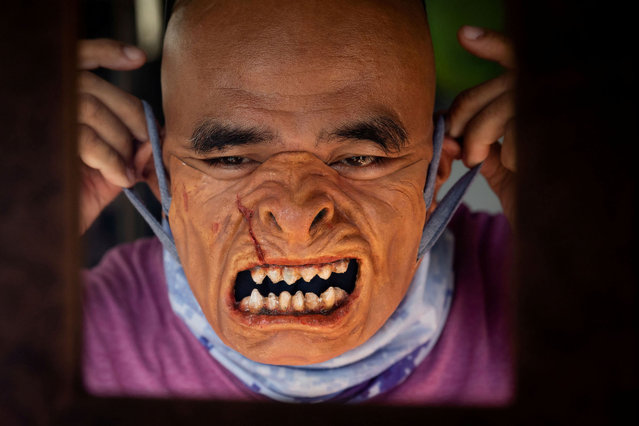
TV prosthetics artist Rene Abelardo tries on a sample of his prosthetic face mask, his latest creation as TV projects took a halt amid the coronavirus disease (COVID-19) outbreak, in San Pedro, Laguna, Philippines, June 17, 2020. (Photo by Eloisa Lopez/Reuters)
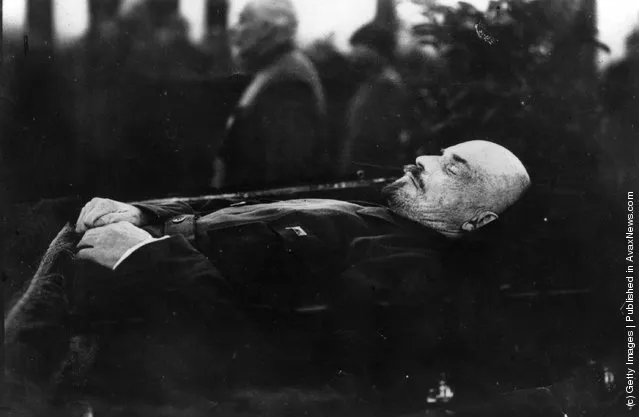
Photo: Vladimir Ilyich Lenin (1870 – 1924) lying in state in the Kremlin. (Photo by Hulton Archive/Getty Images). 1924
Important! For the same article in Russian language click here.
Something quite intriguing is happening within Russian-speaking internet during the last few – should you type a fully academic inquiry (at least, according to Russian academic requirements) in national search engines for "Lenin's mausoleum" – the first thing you get (even in top 10 searches) is website pages talking about black magic and occult. Website authors view this construction differently, but unconditionally agree on one thing: the mausoleum of the "leader of the world proletariat” – the essence of a magical artifact, a sort of “energy vampire”. It was built with a certain purpose: to drain the energy out of miserable Soviet citizens on one hand; and to poison the anthroposphere of one-sixth part of the earth with its vibes (the exact territory that was occupied by the former Soviet Union), depriving the Russian people of will to resist on the other hand. Complete nonsense? No doubt. Nevertheless, an intriguing one. Well, probably because some oddities do exist in mausoleum's history. These oddities are the thing we are going to discuss this time. First, let me refresh you memory on the subject.
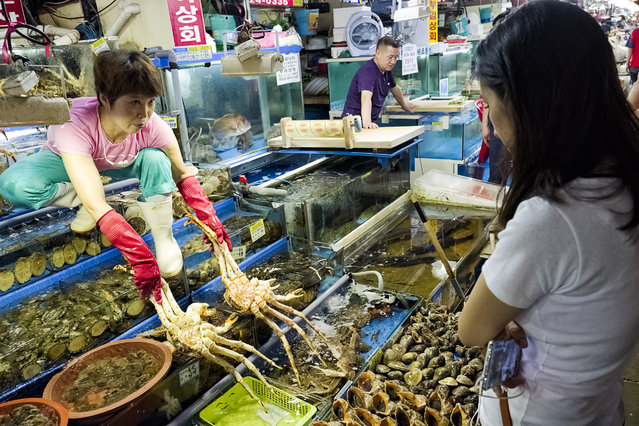
A sales woman of a fish shop shows king crabs to a customer and negotiates the price in Noryangjin Fish Market is seen on August 1, 2015 in Seoul, South Korea. Noryangjin Fish Market was established in 1927 as Gyeongseong Susan in Jung-gu near Seoul Station and moved to its current location in 1971. (Photo by Shin Woong-jae/The Washington Post)