Loading...
Done
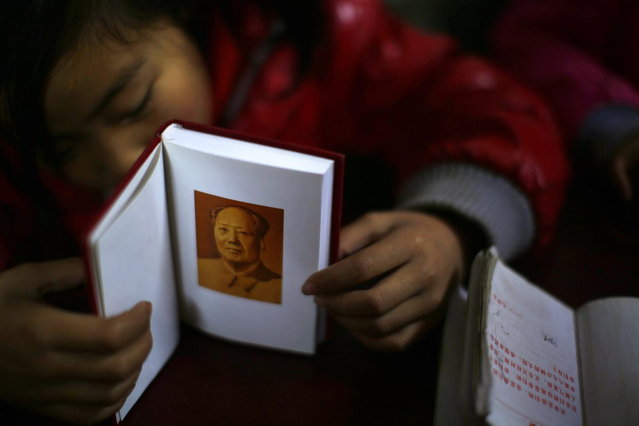
A student falls asleep as she holds a book containing a portrait of China's late chairman Mao Zedong during a lesson at the Democracy Elementary and Middle School in Sitong town, Henan province December 3, 2013. (Photo by Carlos Barria/Reuters)

A student falls asleep as she holds a book containing a portrait of China's late chairman Mao Zedong during a lesson at the Democracy Elementary and Middle School in Sitong town, Henan province December 3, 2013. In a remote part of central China, the day starts at the Democracy Elementary and Middle School with a pre-dawn jog, some revolutionary songs and then an activity long since forgotten at other schools: reciting quotations from Mao Zedong's famed “Little Red Book”. While the ruling Communist Party that Mao led continues to hold him in esteem as the leader of the Communist Revolution, his radical policies and teachings have been largely shelved since his death in 1976 in favour of a pro-market approach that has turned China from a backwater into the world's second biggest economy. The 120th anniversary of Mao's birth is on December 26, 2013. (Photo by Carlos Barria/Reuters)
Details
19 Dec 2013 09:40:00
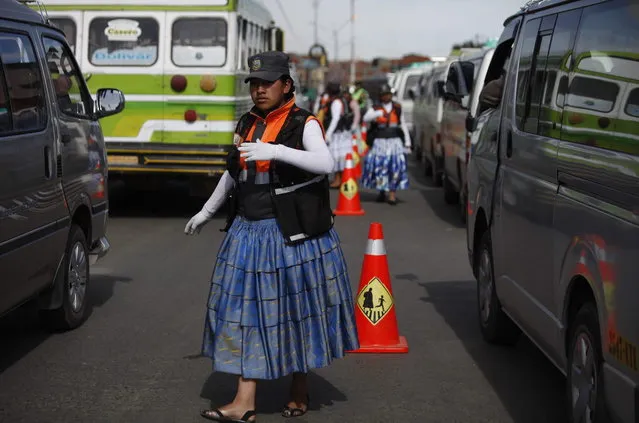
In this December 3, 2013 photo, an Aymara woman cops directs traffic on the streets of El Alto, Bolivia. The women wear the bright petticoats and shawls of indigenous women in the Andes, called cholitas in Bolivian slang, the main difference being that instead of bowler hats they wear khaki green police-style caps. Some don fluorescent traffic vests. (Photo by Juan Karita/AP Photo)

“This city in Bolivia's highlands has hired Aymara women dressed in traditional multilayered Andean skirts and brightly embroidered vests to work as traffic cops and bring order to its road chaos. About 20 of the “traffic cholitas” have been trained to direct cars and buses in El Alto, a teeming, impoverished sister city of La Paz in Bolivia's Andes mountains”. – El Alto via Associated Press. Photo: In this December 3, 2013 photo, an Aymara woman cops directs traffic on the streets of El Alto, Bolivia. The women wear the bright petticoats and shawls of indigenous women in the Andes, called cholitas in Bolivian slang, the main difference being that instead of bowler hats they wear khaki green police-style caps. Some don fluorescent traffic vests. (Photo by Juan Karita/AP Photo)
Details
25 Dec 2013 10:48:00
Dunnottar Castle In Scottish

Dunnottar Castleis a ruined medieval fortress located upon a rocky headland on the north-east coast of Scotland, about 3 kilometres (1.9 mi) south of Stonehaven. The surviving buildings are largely of the 15th and 16th centuries, but the site is believed to have been fortified in the Early Middle Ages. Dunnottar has played a prominent role in the history of Scotland through to the 18th-century Jacobite risings because of its strategic location and the strength of its situation. Dunnottar is best known as the place where the Honours of Scotland, the Scottish crown jewels, were hidden from Oliver Cromwell's invading army in the 17th century. The property of the Keiths from the 14th century, and the seat of the Earl Marischal, Dunnottar declined after the last Earl forfeited his titles by taking part in the Jacobite rebellion of 1715. The castle was restored in the 20th century and is now open to the public.
Details
13 Jan 2014 11:31:00
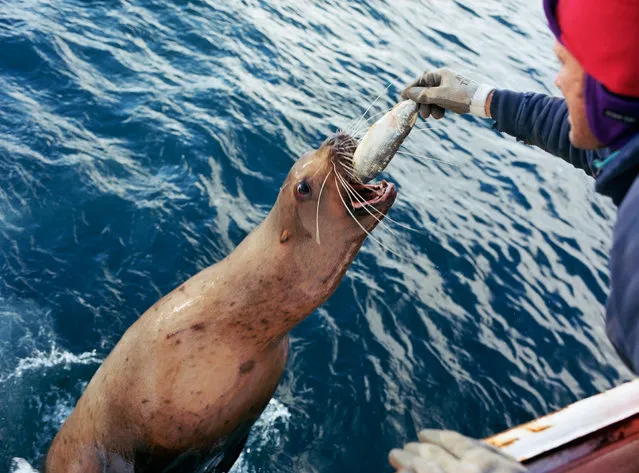
Before heading up to Alaska, the ship loads up with 3 months worth of food. Even so, it's hardly necessary. The ship's cook is constantly steaming fresh crab legs and seafood caught during the day. The hard labour of fishing requires a diet heavy in fat, protein, and omega-3s. Here, a sea lion gets a bite of the grub. (Photo by Corey Arnold)

In 2002 photographer Corey Arnold left behind a poor economy in San Francisco and headed up to Alaska to try his luck at his longtime passion of fishing. Arnold, who had worked summers during college on a salmon boat in Alaska, signed onto the f/v Rollo, a crabbing boat that fishes in the dangerous Bering Sea. While working long, strenuous hours on the Rollo, Arnold often stole away with the captain’s permission to grab his camera and photograph the crew and the ship. Arnold eventually put together “Fish Work: Bering Sea”, a documentation of his seven adventurous and dicey crab seasons aboard the Rollo. (Photo by Corey Arnold)
Details
20 Aug 2014 10:05:00
Illustration By Luna Portnoi Part 1

Luna Portnoi emerging Argentine Artist Luna Portnoi has been developing her practice in Buenos Aires for over five years. Her work is deeply connected to themes of color, nature, astronomy, childhood, magic, ancient civilizations, collaboration and the passions, openness and emotions we experience as children that are often left behind in adulthood. Already well known in Buenos Aires, the Artist has also received international press coverage.


See Also: Part 2 _ Part 3
Details
17 Sep 2014 07:47:00


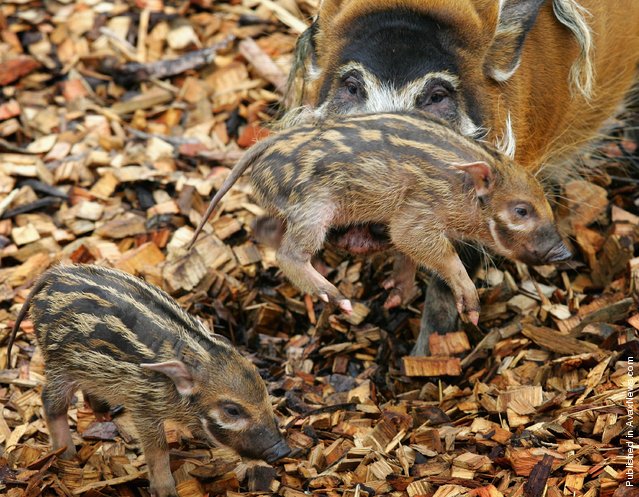
“The Red River Hog (Potamochoerus porcus), also known as the Bush Pig (but not to be confused with P. larvatus, common name “Bushpig”), is a wild member of the pig family living in Africa, with most of its distribution in the Guinean and Congolian forests. It is rarely seen away from rainforests, and generally prefers areas near rivers or swamps.

Red River Hogs eat grass, berries, roots, insects, molluscs, small vertebrates and carrion. They are capable of causing damage to plantations. Red River Hogs typically live in herds of 6-20 members led by a dominant boar. Sows rear 3-6 piglets at a time.”

Photo: Two 17 day old red river hoglet twins forage for food next to their mother Bahiti at London Zoo on August 23, 2007 in London, England. Red River hoglets inhabit the forests and swamps of West and Central Africa. The recent additions to the London Zoo pig pen have been eagerly awaited by zoo keepers. (Photo by Chris Jackson/Getty Images)
Details
18 Mar 2011 15:15:00


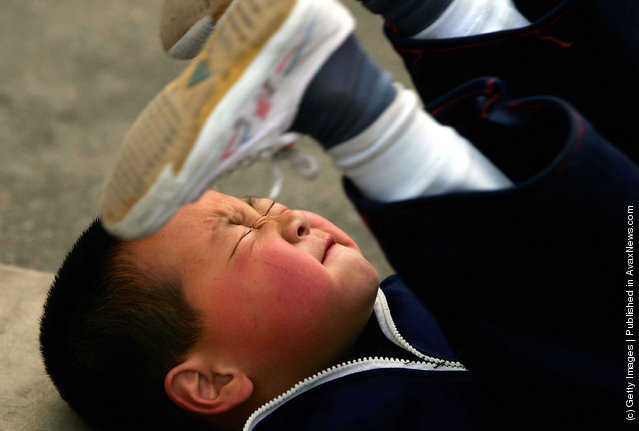
Wang Zeyu, 4, a fee-paying enthusiast of kung fu, practises during a training class at a kung fu school near the Shaolin Temple April 10, 2005 in Dengfeng, Henan Province, China. Zeyu's father sent him to the school from his home in Jiangsu Province, thousands kilometres away from Dengfeng, when he was just 3 years old. And his father must pay 9,800 yuan (US$1195) for one year's tuition at the school, a huge amount for most Chinese. There are more than 80 kung fu schools that line the road from the city of Dengfeng to the Shaolin Temple with hundreds and thousands of young kung-fu lovers from all over the country and beyond studying here. All the schools use the Shaolin name to attract students as the Shaolin Temple is the birthplace of Chinese Kung Fu. (Photo by Cancan Chu/Getty Images)
Details
06 Jul 2011 11:21:00


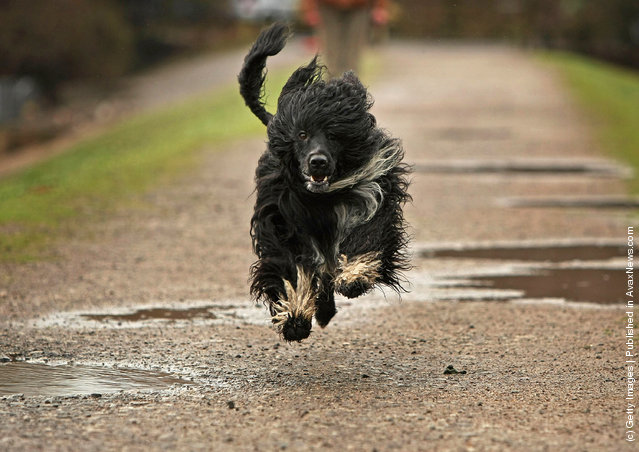
“The Portuguese Water Dog is a breed of working dog as classified by the American Kennel Club. Portuguese Water Dogs are originally from the Portuguese region of the Algarve, from where the breed expanded to all around Portugal's coast, where they were taught to herd fish into fishermen's nets, to retrieve lost tackle or broken nets, and to act as couriers from ship to ship, or ship to shore. Portuguese Water Dogs rode in bobbing fishing trawlers as they worked their way from the warm Atlantic waters of Portugal to the frigid fishing waters off the coast of Iceland where the fleets caught cod to bring home. Portuguese Water Dogs were often taken with sailors during the Portuguese discoveries”. – Wikipedia

Photo: Kix, a Portuguese Water Dog , enjoys a walk around the muddy fields near his home before the grooming and preparation starts for this years Crufts on March 3, 2009 in Telford, England. (Photo by Christopher Furlong/Getty Images)
Details
26 Jul 2011 11:27:00