Loading...
Done
The Berenson robot strolls among visitors during the exhibition “Persona : Oddly Human” at the Quai Branly museum in Paris, France, February 23, 2016. The Berenson robot, developed in France in 2011, is the brainchild of anthropologist Denis Vidal and robotics engineer Philippe Gaussier. Its programming allows it to record reactions of museum visitors to certain pieces of art and then use the data to develop its own unique taste, which allows “Berenson” to judge whether or not it likes a certain work of art within an exhibition. (Photo by Philippe Wojazer/Reuters)

The Berenson robot strolls among visitors during the exhibition “Persona : Oddly Human” at the Quai Branly museum in Paris, France, February 23, 2016. The Berenson robot, developed in France in 2011, is the brainchild of anthropologist Denis Vidal and robotics engineer Philippe Gaussier. Its programming allows it to record reactions of museum visitors to certain pieces of art and then use the data to develop its own unique taste, which allows “Berenson” to judge whether or not it likes a certain work of art within an exhibition. (Photo by Philippe Wojazer/Reuters)
Details
25 Feb 2016 12:26:00
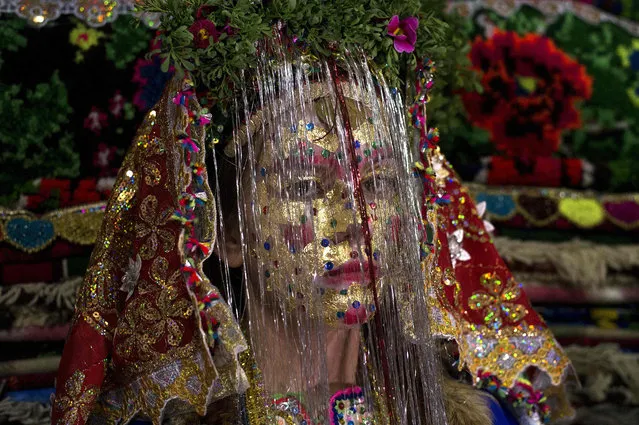
Emilia Pechinkova, a 24-years-old Bulgarian Pomak (Bulgarian speaking Muslims) bride poses for a photograph following the “gelina” or face painting ceremony carried out by female guests and relatives in preparation for her three-day wedding ceremony in the village of Draginovo, 100 kms southeast of Sofia on April 22, 2016. Bulgaria's Muslim population is one of the highest in the European Union. (Photo by Nikolay Doychinov/AFP Photo)

Emilia Pechinkova, a 24-years-old Bulgarian Pomak (Bulgarian speaking Muslims) bride poses for a photograph following the “gelina” or face painting ceremony carried out by female guests and relatives in preparation for her three-day wedding ceremony in the village of Draginovo, 100 kms southeast of Sofia on April 22, 2016. Bulgaria's Muslim population is one of the highest in the European Union. During the Communist regime religious rituals were not tolerated, and Muslims were forced to abandon wearing their traditional wedding outfits. Recently, more young Pomak women want to include traditional wedding customs that were forbidden during the regime, regardless of their secular lifestyles and the high cost of such a wedding. (Photo by Nikolay Doychinov/AFP Photo)
Details
25 Apr 2016 09:55:00
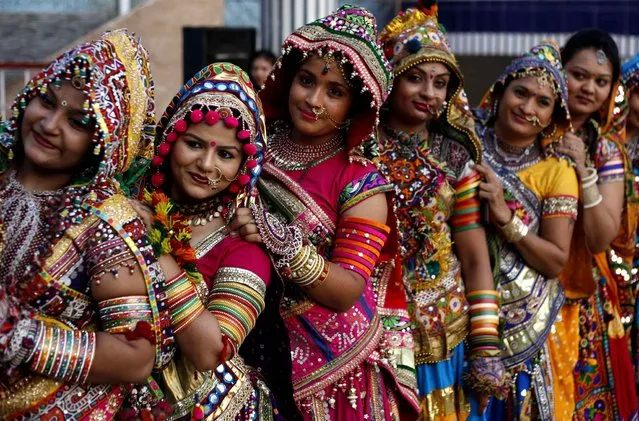
Indian girls in traditional attire pose for photographs as they practice the Garba, the traditional dance of Gujarat state, ahead of Navratri festival in Ahmadabad, India, Saturday, October 3, 2015. Navratri or nine night festival will begin on Oct. 13. (Photo by Ajit Solanki/AP Photo)

Indian girls in traditional attire pose for photographs as they practice the Garba, the traditional dance of Gujarat state, ahead of Navratri festival in Ahmadabad, India, Saturday, October 3, 2015. Navratri or nine night festival will begin on October 13. (Photo by Ajit Solanki/AP Photo)
Details
14 Oct 2015 08:04:00
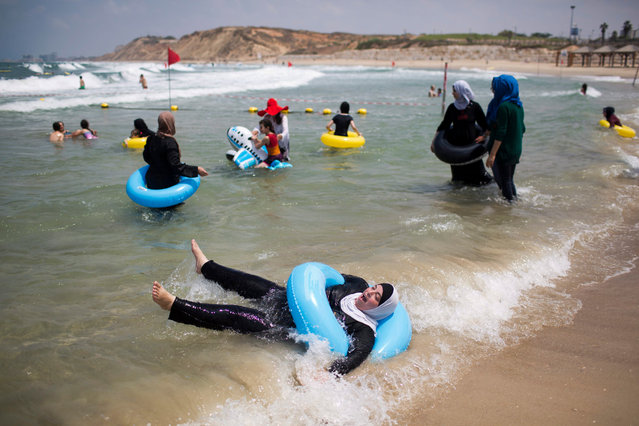
Palestinians kids from the West Bank Palestinian village Umm Al Rajaj cross the Meitar checkpoint into Israel on their way to the beach of Tel Aviv for the first time, Israel, 10 August 2016. A group of humanitarian Israeli women called in Arabic “Min Al Baher” (from the sea) voluntarily arranges authorizations and transportation for Palestinians families that live in the West Bank to cross into Israel in order to visit the sea for the first time. (Photo by Abir Sultan/EPA)

Palestinians kids from the West Bank Palestinian village Umm Al Rajaj cross the Meitar checkpoint into Israel on their way to the beach of Tel Aviv for the first time, Israel, 10 August 2016. A group of humanitarian Israeli women called in Arabic “Min Al Baher” (from the sea) voluntarily arranges authorizations and transportation for Palestinians families that live in the West Bank to cross into Israel in order to visit the sea for the first time. (Photo by Abir Sultan/EPA)
Details
02 Sep 2016 13:41:00
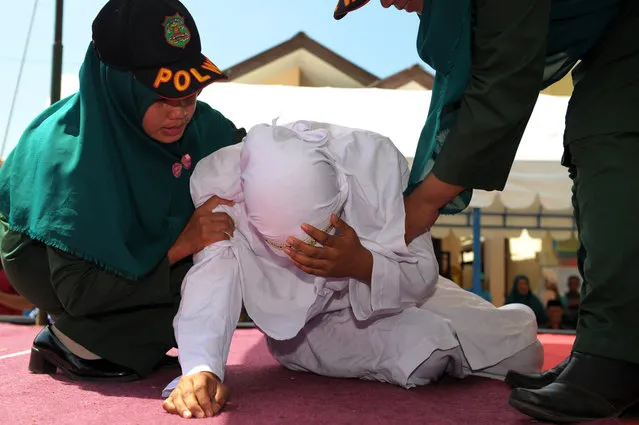
An Indonesian woman known as Linda (C) is helped by two Sharia officials after being caned for spending time in close proximity with a man who is not her husband, which is against Sharia law, in Banda Aceh on February 2, 2017. Aceh is the only province in the world's most populous Muslim-majority country that imposes sharia law. People can face floggings for a range of offences – from gambling, to drinking alcohol, to gay s*x. (Photo by Chaideer Mahyuddin/AFP Photo)

An Indonesian woman known as Linda (C) is helped by two Sharia officials after being caned for spending time in close proximity with a man who is not her husband, which is against Sharia law, in Banda Aceh on February 2, 2017. Aceh is the only province in the world's most populous Muslim-majority country that imposes sharia law. People can face floggings for a range of offences – from gambling, to drinking alcohol, to gay sеx. (Photo by Chaideer Mahyuddin/AFP Photo)
Details
03 Feb 2017 10:45:00
Model Bella Hadid is seen on June 9, 2017 in Paris, France. (Photo by Marc Piasecki/GC Images)

Model Bella Hadid is seen on June 9, 2017 in Paris, France. (Photo by Marc Piasecki/GC Images)
Details
11 Jun 2017 06:55:00
Takeoka Chisaka, Hiroshima, Japan. “One morning in August 1945, I was walking home from the night shift at a factory in Hiroshima. As I reached my door, there was a huge explosion. When I came to, my head was bleeding and I had been blasted 30m away”. (Photo and caption by Sasha Maslov)

Takeoka Chisaka, Hiroshima, Japan. “One morning in August 1945, I was walking home from the night shift at a factory in Hiroshima. As I reached my door, there was a huge explosion. When I came to, my head was bleeding and I had been blasted 30m away. The atomic bomb had detonated. When I found my mother, her eyes were badly burned. A doctor said they had to come out, but he didn’t have the proper tools so used a knife instead. It was hellish. I became a peace-worker after the war. In the 1960s, at a meeting at the UN, I met one of the people who created the atomic bomb. He apologised”. (Photo and caption by Sasha Maslov)
Details
11 May 2015 11:56:00
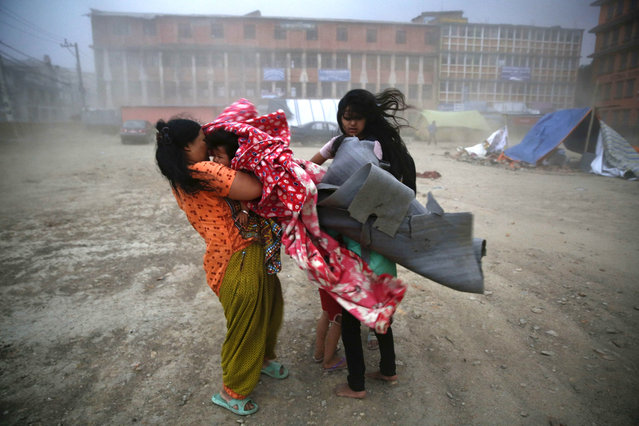
A storm whips through a tented area occupied by Nepalese earthquake survivors as a mother grabs her infant child and runs to find shelter in Kathmandu, Nepal 23 May 2015. Nepalese, who lost their homes in earthquake and fear aftershocks, have been living in temporary shelter in open ground which they had to flee because of the heavy rain and powerful wind. (Photo by Narendra Shrestha/EPA)

A storm whips through a tented area occupied by Nepalese earthquake survivors as a mother grabs her infant child and runs to find shelter in Kathmandu, Nepal 23 May 2015. Nepalese, who lost their homes in earthquake and fear aftershocks, have been living in temporary shelter in open ground which they had to flee because of the heavy rain and powerful wind. (Photo by Narendra Shrestha/EPA)
Details
25 May 2015 10:00:00