Loading...
Done
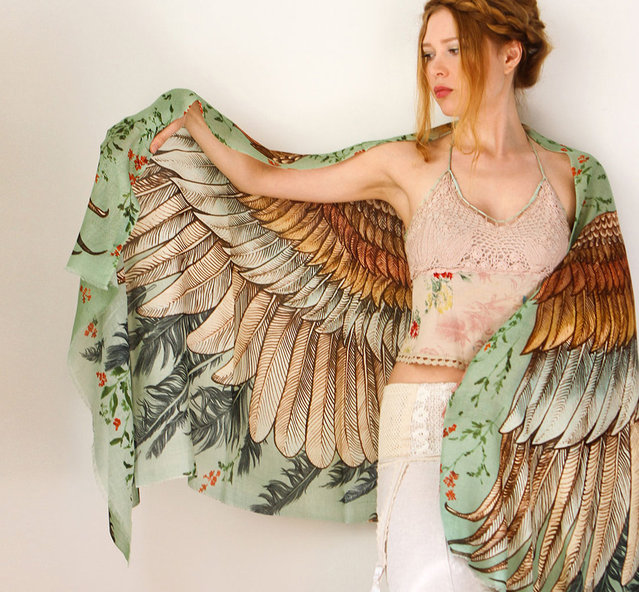
Shovava Wing Scarves By Roza Khamitova

Roza Khamitova was born into a family of artists in Kazakhstan. After finishing design school in Manhattan, New York, she was working in fashion industry for about 8 years. As a visual artist Roza had always drawn most of her inspiration from the natural world around her in the mountains of Kazakhstan. In 2011 she launched Shovava, her personal line of women’s clothing based on her hand drawn paintings and prints of the animals, plants and patterns found in nature. Roza was enchanted by the beauty of wings, its structure and symbolism. First, she sketches big wide-spread wings on paper with a light pencil, adds black ink to create a three-dimensional feel and fills with stunning watercolors.
Details
06 Dec 2015 10:42:00
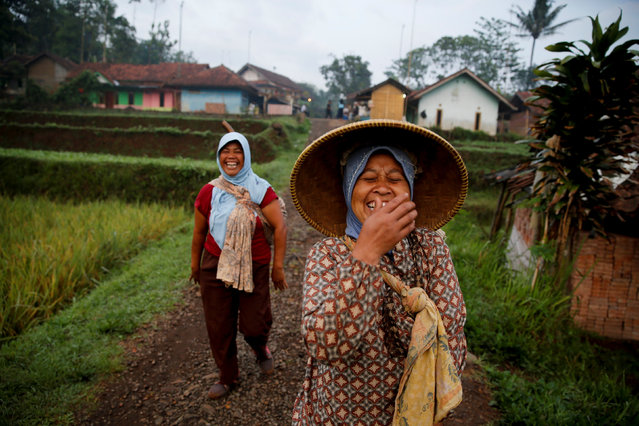
Women share a joke as they walk to a paddy field in Cikawao village of Majalaya, West Java province, Indonesia, October 12, 2017. (Photo by Reuters/Beawiharta)

A gory fight to the death between snarling dogs and captured wild boars. Gathered around a bamboo-walled arena, Indonesians in this remote part of Java island seem eager to watch the blood-curdling contests, known locally as “adu bagong” (boar fighting). Not surprisingly, animal rights activists are up in arms against the regular spectacle, which began in the 1960s when wild pig numbers in this area in West Java soared and they were hunted to protect crops. Here: Women share a joke as they walk to a paddy field in Cikawao village of Majalaya, West Java province, Indonesia, October 12, 2017. (Photo by Reuters/Beawiharta)
Details
21 Oct 2017 07:46:00
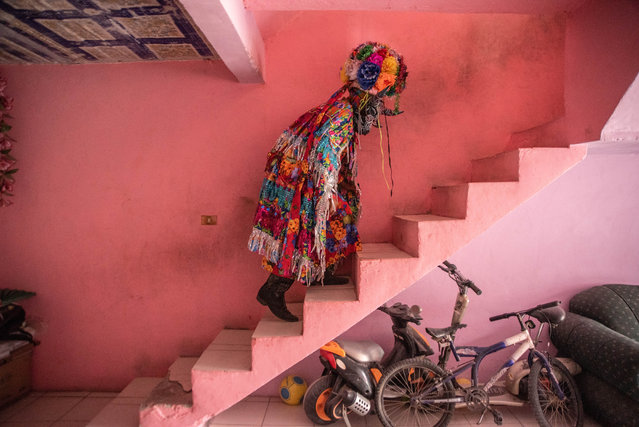
Inhabitants of the community of Coyolillo celebrate their Afro-descendant carnival in Veracruz, Mexico on February 25, 2020. This carnival has more than 100 years of history and is the heritage of the African workers who arrived in that area more than 300 years ago to work in the sugar cane fields. The event is known for the colourful robes, capes and animal masks – of bulls, deer, goats and cows – worn by participants. As such, the carnival is a unique expression of African-Mexican folk art. (Photo by Hector Adolfo Quintanar Perez/ZUMA Wire/Rex Features/Shutterstock)

Inhabitants of the community of Coyolillo celebrate their Afro-descendant carnival in Veracruz, Mexico on February 25, 2020. This carnival has more than 100 years of history and is the heritage of the African workers who arrived in that area more than 300 years ago to work in the sugar cane fields. (Photo by Hector Adolfo Quintanar Perez/ZUMA Wire/Rex Features/Shutterstock)
Details
05 Mar 2020 00:03:00
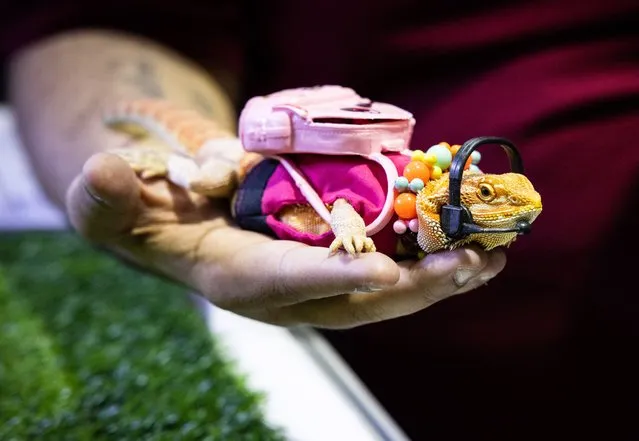
A lizard wears clothing and a headset at Pet Expo Thailand on May 07, 2023 in Bangkok, Thailand. Dogs take part in a skateboarding competition at Pet Expo Thailand, a four day exhibition held at the Queen Sirikit National Convention Center. Dogs were judged on form and agility and separated into novice and experienced categories. Placing first place in the novice category was Mui and first in the experienced category was Suradej. Both house pets and exotic animals were featured at the expo, with visitors and their pets able to interact with them. (Photo by Lauren DeCicca/Getty Images)

A lizard wears clothing and a headset at Pet Expo Thailand on May 07, 2023 in Bangkok, Thailand. Dogs take part in a skateboarding competition at Pet Expo Thailand, a four day exhibition held at the Queen Sirikit National Convention Center. Dogs were judged on form and agility and separated into novice and experienced categories. (Photo by Lauren DeCicca/Getty Images)
Details
19 May 2023 04:32:00
Vinyl Clock By Pavel Sidorenko Part 2

Pavel Sidorenko is an award winning Estonian designer who was born in 1980 in Tallinn and studied product design at Estonian Academy of Arts and Graduated in 2006. Not only does he incorporate pragmatic necessity, but also transmits an emotional qualities within the everyday environment. His fantastic collection of Re Vinyl designs are a result of upcycling a product fashioned from old vinyl records. Beautifully crafted and working with a range of themes from scenography to animal creatures, there is sure to be something for everyone with these stylish selection of recycled vinyl clocks!


See also: Part 1
Details
01 Mar 2014 11:09:00
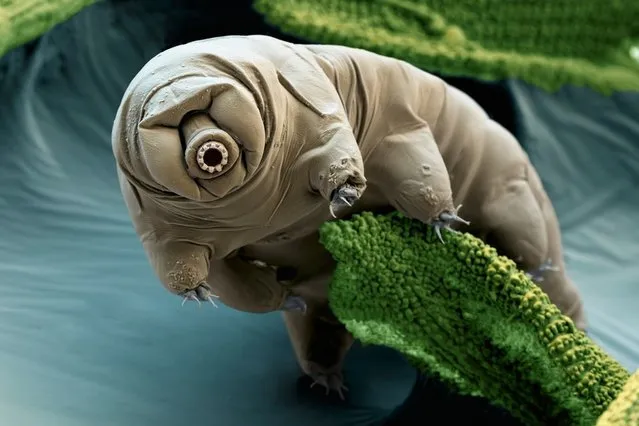
Tardigrades (commonly known as waterbears or moss piglets). (Photo by SPL/East News)

“Tardigrades (commonly known as waterbears or moss piglets) are small, water-dwelling, segmented animals with eight legs. Tardigrades were first discovered in 1773 by Johann August Ephraim Goeze, who called them kleiner Wasserbär, meaning “little water bear” in German. The name Tardigrada means “slow walker” and was given by Lazzaro Spallanzani in 1777. The name water bear comes from the way they walk, reminiscent of a bear's gait. The biggest adults may reach a body length of 1.5 millimetres (0.059 in), the smallest below 0.1 mm. Freshly hatched tardigrades may be smaller than 0.05 mm”. – Wikipedia. Photo: Tardigrades. (Photo by SPL/East News)
Details
26 Sep 2012 09:55:00


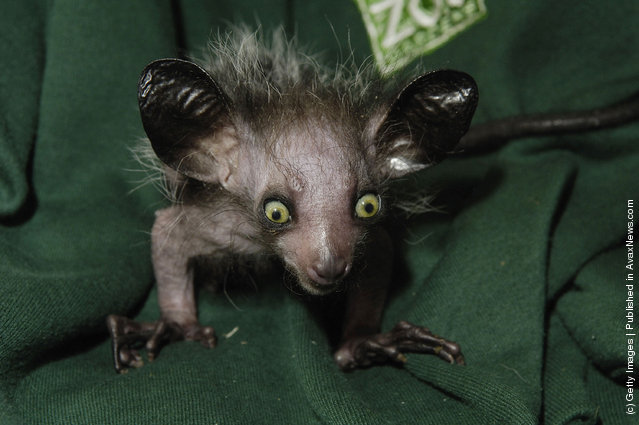
“The aye-aye (Daubentonia madagascariensis) is a lemur, a strepsirrhine primate native to Madagascar that combines rodent-like teeth and a special thin middle finger to fill the same ecological niche as a woodpecker. It is the world's largest nocturnal primate, and is characterized by its unusual method of finding food; it taps on trees to find grubs, then gnaws holes in the wood and inserts its narrow middle finger to pull the grubs out. The only other animal species known to find food in this way is the striped possum. From an ecological point of view the aye-aye fills the niche of a woodpecker as it is capable of penetrating wood to extract the invertebrates within”. – Wikipedia

Photo: In this handout image from Bristol Zoo is seen the first captive bred aye-aye in the UK named “Kintana” (meaning star in Malagasy) April 15, 2005 at Bristol Zoo Gardens, England. The zoo announced today only the second baby aye-aye to be hand-reared in the world (the first was in Jersey Zoo) and has now made his first public appearance since his birth on 11 February 2005. (Photo by Rob Cousins/Bristol Zoo via Getty Images)
Details
13 Apr 2011 13:33:00


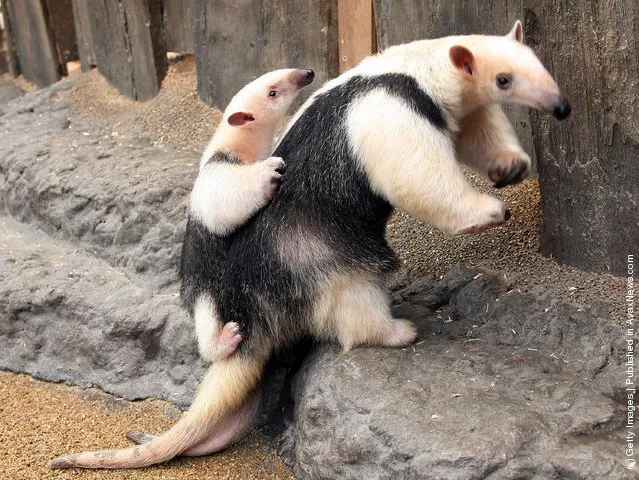
“The Southern Tamandua, Collared Anteater or Lesser Anteater (Tamandua tetradactyla) is a species of anteater from South America. It is a solitary animal, found in many habitats from mature to highly disturbed secondary forests and arid savannas. It feeds on ants, termites and bees. It has very strong foreclaws that can be used to break insect nests or to defend itself”. – Wikipedia

Photo: A three-month-old baby Southern Tamandua “Konbu” lies on its mother Tae's back at Sunshine International Aquarium on July 7, 2009 in Tokyo, Japan. Baby Southern Tamandua feels safe and comfortable holding onto something and normally stays on the mother's back until around 3 months old. (Photo by Junko Kimura/Getty Images)
Details
19 May 2011 10:31:00