Loading...
Done
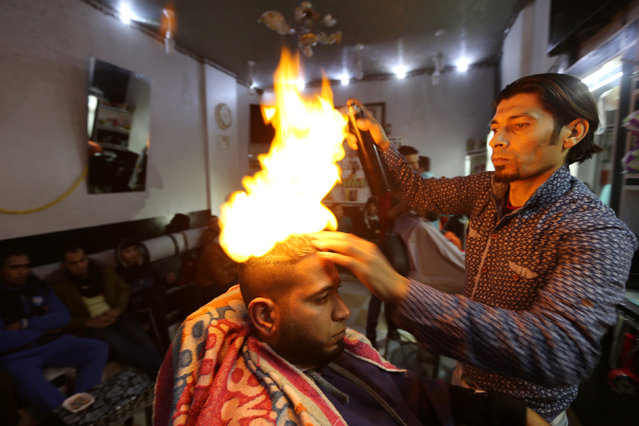
Palestinian barber Ramadan Odwan styles and straightens the hair of a customer with fire at his salon in Rafah, in the southern Gaza Strip February 2, 2017. In Ramadan Odwan's barbershop in Gaza, hair isn't just blow-dried, it's blowtorch-dried. “People have gone crazy about it, many people are curious to go through the experience and they are not afraid”, he told Reuters. “People here love adventures”. Odwan, 37, is not the first stylist in the world to use flame to straighten hair, but his craft is unique in the Gaza Strip. In his salon in the southern Gaza town of Rafah, Odwan applied what he described as a protective liquid coating to a customer's hair – he declined to disclose its contents – before aiming for the head and pressing the button on a small blowtorch. “I control how long I apply fire, I keep it on and off for 10 seconds or 15 seconds. It is completely safe and I have not encountered any accident since I started it two months ago”, Odwan added. Odwan charges 20 shekels ($5.20) for a haircut and fire-straightening. A barber for the past 18 years, he said part of the reason he uses the technique is to show that Palestinian barbers are as “professional as those out there around the world”. (Photo by Ibraheem Abu Mustafa/Reuters)

Palestinian barber Ramadan Odwan styles and straightens the hair of a customer with fire at his salon in Rafah, in the southern Gaza Strip February 2, 2017. In Ramadan Odwan's barbershop in Gaza, hair isn't just blow-dried, it's blowtorch-dried. “People have gone crazy about it, many people are curious to go through the experience and they are not afraid”, he told Reuters. “People here love adventures”. (Photo by Ibraheem Abu Mustafa/Reuters)
Details
11 Feb 2017 00:05:00
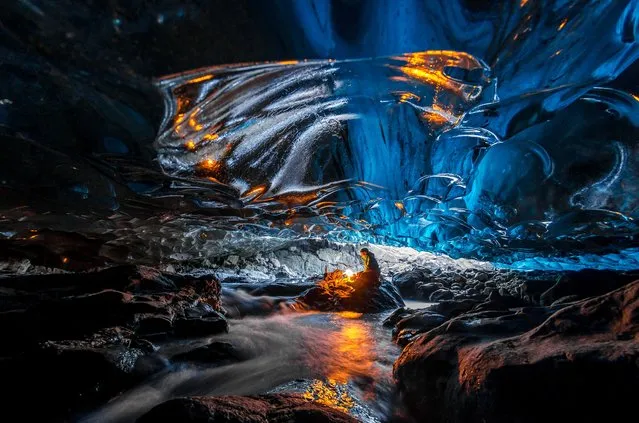
Stunning images have revealed ice-cool British tourists chilling out inside Europe’s largest glacier – despite being at risk of flooding. The spectacular collection of images show the explorers braving the freezing temperatures to climb, photograph and even abseil down the inside of the icy cliff sides. Another image shows one visitor on his knees appearing to pray next to a water fall of melted ice. Other glistening shots show an adventurer trying to keep warm by a fire whose flames dance beautifully against the glossy roof. More shots show the caves sparkling like crystal with one ice formation appearing to resemble bubble wrap. In one picture, a brave tourist stands at the edge of a river flowing through the centre of the frosty caves. (Photo by Einar Runar Sigurdsson/Mediadrumworld.com)

Stunning images have revealed ice-cool British tourists chilling out inside Europe’s largest glacier – despite being at risk of flooding. The spectacular collection of images show the explorers braving the freezing temperatures to climb, photograph and even abseil down the inside of the icy cliff sides. Another image shows one visitor on his knees appearing to pray next to a water fall of melted ice. Other glistening shots show an adventurer trying to keep warm by a fire whose flames dance beautifully against the glossy roof. (Photo by Einar Runar Sigurdsson/Mediadrumworld.com)
Details
03 Dec 2016 11:36:00
In this Tuesday, September 12, 2017 photo, Amornrat Simapsaisan, a local shop manager, watches before she ate watermelon salad with bamboo worms, at Inspects in the Backyard restaurant, Bangkok, Thailand. Tucking into insects is nothing new in Thailand, where street vendors pushing carts of fried crickets and buttery silkworms have long fed locals and adventurous tourists alike. But bugs are now fine-dining at the Bangkok bistro aiming to revolutionize views of nature’s least-loved creatures and what you can do with them. She tucked in quite happily to her watermelon and cricket salad on a recent evening.  “It’s tasty. It’s munchy”, she said. (Photo by Sakchai Lalit/AP Photo)

In this Tuesday, September 12, 2017 photo, Amornrat Simapsaisan, a local shop manager, watches before she ate watermelon salad with bamboo worms, at Inspects in the Backyard restaurant, Bangkok, Thailand. Tucking into insects is nothing new in Thailand, where street vendors pushing carts of fried crickets and buttery silkworms have long fed locals and adventurous tourists alike. But bugs are now fine-dining at the Bangkok bistro aiming to revolutionize views of nature’s least-loved creatures and what you can do with them. She tucked in quite happily to her watermelon and cricket salad on a recent evening. “It’s tasty. It’s munchy”, she said. (Photo by Sakchai Lalit/AP Photo)
Details
04 Oct 2017 06:54:00
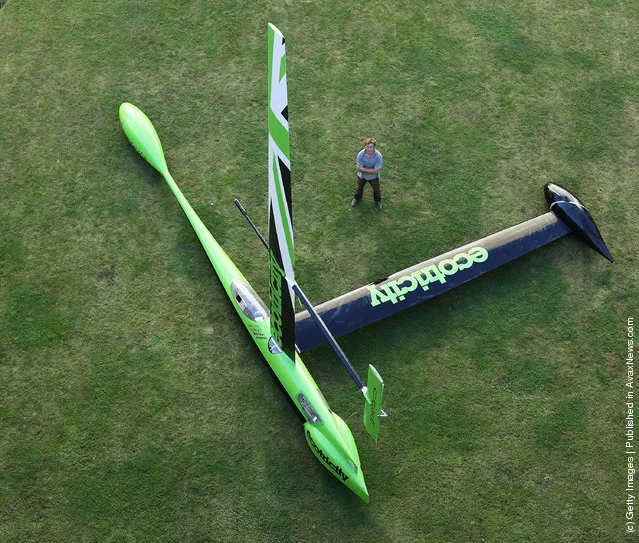
Ecotricity's Greenbird vehicle, designed and piloted by Richard Jenkins, broke the land speed world record for a wind-powered vehicle in 2009

“Ecotricity's Greenbird vehicle, designed and piloted by Richard Jenkins, broke the land speed world record for a wind-powered vehicle in 2009. Greenbird recorded a top speed of 126.4 mph (203.4 km/h), and sustained a speed of 126.2 mph (203.1 km/h) for the required time of three seconds, beating the previous, American held, record of 116 mph (186.7 km/h), set by Bob Schumacher in the Iron Duck in March 1999 at the same location”. – Wikipedia

Photo: Richard Jenkins poses for photographs with the world's fastest wind powered land Vehicle at Science Museum on August 3, 2009 in London, England. (Photo by Dan Kitwood/Getty Images)
Details
12 Dec 2011 12:30:00
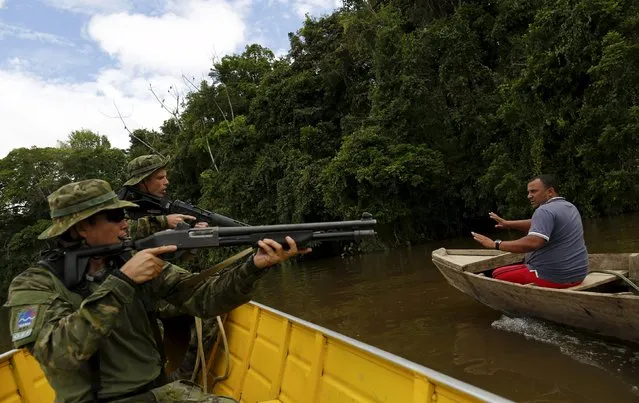
A gold prospector is detained by agents of Brazil’s environmental agency on the Uraricoera River during an operation against illegal gold mining on indigenous land, in the heart of the Amazon rainforest, in Roraima state, Brazil April 15, 2016. (Photo by Bruno Kelly/Reuters)

A gold prospector is detained by agents of Brazil’s environmental agency on the Uraricoera River during an operation against illegal gold mining on indigenous land, in the heart of the Amazon rainforest, in Roraima state, Brazil April 15, 2016. At over 9.5 million hectares, the Yanomami territory is twice the size of Switzerland and home to around 27,000 indians. The land has legally belonged to the Yanomami since 1992, but illegal miners continue to plague the area, sawing down trees and poisoning rivers with mercury in their lust for gold. (Photo by Bruno Kelly/Reuters)
Details
27 Apr 2016 10:01:00
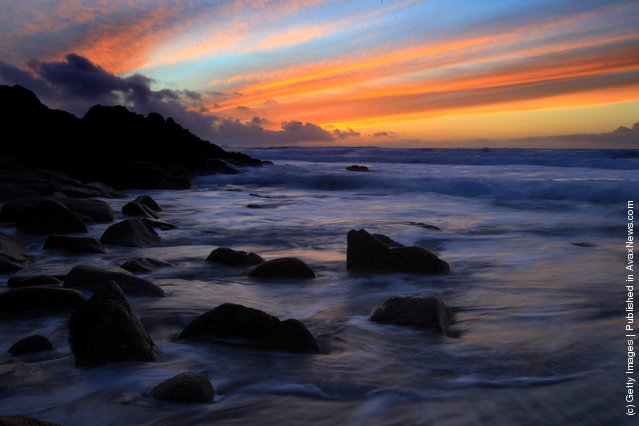
Beautiful Sunset in Cornwall

The sun sets over the sea looking towards Lands End viewed from Gwenver beach near Sennen Cove on February 7, 2011 in Cornwall, England. (Photo by Matt Cardy/Getty Images)
Details
22 Sep 2011 12:34:00
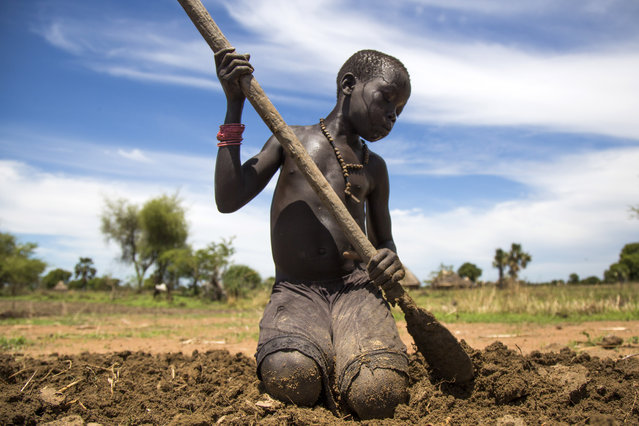
Nyibol Lual, 13 years old, helps her family to prepare the land for cultivation on May 31, 2017, in Panthau, Northern Bahr al Ghazal, South Sudan. The family has a small land where they cultivate sorghum. An estimated 63 per cent of the population in Northern Bahr al Ghazal is experiencing severe food insecurity, according to the latest Integrated Food Security Phase Classification (IPC) report. The situation is particularly bad in Aweil West and Aweil South counties, where the exhaustion of household food stocks and growing dependence on financially inaccessible markets have left the population facing Emergency levels of food insecurity. (Photo by Albert Gonzalez Farran/AFP Photo)

Nyibol Lual, 13 years old, helps her family to prepare the land for cultivation on May 31, 2017, in Panthau, Northern Bahr al Ghazal, South Sudan. The family has a small land where they cultivate sorghum. An estimated 63 per cent of the population in Northern Bahr al Ghazal is experiencing severe food insecurity, according to the latest Integrated Food Security Phase Classification (IPC) report. The situation is particularly bad in Aweil West and Aweil South counties, where the exhaustion of household food stocks and growing dependence on financially inaccessible markets have left the population facing Emergency levels of food insecurity. (Photo by Albert Gonzalez Farran/AFP Photo)
Details
01 Jun 2017 10:10:00
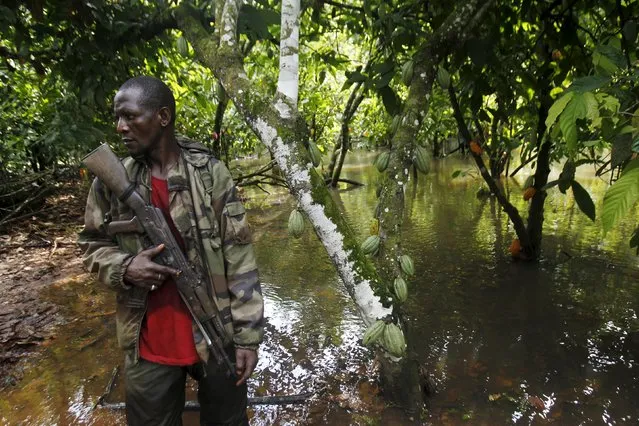
An agent of the OIPR, one of the government agencies charged with managing protected land, stands next to cocoa trees inside Mont Peko National Park in Duekoue department, western Ivory Coast August 18, 2015. (Photo by Luc Gnago/Reuters)

An agent of the OIPR, one of the government agencies charged with managing protected land, stands next to cocoa trees inside Mont Peko National Park in Duekoue department, western Ivory Coast August 18, 2015. (Photo by Luc Gnago/Reuters)
Details
08 Oct 2015 08:06:00