The Sunda lemur uses a special membrane to “fly” between trees while on the lookout for food in Java, Indonesia in the last decade of June 2024. (Photo by Dzulfikri/Solent News)
Drag performer Maxi Shield chats to her online audience on May 18, 2020 in Sydney, Australia. Drag performer Maxi Shield started hosting a live instagram chat show “Maxi's Couch Potato” as a way to keep performing and connected with fans on social media after perfomance venues were closed due to the COVID-19 outbreak. (Photo by Don Arnold/Getty Images)
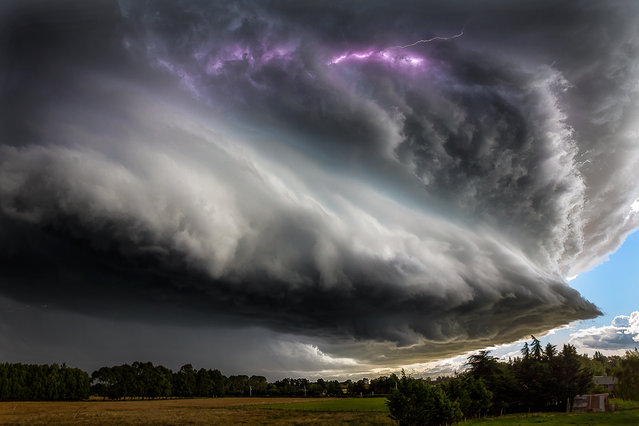
“Thunderstruck”. Summer stom. A super cell formed off the coast of New Zealand, intensified and swept across Christchurch and North Canterbury, February 23, 2014. Photo location: Christchurch, New Zealand. (Photo and caption by David Hardy/National Geographic Photo Contest)
A drag performer named Reagan Holiday competes in a drag queen competition called MR(S) BK in the Brooklyn borough in New York City, U.S. on March 10, 2018. (Photo by Stephanie Keith/Reuters)
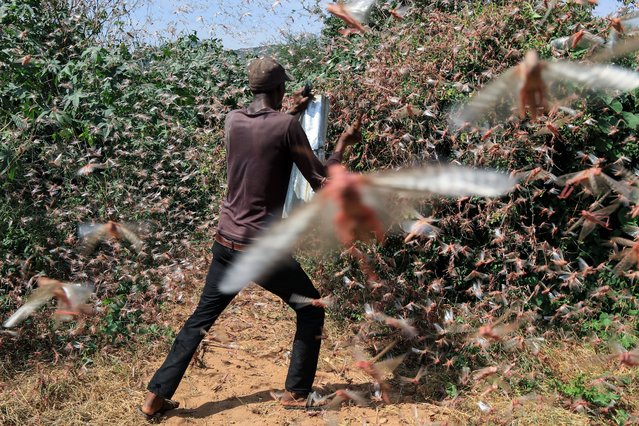
A man uses iron sheet to make noises, as a way of trying to disperse desert locusts that had invaded their farms during the second wave invasion in Kakongo village, in Nuu-Mwingi East, in Kitui, Kenya, 06 February 2021. The second wave invasion of the desert locusts in the country comes at a time where most famers are expecting to harvest their farm produce in the country. (Photo by Daniel Irungu/EPA/EFE)
For her series “Japanese Whispers”, Belgian photographer Zaza Bertrand headed inside the intimate world of rabuhos – Japanese love hotels. Love hotels became popular in Japan from the 1960s onwards, due to a lack of privacy in many family homes. There are now around 37,000 of these hotels in Japan, allowing short daytime “rests” or overnight stays. (Photo by Zaza Bertrand/The Guardian)
A man presents a self-made robot that local media reported is able to carry a person, in Heihe, Heilongjiang province, China, April 5, 2017. (Photo by Reuters/China Daily)
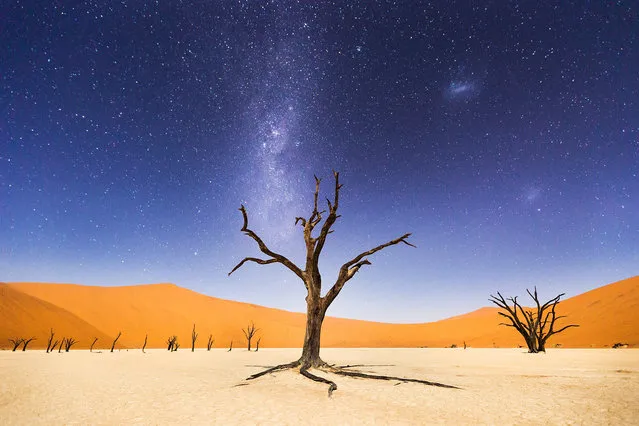
Merit: A Night at Deadvlei. The night before returning to Windhoek, we spent several hours at Deadveli. The moon was bright enough to illuminate the sand dunes in the distance, but the skies were still dark enough to clearly see the milky way and magellanic clouds. Deadveli means “dead marsh. The camelthorn trees are believed to be about 900 years old, but have not decomposed because the environment is so dry. (Photo and caption by Beth McCarley/National Geographic Traveler Photo Contest)