Loading...
Done
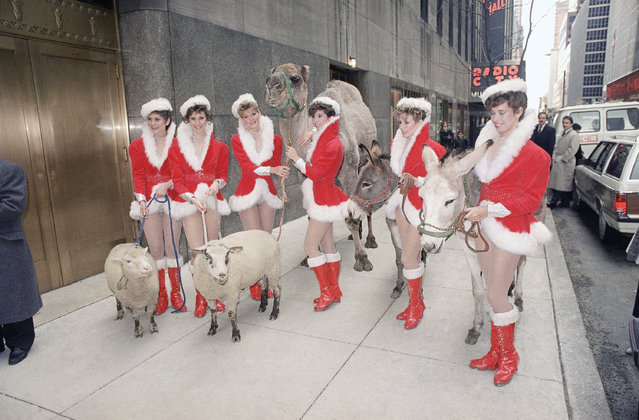
Animals destined for the stage of Radio City Music Hall in New York on November 13, 1986 are led to the stage door by their co-stars, the Rockettes dancers. A variety of animals, including camels, sheep and donkeys, will star in an annual Christmas production. (Photo by G. Paul Burnett/AP Photo)

Animals destined for the stage of Radio City Music Hall in New York on November 13, 1986 are led to the stage door by their co-stars, the Rockettes dancers. A variety of animals, including camels, sheep and donkeys, will star in an annual Christmas production. (Photo by G. Paul Burnett/AP Photo)
Details
22 Dec 2014 11:48:00
Models walk the runway at the A Child of the Jago fashion show during London Fashion Week

Models walk the runway at the “A Child of the Jago” fashion show during London Fashion Week at the Wilton Music Hall on September 21, 2011 in London, United Kingdom. (Photo by Ian Gavan/Getty Images)
Details
24 Sep 2011 11:08:00
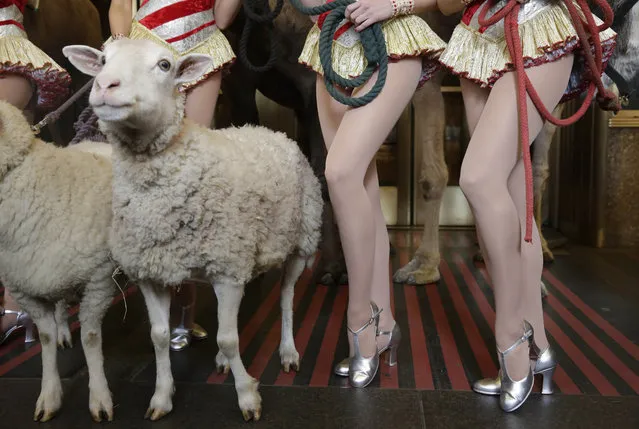
The legs of camel and sheep for the “Living Nativity” scene, and Rockettes, of the “Radio City Christmas Special”, are juxtaposed as they pose for photos outside New York's Radio City Music Hall, Tuesday, October 28, 2014. The show is scheduled to open Friday, November 7, 2014 and continue through Wednesday, December 31, 2014. The “Living Nativity” has been part of the Christmas Spectacular since its inception in 1933. (Photo by Richard Drew/AP Photo)

The legs of camel and sheep for the “Living Nativity” scene, and Rockettes, of the “Radio City Christmas Special”, are juxtaposed as they pose for photos outside New York's Radio City Music Hall, Tuesday, October 28, 2014. The show is scheduled to open Friday, November 7, 2014 and continue through Wednesday, December 31, 2014. The “Living Nativity” has been part of the Christmas Spectacular since its inception in 1933. (Photo by Richard Drew/AP Photo)
Details
01 Nov 2014 14:53:00
A woman leans against one of the stones of the Stonehenge monument on the summer solstice near Amesbury, Britain on June 21, 2017. (Photo by Neil Hall/Reuters)

A woman leans against one of the stones of the Stonehenge monument on the summer solstice near Amesbury, Britain on June 21, 2017. The annual festival attracts hundreds of people to the 5000 year old stone circle to mark the longest day in the northern hemisphere. sunrise was at 4.52am and was celebrated by dancing, music, and ritualistic events around the stones. (Photo by Neil Hall/Reuters)
Details
22 Jun 2017 08:41:00
Dancers learn choreography they will need to perform as part of an open audition for the 2022 Radio City Rockettes at Radio City Music Hall in New York, New York, USA, 18 April 2022. The open auditions, the first being held since the start of the coronavirus pandemic, were expected to draw nearly 900 dancers competing for one of the few open spots in the 2022 Christmas Spectacular Starring the Radio City Rockettes, a long running holiday show. (Photo by Justin Lane/EPA/EFE)

Dancers learn choreography they will need to perform as part of an open audition for the 2022 Radio City Rockettes at Radio City Music Hall in New York, New York, USA, 18 April 2022. The open auditions, the first being held since the start of the coronavirus pandemic, were expected to draw nearly 900 dancers competing for one of the few open spots in the 2022 Christmas Spectacular Starring the Radio City Rockettes, a long running holiday show. (Photo by Justin Lane/EPA/EFE)
Details
20 Apr 2022 05:43:00
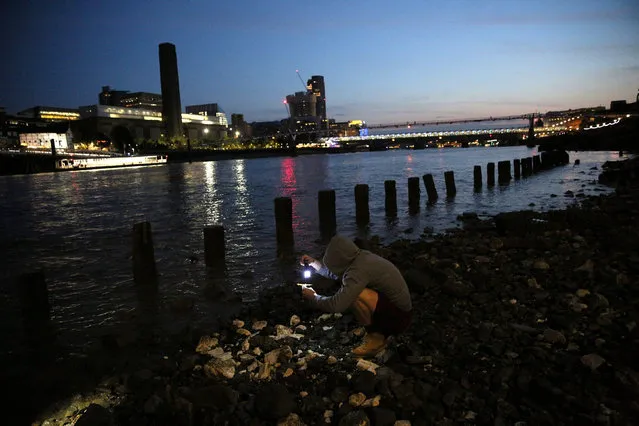
A mudlark uses a torch to look for items on the bank of the River Thames in London, Britain June 06, 2016. Mudlarking is believed to trace its origins to the 18th and 19th century, when scavengers searched the Thames' shores for items to sell. These days, history and archaeology fans are the ones hoping to find old relics such as coins, ceramics, artifacts or everyday items from across centuries. They wait for the low tide and then scour specific areas of exposed shores. "If you're in a field you could be out all day long, with the river you're restricted to about two or three hours," mudlark Nick Stevens said. While many just use the naked eye for their searches, others rely on metal detectors for which a permit from the Port of London Authority is needed. Digging also requires consent. (Photo by Neil Hall/Reuters)

A mudlark uses a torch to look for items on the bank of the River Thames in London, Britain June 06, 2016. Mudlarking is believed to trace its origins to the 18th and 19th century, when scavengers searched the Thames' shores for items to sell. These days, history and archaeology fans are the ones hoping to find old relics such as coins, ceramics, artifacts or everyday items from across centuries. their finds with the Portable Antiquities Scheme. Any item over 300 years old must be recorded. (Photo by Neil Hall/Reuters)
Details
27 Aug 2016 10:43:00
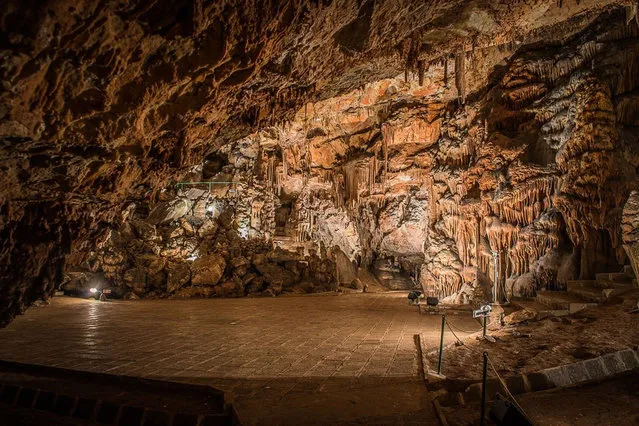
Saeva Dupka Cave

Saeva dupka (Bulgarian: Съева дупка) is a cave in Northern Bulgaria near the village of Brestnitsa, Lovech Province (43°2′N 24°11′E). Its five halls and 400 metres of corridors offer some of the most beautiful cave formations in the country. Besides that the cave has hosted many Choral music performances, thanks to the excellent acoustic conditions. Saeva dupka was named after two brothers Seyu and Sae who used it as a hiding place during the Ottoman occupation of Bulgaria. Recent excavations have showed the cave was inhabited since Roman times. Currently Saeva dupka is one of the 100 Tourist Sites of Bulgaria.
Details
20 Feb 2013 11:30:00


Hong Yi is a Malaysian architect and artist whose impressive portfolio includes work for Chicago’s Union Station, the Melbourne Hall of Music, and alternative medium portraits using coffee stains or tea bags. Her unorthodox approach to creation has led her to her most recent blog project. Over the course of 31 days, Hong Yi (who also goes by Red) will post art pieces made from food. So far, the pieces range from simpler ones of a watermelon sailboat to a complex recreation of Hokusai’s “The Great Wave.”
Details
29 Mar 2013 10:31:00