Loading...
Done
A woman shouts asking for help during an eviction in Rio de Janeiro, Brazil, Friday, April 11, 2014. Squatters in Rio de Janeiro are clashing with police after a Brazilian court ordered that 5,000 people be evicted from abandoned buildings of a telecommunications company. Officers have used tear gas and stun grenades to try to disperse the families. (Photo by Silvia Izquierdo/AP Photo)

A woman shouts asking for help during an eviction in Rio de Janeiro, Brazil, Friday, April 11, 2014. Squatters in Rio de Janeiro are clashing with police after a Brazilian court ordered that 5,000 people be evicted from abandoned buildings of a telecommunications company. Officers have used tear gas and stun grenades to try to disperse the families. (Photo by Silvia Izquierdo/AP Photo)
Details
13 Apr 2014 07:22:00
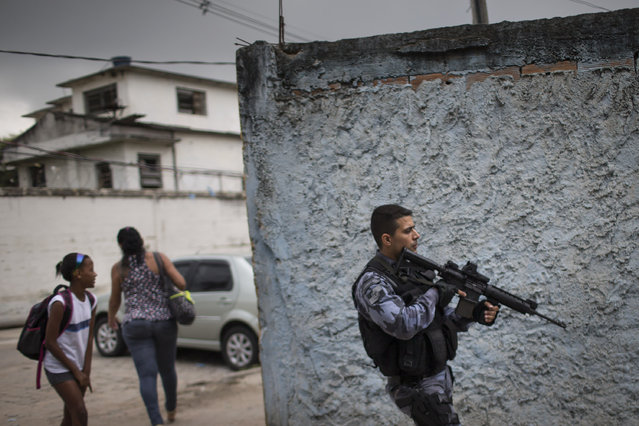
A military police officer patrols in the Roquette Pinto shantytown, part of the Mare slum complex in Rio de Janeiro, Brazil, Wednesday, April 1, 2015. The Brazilian army has begun to pull out of one of Rio de Janeiro's most violent slums, with police assuming responsibility for security in the area. (Photo by Felipe Dana/AP Photo)

A military police officer patrols in the Roquette Pinto shantytown, part of the Mare slum complex in Rio de Janeiro, Brazil, Wednesday, April 1, 2015. The Brazilian army has begun to pull out of one of Rio de Janeiro's most violent slums, with police assuming responsibility for security in the area. (Photo by Felipe Dana/AP Photo)
Details
02 Apr 2015 12:26:00
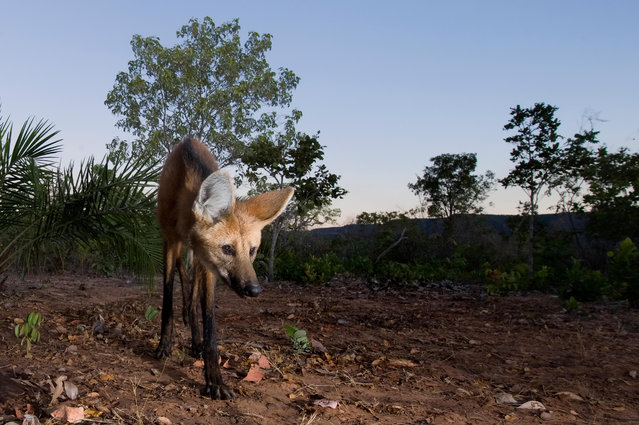
The maned wolf is among the large mammals in the Brazilian Cerrado that are threatened by the increasing conversion of grasslands into farmland for grazing and growing crops. (Photo by Ben Cranke/Nature Picture Library/Alamy Stock Photo)

Global wildlife populations will decline by 67% by 2020 unless urgent action is taken to reduce human impact on species and ecosystems, warns the biennial Living Planet Index report from WWF (World Wide Fund for Nature) and ZSL (Zoological Society of London). From elephants to eels, here are some of the wildlife populations most affected by human activity. Here: The maned wolf is among the large mammals in the Brazilian Cerrado that are threatened by the increasing conversion of grasslands into farmland for grazing and growing crops. (Photo by Ben Cranke/Nature Picture Library/Alamy Stock Photo)
Details
28 Oct 2016 10:47:00
Costume details featuring Joao Candido, a black sailor who led a revolt against the physical punishment of Brazilian Navy soldiers at the beginning of the 20th century, lie inside the Paraíso do Tuiuti Samba school at the Samba City complex in Rio de Janeiro, Brazil, Tuesday, January 16, 2024. Samba schools are gearing up for this year's Carnival, scheduled from Feb. 9-17. (Photo by Bruna Prado/AP Photo)

Costume details featuring Joao Candido, a black sailor who led a revolt against the physical punishment of Brazilian Navy soldiers at the beginning of the 20th century, lie inside the Paraíso do Tuiuti Samba school at the Samba City complex in Rio de Janeiro, Brazil, Tuesday, January 16, 2024. Samba schools are gearing up for this year's Carnival, scheduled from Feb. 9-17. (Photo by Bruna Prado/AP Photo)
Details
05 Apr 2025 02:24:00
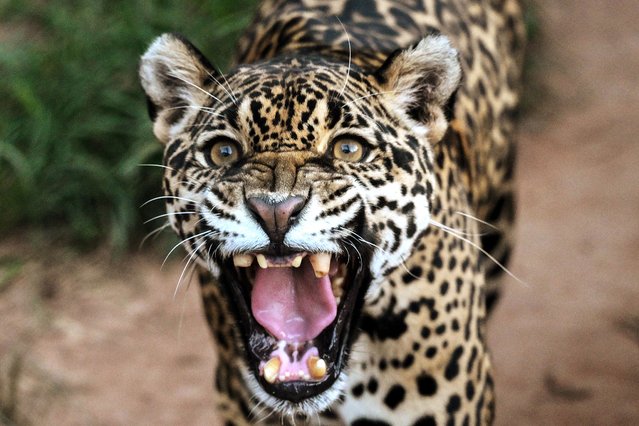
A jaguar (Panthera onca) growls at the Mata Ciliar association, an organization for the conservation of biodiversity, in Jundiai, Sao Paulo state, Brazil on May 29, 2025. Twenty-five pumas and ten jaguars are currently recovering at the Brazilian Center for the Conservation of Neotropical Felines at Mata Ciliar, a site as large as 40 football fields where monkeys, wild dogs, maned wolves, ocelots, and other regional animals are also rehabilitated. (Photo by Nelson Almeida/AFP Photo)

A jaguar (Panthera onca) growls at the Mata Ciliar association, an organization for the conservation of biodiversity, in Jundiai, Sao Paulo state, Brazil on May 29, 2025. Twenty-five pumas and ten jaguars are currently recovering at the Brazilian Center for the Conservation of Neotropical Felines at Mata Ciliar, a site as large as 40 football fields where monkeys, wild dogs, maned wolves, ocelots, and other regional animals are also rehabilitated. (Photo by Nelson Almeida/AFP Photo)
Details
22 Jun 2025 02:21:00


It looks like 2024 has ended and we are still alive (although of course it's not evening yet). Well, let's wish ourselves the same in the future. If someone wants to put USDT TRC20 under the tree: TDWPvSi7RY4wNZPukDRyKghhLGTGsRNRBe (nobody will put anything, of course – but you understand, it's a ritual). Happy New Year! And now disco.
Details
31 Dec 2024 04:28:00
A child plays in front of “Etnias”, a large graffiti wall by Brazilian graffiti artist Eduardo Kobra created ahead of the Rio 2016 Olympic Games at Porto Maravilha in Rio de Janeiro, Brazil, 30 July 2016. The Olympics start on 05 August. Eduardo Kobra hopes to set a Guinness World Record for the largest graffiti created by a single artist. (Photo by Lukas Coch/EPA)

A child plays in front of “Etnias”, a large graffiti wall by Brazilian graffiti artist Eduardo Kobra created ahead of the Rio 2016 Olympic Games at Porto Maravilha in Rio de Janeiro, Brazil, 30 July 2016. The Olympics start on 05 August. Eduardo Kobra hopes to set a Guinness World Record for the largest graffiti created by a single artist. (Photo by Lukas Coch/EPA)
Details
01 Aug 2016 10:35:00
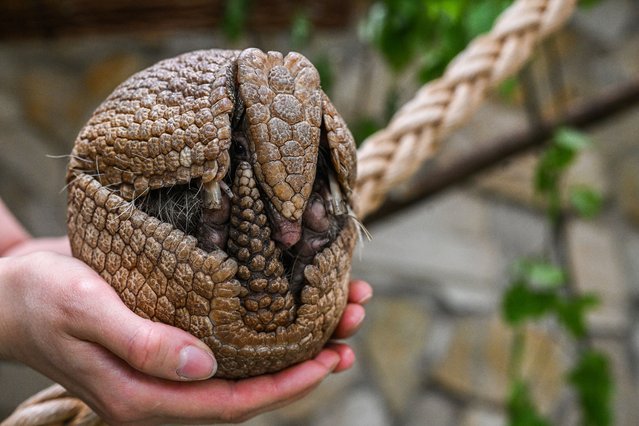
Zookeeper Agata holds a rare newborn Brazilian three-banded armadillo inside its enclosure at the Wroclaw Zoo in Wroclaw, Poland on May 11, 2023. The Tolypeutes matatus, or the southern armor also known as bolita or tatu-bola, is a fairly popular animal in South America but is increasingly rare. The new zoo child was born on March 23. The species is listed as vulnerable by the International Union for the Conservation of Nature (IUCN) and threatened by habitat loss and hunting. (Photo by Omar Marques/Anadolu Agency via Getty Images)

Zookeeper Agata holds a rare newborn Brazilian three-banded armadillo inside its enclosure at the Wroclaw Zoo in Wroclaw, Poland on May 11, 2023. The Tolypeutes matatus, or the southern armor also known as bolita or tatu-bola, is a fairly popular animal in South America but is increasingly rare. The new zoo child was born on March 23. The species is listed as vulnerable by the International Union for the Conservation of Nature (IUCN) and threatened by habitat loss and hunting. (Photo by Omar Marques/Anadolu Agency via Getty Images)
Details
28 May 2023 04:09:00