Loading...
Done
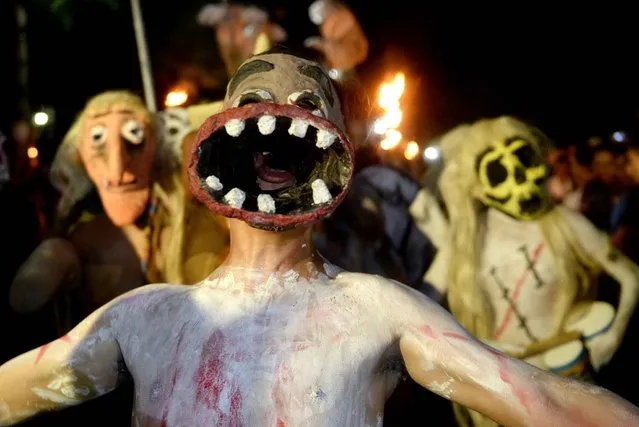
Young revelers take part in a parade called "La Calabiuza" on November 1, 2015, on the eve of the Day of the Dead in Tonacatepeque, 20 kms (13 miles) north of San Salvador. During the celebration, the residents of Tonacatepeque, originally an indigenous community, recall the characters from the mythology of Cuscatlan – pre-Columbian west and central regions of El Salvador – and their dead relatives. (Photo by Marvin Recinos/AFP Photo)

Young revelers take part in a parade called "La Calabiuza" on November 1, 2015, on the eve of the Day of the Dead in Tonacatepeque, 20 kms (13 miles) north of San Salvador. During the celebration, the residents of Tonacatepeque, originally an indigenous community, recall the characters from the mythology of Cuscatlan – pre-Columbian west and central regions of El Salvador – and their dead relatives. (Photo by Marvin Recinos/AFP Photo)
Details
04 Nov 2015 11:50:00
Skeletons are arranged in a bar scene as part of a competition to create Day of the Dead altars on pedestrian Regina Street in central Mexico City, Tuesday, November 1, 2016. The holiday honors the dead as friends and families gather in cemeteries to decorate their loved ones' graves and hold vigil through the night on Nov. 1 and 2. (Photo by Rebecca Blackwell/AP Photo)

Skeletons are arranged in a bar scene as part of a competition to create Day of the Dead altars on pedestrian Regina Street in central Mexico City, Tuesday, November 1, 2016. The holiday honors the dead as friends and families gather in cemeteries to decorate their loved ones' graves and hold vigil through the night on Nov. 1 and 2. (Photo by Rebecca Blackwell/AP Photo)
Details
03 Nov 2016 12:57:00
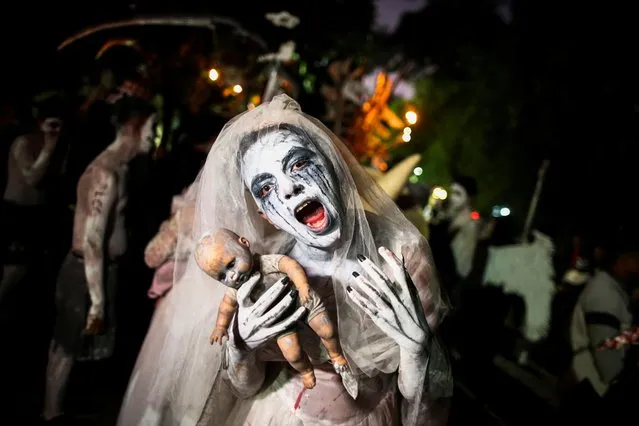
A reveller dressed as “La Llorona” participates in a parade known as “La Calabiuza” on the eve of the Day of the Dead in Tonacatepeque, El Salvador on November 1, 2022. (Photo by Jose Cabezas/Reuters)

A reveller dressed as “La Llorona” participates in a parade known as “La Calabiuza” on the eve of the Day of the Dead in Tonacatepeque, El Salvador on November 1, 2022. (Photo by Jose Cabezas/Reuters)
Details
28 Dec 2023 21:12:00
Voodoo followers, called Pitit Fey, attend a ceremony during the Day of the Dead celebrations at the Meyotte cemetery in Kay Gouye, in Port-au-Prince, Haiti, November 1, 2021. (Photo by Claudia Daut/Reuters)

Voodoo followers, called Pitit Fey, attend a ceremony during the Day of the Dead celebrations at the Meyotte cemetery in Kay Gouye, in Port-au-Prince, Haiti, November 1, 2021. (Photo by Claudia Daut/Reuters)
Details
08 Nov 2021 08:18:00
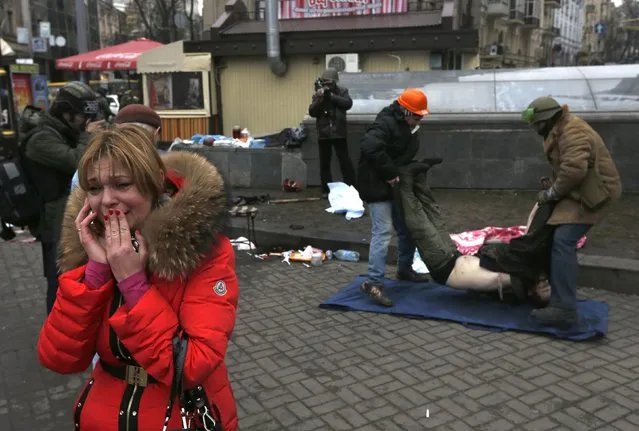
A woman reacts as anti-government protesters place a dead body on a stretcher after violence erupted in the Independence Square in Kiev, in this February 20, 2014 file photo. (Photo by Vasily Fedosenko/Reuters)

A woman reacts as anti-government protesters place a dead body on a stretcher after violence erupted in the Independence Square in Kiev, in this February 20, 2014 file photo. (Photo by Vasily Fedosenko/Reuters)
Details
14 Dec 2014 12:08:00
Tourist Amy Powers is approached by “Walker” Matthew Tomlin during The Walking Dead Tour of a Season 3 location of the AMC production in Haralson, Georgia, U.S. on June 15, 2019. (Photo by Chris Aluka Berry/Reuters)

Tourist Amy Powers is approached by “Walker” Matthew Tomlin during The Walking Dead Tour of a Season 3 location of the AMC production in Haralson, Georgia, U.S. on June 15, 2019. (Photo by Chris Aluka Berry/Reuters)
Details
08 Jul 2019 00:01:00
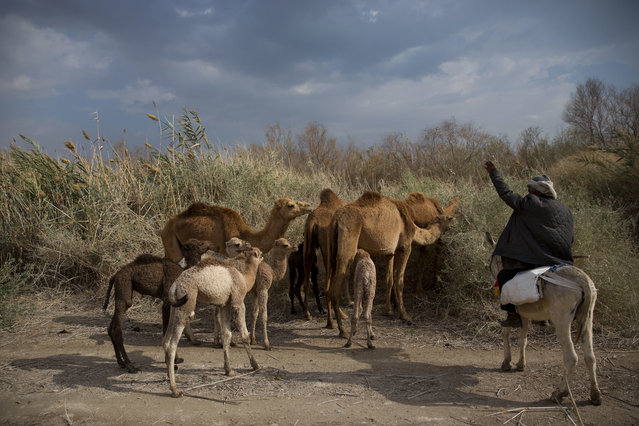
In this Sunday, February 18, 2018 photo, Palestinian camel herder Salem Rashaideh, leads the way for the camels in the territory of Israeli Kibbutz Kalya, near the Dead Sea in the West Bank. (Phoro by Oded Balilty/AP Photo)

In this Sunday, February 18, 2018 photo, Palestinian camel herder Salem Rashaideh, leads the way for the camels in the territory of Israeli Kibbutz Kalya, near the Dead Sea in the West Bank. For three months a year, in the winter time Bedouin Arab herders take their 130 camels to graze on the shores of the Dead Sea, at the lowest place on Earth. (Phoro by Oded Balilty/AP Photo)
Details
19 Mar 2018 00:03:00
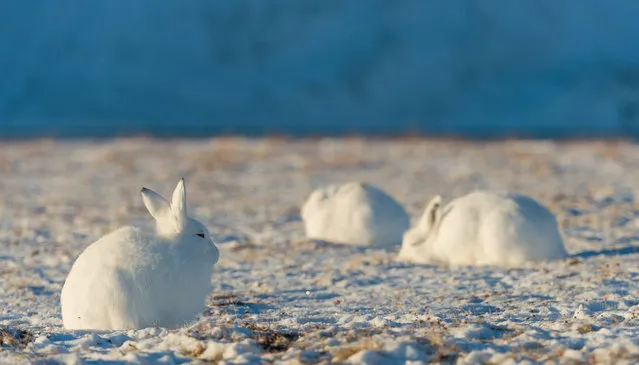
Arctic Hare

The arctic hare, or polar rabbit, is a species of hare which is adapted largely to polar and mountainous habitats. The arctic hare survives with a thick coat of fur and usually digs holes in the ground or under snow to keep warm and sleep. Arctic hares look like rabbits but have shorter ears, are taller when standing, and, unlike rabbits, can thrive in cold climates. They can travel together with many other hares, sometimes huddling with dozens or more, but are usually found alone, taking, in some cases, more than one partner. The arctic hare can run up to 60 kilometres per hour (40 mph). Its predators include the arctic wolf, arctic fox, and ermine.
Details
17 Mar 2014 13:56:00