Loading...
Done
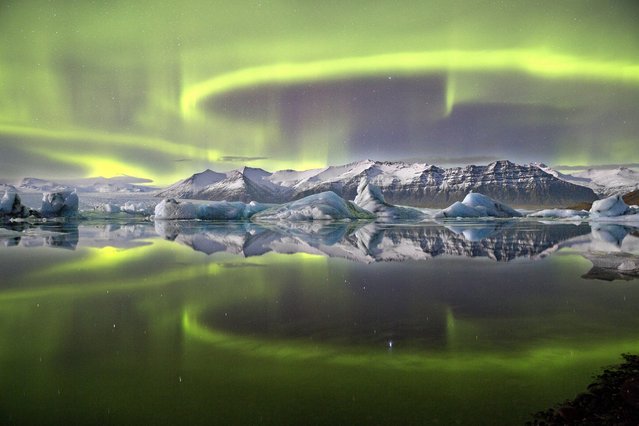
“Aurora over a glacier lagoon”. A vivid green overheaded aurrora pictured in Iceland's Vatnajokull National Park reflected almost symetrically in Jokulsrlon Glacier lagoon. A complete lack of wind and currrent combin in this sheltred lagoon scene to crete an arresting mirror effect giving the image a sensation of utter stillness. Despite theis there is motion on a suprising scale, as the loops and arcs of the aurora are shaped by the shifting forces of the Earth's magnetic field. (Photo by  James Woodend/The Astronomy Photographer of the Year 2014 Contest)

“Aurora over a glacier lagoon”. A vivid green overheaded aurrora pictured in Iceland's Vatnajokull National Park reflected almost symetrically in Jokulsrlon Glacier lagoon. A complete lack of wind and currrent combin in this sheltred lagoon scene to crete an arresting mirror effect giving the image a sensation of utter stillness. Despite theis there is motion on a suprising scale, as the loops and arcs of the aurora are shaped by the shifting forces of the Earth's magnetic field. James Woodend of Great Britain won the grand prize with the image, beating out more than 2,500 other entries. The Astronomy Photographer of the Year 2014 contest is judged by the Royal Observatory Greenwich and BBC Sky at Night magazine. (Photo by James Woodend/The Astronomy Photographer of the Year 2014 Contest)
Details
26 Sep 2014 13:39:00
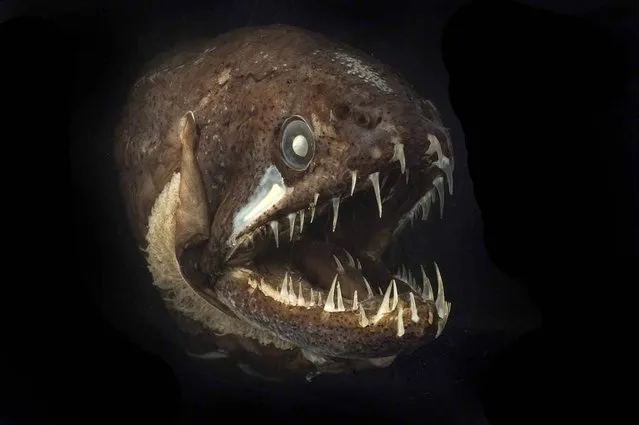
Imagine living in the sea where it is permanently dark, cold, and food is hard to find. For many animals at depth, it may be weeks to months between meals. If you find something to eat, you have to hang on to it

Imagine living in the sea where it is permanently dark, cold, and food is hard to find. For many animals at depth, it may be weeks to months between meals. If you find something to eat, you have to hang on to it. This is why so many deep-sea fishes have lots of big teeth. This dragonfish, spotted off the coast of Australia, even has teeth on its tongue. They would be terrifying animals ... if they weren’t the size of a banana. (Photo by Julian Finn/Museum Victoria)
Details
21 May 2012 12:14:00
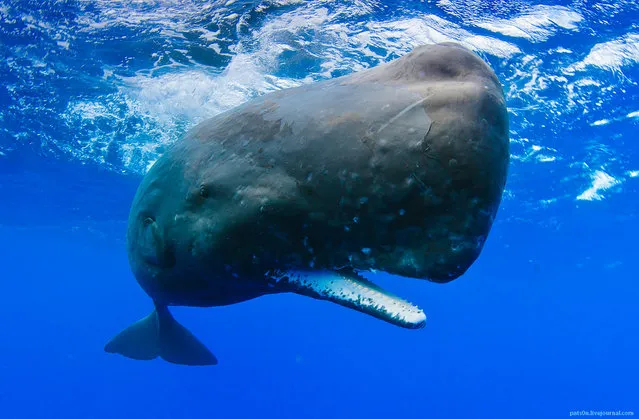
“Sperm whale opening it's huge mouth, Ogasawara Islands, Japan. Sperm whales are the biggest carnivorous animals on the planet. Each teeth in the mouth of adult specimen weights more than 1 kilogram. Interestingly enough that modern marine biologists believe that these teeth despite being fearsome play little role in capturing and eating giant squid – with their main function being mainly ritual aggression between males!”. (Alexander Safonov)

“Sperm whale opening it's huge mouth, Ogasawara Islands, Japan. Sperm whales are the biggest carnivorous animals on the planet. Each teeth in the mouth of adult specimen weights more than 1 kilogram. Interestingly enough that modern marine biologists believe that these teeth despite being fearsome play little role in capturing and eating giant squid – with their main function being mainly ritual aggression between males!”. (Photo by Alexander Safonov)
Details
30 Nov 2012 11:22:00
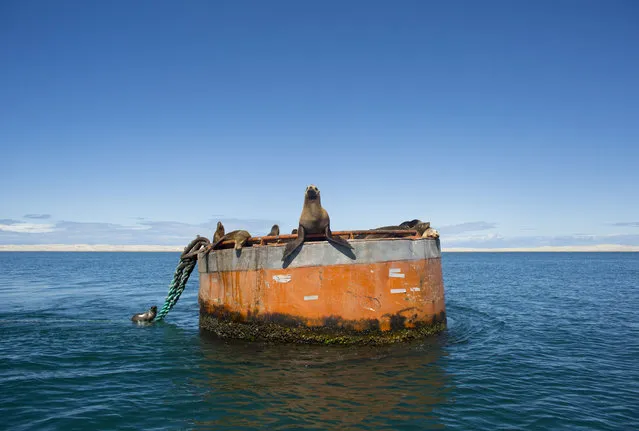
In this March 3, 2015 photo, a group of California sea lions rest on a large bouy in the San Ignacio lagoon, in the Pacific Ocean, near Guerrero Negro, in Mexico's Baja California peninsula. (Photo by Dario Lopez-Mills/AP Photo)

In this March 3, 2015 photo, a group of California sea lions rest on a large bouy in the San Ignacio lagoon, in the Pacific Ocean, near Guerrero Negro, in Mexico's Baja California peninsula. (Photo by Dario Lopez-Mills/AP Photo)
Details
20 Mar 2015 10:37:00
Fan Bing Bing, Concha de Plata (Silver Shell) award winnerfor best actress for the feature film “I Am Not Madame Bovary” speaks on her telephone during the awards ceremony at the San Sebastian Film Festival, September 24, 2016, in San Sebastian, northern Spain. (Photo by Vincent West/Reuters)

Fan Bing Bing, Concha de Plata (Silver Shell) award winnerfor best actress for the feature film “I Am Not Madame Bovary” speaks on her telephone during the awards ceremony at the San Sebastian Film Festival, September 24, 2016, in San Sebastian, northern Spain. (Photo by Vincent West/Reuters)
Details
25 Sep 2016 07:53:00
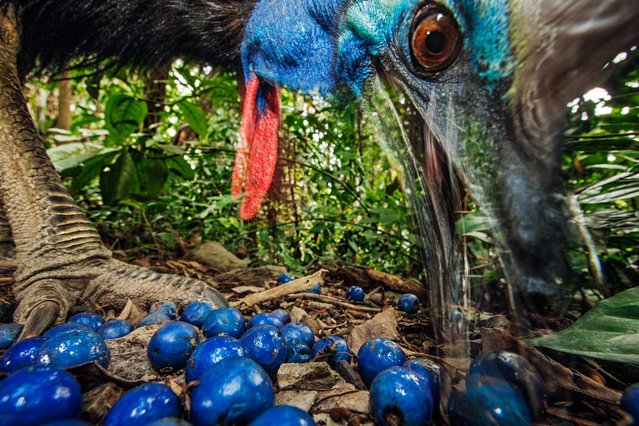
“Cassowaries are large, flightless birds related to emus and (more distantly) to ostriches, rheas, and kiwis”, writes Olivia Judson in the September issue of National Geographic magazine. (Photo by Christian Ziegler/National Geographic)

“Cassowaries are large, flightless birds related to emus and (more distantly) to ostriches, rheas, and kiwis”, writes Olivia Judson in the September issue of National Geographic magazine. How large? People-size: Adult males stand well over five foot five and top 110 pounds. Females are even taller, and can weigh more than 160 pounds. Dangerous when roused, they’re shy and peaceable when left alone. But even birds this big and tough are prey to habitat loss. The dense New Guinea and Australia rain forests where they live have dwindled. Today cassowaries might number 1,500 to 2,000. And because they help shape those same forests – by moving seeds from one place to another – “if they vanish”, Judson writes, “the structure of the forest would gradually change” too. (Photo by Christian Ziegler/National Geographic)
Details
06 Jan 2014 12:21:00
The Wood Art Of Mark Doolittle

Mantle Or Desk Clock “Ancient Sea Form”

A large Mantle or Desk Clock featuring a fossil ammonite at its center, carved from the South American wood Keolbra with radiating Walnut spines. The clock hangs on a round, Plexiglass back supported by a wood base (Bubinga). The clockworks is a quartz, high-torque movement that runs on a single AA battery.
Details
21 Nov 2013 11:49:00
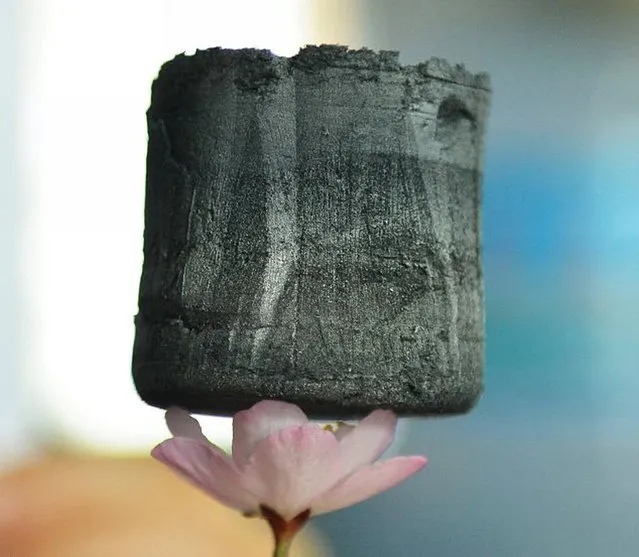
Carbon Aerogel The New Lightest Material

The lightest material ever made has been produced by a team of scientists in China, a Chinese university announced.
Details
07 Jan 2014 11:03:00