Loading...
Done
A Maasai woman arrives with collected firewoods at a village nearby Selenkay Conservancy, a community-owned conservation area running by a private company, in Amboseli, Kenya, on June 22, 2022. The camp's ten luxurious tents see tourists flocking again, after the shutdown linked to Covid-19. They observe in small groups elephants, giraffes, antelopes or lions on 5,000 hectares, located on the edge of Amboseli National Park, in the south of the country, and have a glimpse of the life of the Masai, the owners of the land. (Photo by Yasuyoshi Chiba/AFP Photo)

A Maasai woman arrives with collected firewoods at a village nearby Selenkay Conservancy, a community-owned conservation area running by a private company, in Amboseli, Kenya, on June 22, 2022. The camp's ten luxurious tents see tourists flocking again, after the shutdown linked to Covid-19. They observe in small groups elephants, giraffes, antelopes or lions on 5,000 hectares, located on the edge of Amboseli National Park, in the south of the country, and have a glimpse of the life of the Masai, the owners of the land. (Photo by Yasuyoshi Chiba/AFP Photo)
Details
22 Jul 2022 04:32:00
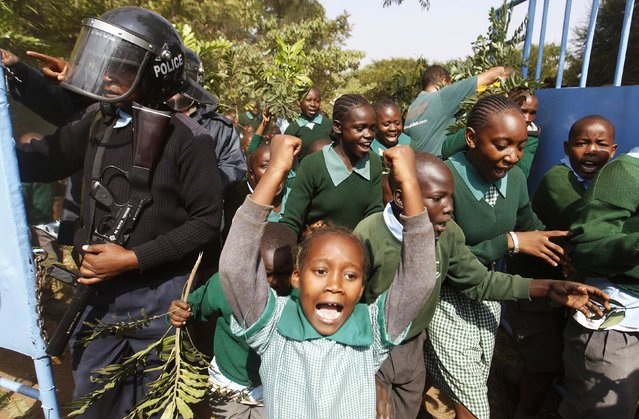
A woman who was injured after being trampled is helped away, after residents desperate for a planned distribution of food for those suffering under Kenya's coronavirus-related movement restrictions pushed through a gate and created a stampede, causing police to fire tear gas and leaving several injured, at a district office in the Kibera slum, or informal settlement, of Nairobi, Friday, April 10, 2020. (Photo by Brian Inganga/AP Photo)

A woman who was injured after being trampled is helped away, after residents desperate for a planned distribution of food for those suffering under Kenya's coronavirus-related movement restrictions pushed through a gate and created a stampede, causing police to fire tear gas and leaving several injured, at a district office in the Kibera slum, or informal settlement, of Nairobi, Friday, April 10, 2020. (Photo by Brian Inganga/AP Photo)
Details
12 Apr 2020 00:07:00
An innovative photographer attached a camera to a remote-controlled car, allowing him to capture angles of wild lions, rhinos and other animals. Over the last 11 years, Chris Bray has been taking pictures of animals using his toy car contraption while he takes guests on photography tours in Kenya. Bray purchased an ordinary remote-controlled car, stripped it of anything that could chewed or ripped off, leaving the chassis, then strapped a GoPro to the top of it. When a herd of animals has been sighted, Bray uses the toy car to approach the subjects’ general area without intruding. (Photo by Chris Bray/Caters News Agency)

An innovative photographer attached a camera to a remote-controlled car, allowing him to capture angles of wild lions, rhinos and other animals. Over the last 11 years, Chris Bray has been taking pictures of animals using his toy car contraption while he takes guests on photography tours in Kenya. (Photo by Chris Bray/Caters News Agency)
Details
25 Oct 2019 00:01:00
An orphaned giraffe nuzzling a wildlife keeper at Sarara camp in Kenya, one of 70 pictures being sold by Prints for Nature (printsfornature.com) to raise money for work by the Conservation International charity. This giraffe was rehabilitated and returned to the wild, as a number of others have done before him. Right now, giraffe are undergoing what has been referred to as a silent extinction. Current estimates are that giraffe populations across Africa have dropped 40 percent in three decades, plummeting from approximately 155,000 in the late 1980s to under 100,000 today. (Photo by Ami Vitale/National Geographic)

An orphaned giraffe nuzzling a wildlife keeper at Sarara camp in Kenya, one of 70 pictures being sold by Prints for Nature (printsfornature.com) to raise money for work by the Conservation International charity. This giraffe was rehabilitated and returned to the wild, as a number of others have done before him. Right now, giraffe are undergoing what has been referred to as a silent extinction. Current estimates are that giraffe populations across Africa have dropped 40 percent in three decades, plummeting from approximately 155,000 in the late 1980s to under 100,000 today. (Photo by Ami Vitale/National Geographic)
Details
22 Nov 2020 00:03:00
A member of the Africa Roho Msalaba church throws a 2 month old baby into the air during the “Throwing babies into the air” ritual in Kibera Slum of Nairobi, Kenya on March 10, 2024. The babies of the members of the Africa Roho Msalaba church, who are not taken out of the house until they are 2 months old and are not allowed to be seen by strangers, are introduced to the community by being paraded through the streets with the 'throwing babies in the air' ritual. (Photo by Edwin Ndeke/Anadolu via Getty Images)

A member of the Africa Roho Msalaba church throws a 2 month old baby into the air during the “Throwing babies into the air” ritual in Kibera Slum of Nairobi, Kenya on March 10, 2024. The babies of the members of the Africa Roho Msalaba church, who are not taken out of the house until they are 2 months old and are not allowed to be seen by strangers, are introduced to the community by being paraded through the streets with the 'throwing babies in the air' ritual. (Photo by Edwin Ndeke/Anadolu via Getty Images)
Details
02 Apr 2024 03:57:00
People look on at the side of a road as Toyota Gazoo Racing WRT's British driver Elfyn Evans steers his Toyota GR Yaris Rally1 Hybrid with British co-driver Scott Martin while arriving to Naivasha ahead of the second day of the World Rally Championship (WRC) Safari Rally Kenya in Naivasha, on March 28, 2024. (Photo by Luis Tato/AFP Photo)

People look on at the side of a road as Toyota Gazoo Racing WRT's British driver Elfyn Evans steers his Toyota GR Yaris Rally1 Hybrid with British co-driver Scott Martin while arriving to Naivasha ahead of the second day of the World Rally Championship (WRC) Safari Rally Kenya in Naivasha, on March 28, 2024. (Photo by Luis Tato/AFP Photo)
Details
12 Apr 2024 00:15:00
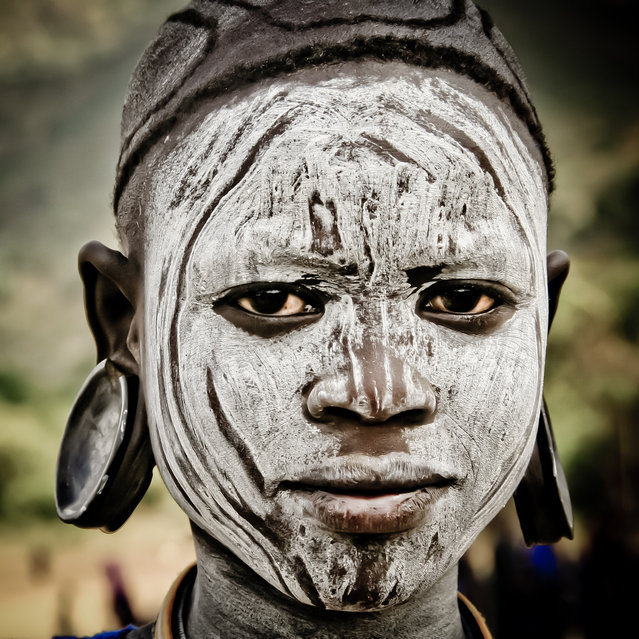
Omo River People, Ethiopia

“The Omo River is an important river of southern Ethiopia. Its course is entirely contained within the boundaries of Ethiopia, and empties into Lake Turkana on the border with Kenya. The lower valley of the Omo is currently believed by some to have been a crossroads for thousands of years as various cultures and ethnic groups migrated around the region. To this day, the people of the Lower Valley of the Omo, including the Mursi, Suri, Nyangatom, Dizi and Me'en, are studied for their diversity”. – Wikipedia (Photo by Hamerscat)

SEE ALSO: «Ethiopia By Brent Stirton»

Details
04 Oct 2012 09:05:00
A Pokot girl, covered in animal skins, walks to a place where she will rest after being circumcised in a tribal ritual in a village about 80 kilometres from the town of Marigat in Baringo County, October 16, 2014. (Photo by Siegfried Modola/Reuters)

Reuters photographer Siegfried Modola gained access to a circumcision ceremony in rural Kenya for young girls of the Pokot tribe, in Baringo County. Here: a Pokot girl, covered in animal skins, walks to a place where she will rest after being circumcised in a tribal ritual in a village about 80 kilometres from the town of Marigat in Baringo County, October 16, 2014. (Photo by Siegfried Modola/Reuters)
Details
13 Nov 2014 14:12:00