Loading...
Done
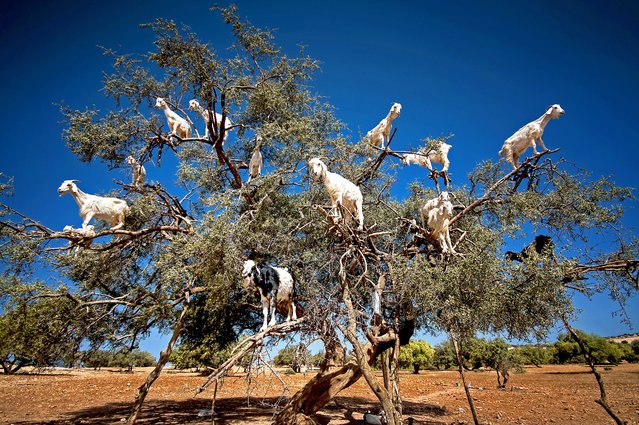
These goats threw caution to the wind and scaled this Argan tree right to the very top, even balancing on the most unsturdy of branches. It looks like a bit of a baa-lancing act, but the goats hooves are perfectly adapted to climbing the trees, where they graze on the Argan fruit. Amateur photographer Burak Senbak, 51, took these photos whilst travelling through Morocco in July 2016. Burak is originally from Turkey and works as a mechanical engineer, but has pursued his passion for photography for 10 years. Intrigued by the sight of goats in a tree, Burak couldnt resist the opportunity to take some photos, and said the goats proved a perfect subject. (Photo by Burak Senbak/Caters News)

These goats threw caution to the wind and scaled this Argan tree right to the very top, even balancing on the most unsturdy of branches. It looks like a bit of a baa-lancing act, but the goats hooves are perfectly adapted to climbing the trees, where they graze on the Argan fruit. Amateur photographer Burak Senbak, 51, took these photos whilst travelling through Morocco in July 2016. Burak is originally from Turkey and works as a mechanical engineer, but has pursued his passion for photography for 10 years. Intrigued by the sight of goats in a tree, Burak couldnt resist the opportunity to take some photos, and said the goats proved a perfect subject. (Photo by Burak Senbak/Caters News)
Details
27 Aug 2017 07:00:00
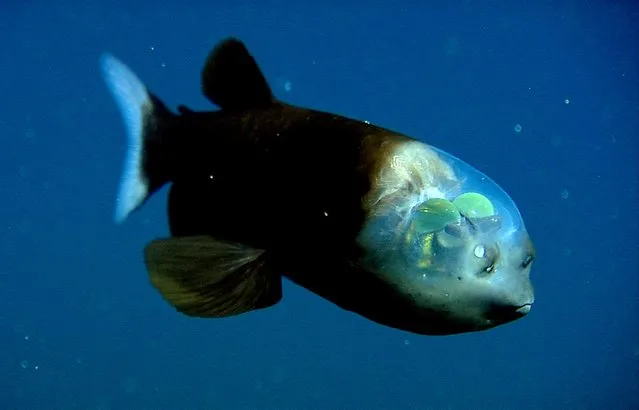
Macropinna Microstoma

Macropinna microstoma is the only species of fish in the genus Macropinna, belonging to Opisthoproctidae, the barreleye family. It is recognized for a highly unusual transparent, fluid-filled dome on its head, through which the lenses of its eyes can be seen. The eyes have a barrel shape and can be rotated to point either forward or straight up, looking through the fish's transparent dome. M. microstoma has a tiny mouth and most of its body is covered with large scales.
Details
08 Jan 2013 17:42:00
A couple walks across the Francis Scott Key Bridge as the setting sun lights up the clouds in Washington, Friday, October 30, 2020. (Photo by J. David Ake/AP Photo)

A couple walks across the Francis Scott Key Bridge as the setting sun lights up the clouds in Washington, Friday, October 30, 2020. (Photo by J. David Ake/AP Photo)
Details
19 Nov 2020 00:03:00
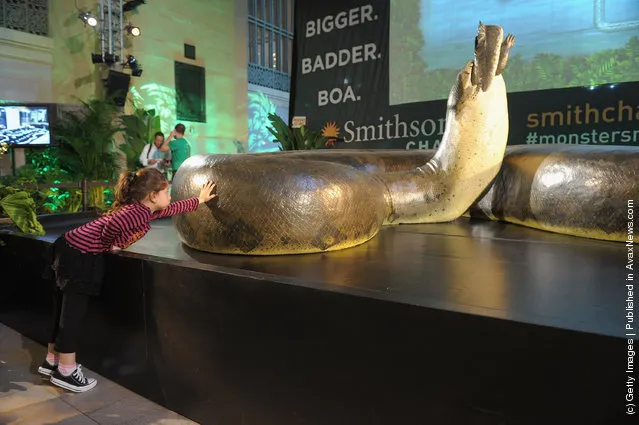
Attendees view a replica of the prehistoric Titanoboa, the largest snake to ever live, on display at Grand Central Terminal in New York City

“Titanoboa is a genus of snake that lived approximately 58–60 million years ago, during the Paleocene epoch, a 10-million-year period immediately following the dinosaur extinction event. The only known species is the Titanoboa cerrejonensis, the largest snake ever discovered, which supplanted the previous record holder, Gigantophis”. – Wikipedia

Photo: Leah Del Rio views a replica of the prehistoric Titanoboa, the largest snake to ever live, on display at Grand Central Terminal on March 23, 2012 in New York City. (Photo by Michael Loccisano/Getty Images)
Details
24 Mar 2012 10:14:00
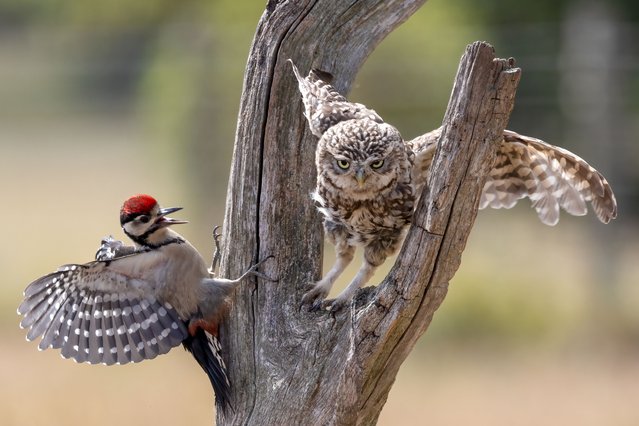
A woodpecker and an owl bicker on a tree branch near Bromsgrove in the West Midlands, UK in the second decade of July 2025. The photographer says the juvenile woodpecker, with a red crown, poked the owl in the eye before flying off. (Photo by Julie Yates/Solent News & Photo Agency)

A woodpecker and an owl bicker on a tree branch near Bromsgrove in the West Midlands, UK in the second decade of July 2025. The photographer says the juvenile woodpecker, with a red crown, poked the owl in the eye before flying off. (Photo by Julie Yates/Solent News & Photo Agency)
Details
27 Jul 2025 04:31:00
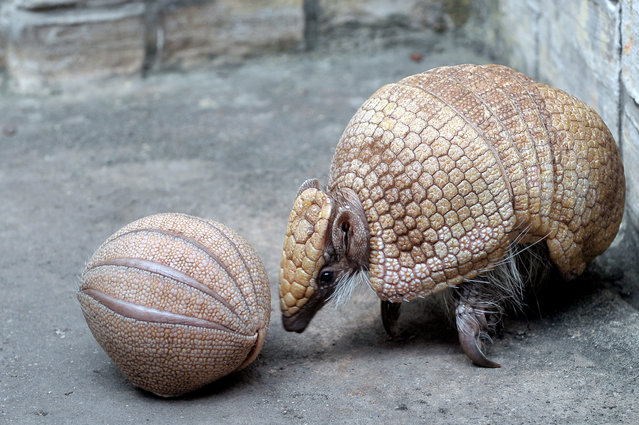
A four-week old southern three-banded armadillo (Tolypeutes matacus) is rolled up into a ball next to its mother in the tropical house of Budapest Zoo in Budapest, Hungary on May 3, 2019. The South American insect-eating mammal and its close relative, the Brasilian three-banded armadillo (Tolypeutes tricinctus) are the only two species of armadillos capable of rolling into a complete ball to defend themselves when feeling threatened. (Photo by Attila Kovács/EPA/EFE)

A four-week old southern three-banded armadillo (Tolypeutes matacus) is rolled up into a ball next to its mother in the tropical house of Budapest Zoo in Budapest, Hungary on May 3, 2019. The South American insect-eating mammal and its close relative, the Brasilian three-banded armadillo (Tolypeutes tricinctus) are the only two species of armadillos capable of rolling into a complete ball to defend themselves when feeling threatened. (Photo by Attila Kovács/EPA/EFE)
Details
05 May 2019 00:03:00
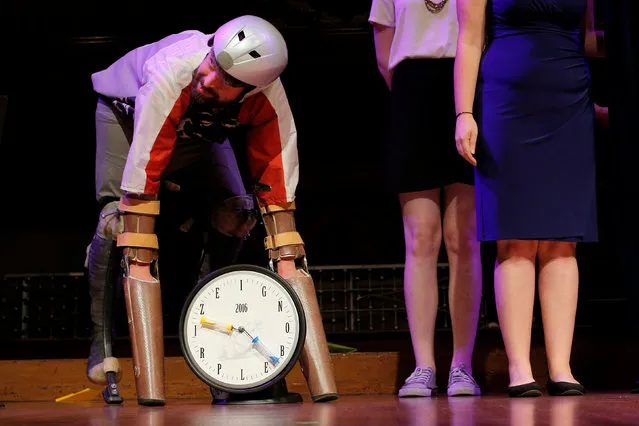
Thomas Thwaites of the United Kingdom accepts the 2016 Ig Nobel Prize in Biology for “creating prosthetic extensions of his limbs that allowed him to move in the manner of, and spend time roaming the hills in the company of, goats” during the 26th First Annual Ig Nobel Prize ceremony at Harvard University in Cambridge, Massachusetts, U.S. September 22, 2016. (Photo by Brian Snyder/Reuters)

Thomas Thwaites of the United Kingdom accepts the 2016 Ig Nobel Prize in Biology for “creating prosthetic extensions of his limbs that allowed him to move in the manner of, and spend time roaming the hills in the company of, goats” during the 26th First Annual Ig Nobel Prize ceremony at Harvard University in Cambridge, Massachusetts, U.S. September 22, 2016. (Photo by Brian Snyder/Reuters)
Details
24 Sep 2016 10:46:00
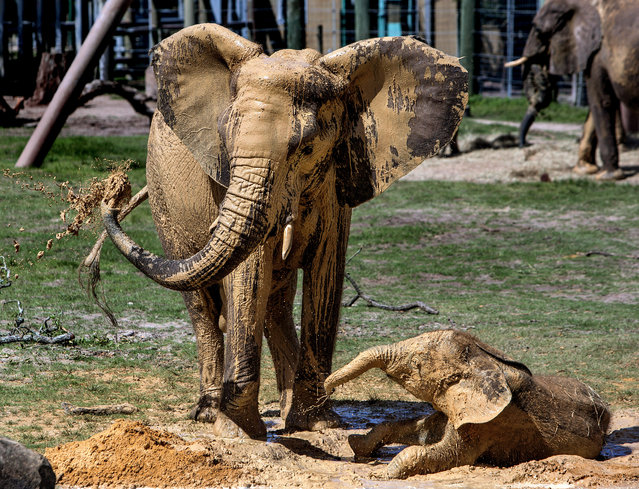
Lowry Park Zoo elephants Matjeka, 23, and her 1-year-old daughter, Mavi, apply a liberal coating of “sunscreen”  to themselves in a clay mud wallow at the park Tuesday, August 12, 2014, in Tampa, Fla., on the park's first observation of World Elephant Day to raise awareness of the wild African elephant crisis. (Photo by Cherie Diez/AP Photo/The Tampa Bay Times)

Lowry Park Zoo elephants Matjeka, 23, and her 1-year-old daughter, Mavi, apply a liberal coating of “sunscreen” to themselves in a clay mud wallow at the park Tuesday, August 12, 2014, in Tampa, Fla., on the park's first observation of World Elephant Day to raise awareness of the wild African elephant crisis. “Elephants are prone to being sunburned”, said associate curator Chris Massaro. “What they need is lot of mud or clay to roll around in and cover up their skin so it will protect it from the sun”. (Photo by Cherie Diez/AP Photo/The Tampa Bay Times)
Details
16 Aug 2014 11:38:00