Loading...
Done
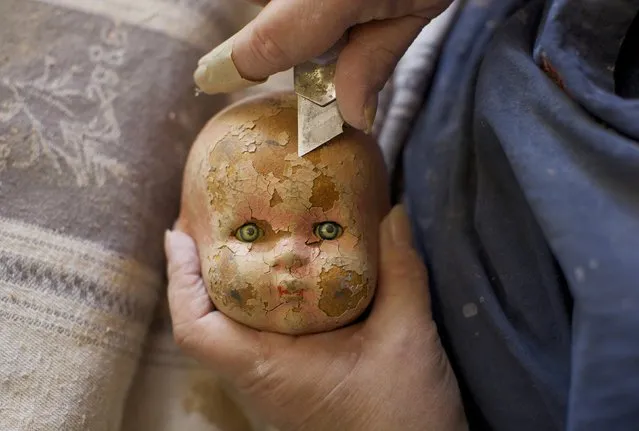
A badly-weathered composition doll, made from compressed wood chip, has its flakey paint cut off before being repaired and repainted by Gail Grainger, a 14-year veteran doll repairer at Sydney's Doll Hospital, August 19, 2014. (Photo by Jason Reed/Reuters)

A badly-weathered composition doll, made from compressed wood chip, has its flakey paint cut off before being repaired and repainted by Gail Grainger, a 14-year veteran doll repairer at Sydney's Doll Hospital, August 19, 2014. Opened in 1913, Sydney's Doll Hospital has worked on millions of dolls, teddy bears and other toys. Behind a toy shop on a busy suburban street in Sydney's south, “doll surgeons” transplant fingers, toes and heads, and repair broken eye sockets in dolls who were the victim of a childhood tantrum or sibling rivalry, sometimes decades ago. (Photo by Jason Reed/Reuters)
Details
26 Aug 2014 10:45:00
Sunrise over a moor viewed from Littaford Tor, Dartmoor, UK, 2016. Autumn visits the windswept moors and granite tors of Dartmoor earlier than the rest of the south-west. While there aren’t many trees here, autumn shades appear in golden ferns and tan heather. Littaford Tors, near Two Bridges and a mile from Princetown, is a short walk and can be combined with a visit to the adjacent Wistman’s Wood. (Photo by Stuart Holmes)

Sunrise over a moor viewed from Littaford Tor, Dartmoor, UK, 2016. Autumn visits the windswept moors and granite tors of Dartmoor earlier than the rest of the south-west. While there aren’t many trees here, autumn shades appear in golden ferns and tan heather. Littaford Tors, near Two Bridges and a mile from Princetown, is a short walk and can be combined with a visit to the adjacent Wistman’s Wood. (Photo by Stuart Holmes)
Details
03 Nov 2016 13:02:00
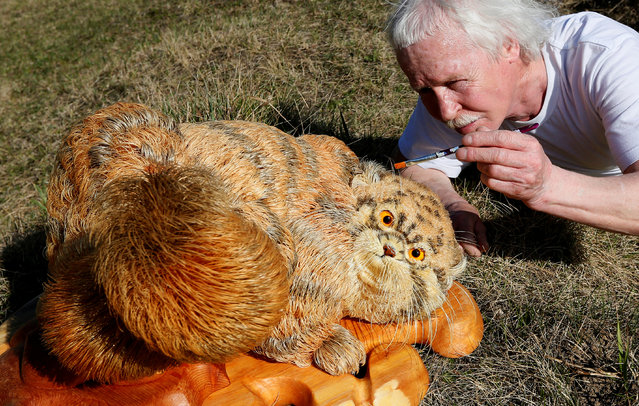
Sergei Bobkov, 59, paints Siberian cedar nut oil onto a life-size sculpture of Pallas's Cat, also known in Russia as Manul Cat, which he made from Siberian cedar wood shavings using more than 700 thousand pieces over four years, in the village of Kozhany, southwest of the Siberian city of Krasnoyarsk, Russia, April 28, 2017. (Photo by Ilya Naymushin/Reuters)

Sergei Bobkov, 59, paints Siberian cedar nut oil onto a life-size sculpture of Pallas's Cat, also known in Russia as Manul Cat, which he made from Siberian cedar wood shavings using more than 700 thousand pieces over four years, in the village of Kozhany, southwest of the Siberian city of Krasnoyarsk, Russia, April 28, 2017. (Photo by Ilya Naymushin/Reuters)
Details
29 Apr 2017 09:20:00
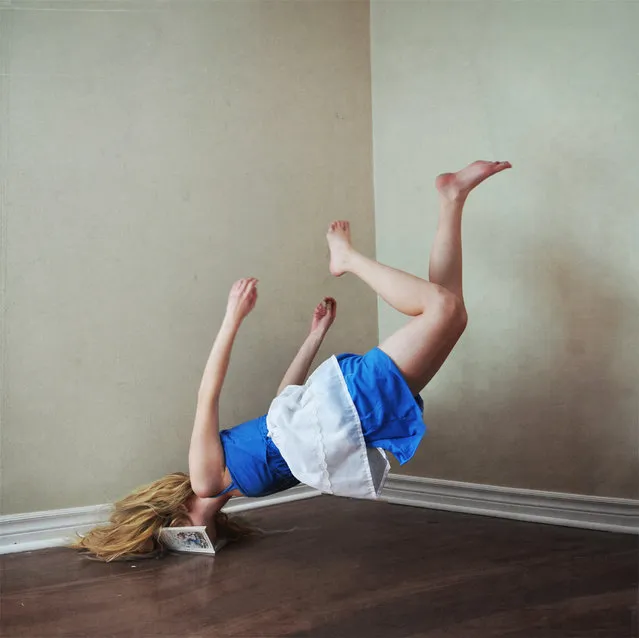
Get Back in Your Book By Lissy Elle

Lissy Elle is a Canadian photographer who creates mysterious and dreamy images through the use of props and photo manipulation. Full of woods, classic tales references, giant teacups and girls defying gravity, her work is both engaging and disturbing, it transports us to an oniric world, or is it a nightmare?
Details
19 Apr 2014 15:44:00
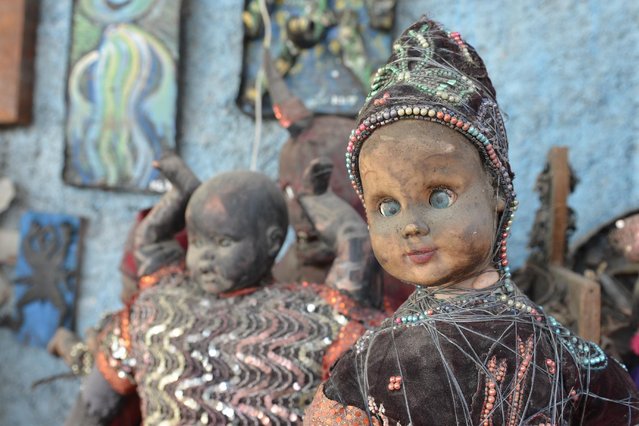
In this April 2, 2016 photo, dusty sculptures made of cast-off baby dolls sit in an open-air museum and art workshop off a trash-strewn street cutting through some of the poorest neighborhoods in Port-au-Prince, Haiti. They were created by Haitian artists called Atis Rezistans who have become celebrated in the international art world by creating sculptures out of scrapped car parts, old wood, discarded toys and even human skulls found scattered outside crumbling mausoleums. (Photo by David McFadden/AP Photo)

In this April 2, 2016 photo, dusty sculptures made of cast-off baby dolls sit in an open-air museum and art workshop off a trash-strewn street cutting through some of the poorest neighborhoods in Port-au-Prince, Haiti. They were created by Haitian artists called Atis Rezistans who have become celebrated in the international art world by creating sculptures out of scrapped car parts, old wood, discarded toys and even human skulls found scattered outside crumbling mausoleums. (Photo by David McFadden/AP Photo)
Details
12 Apr 2016 11:10:00
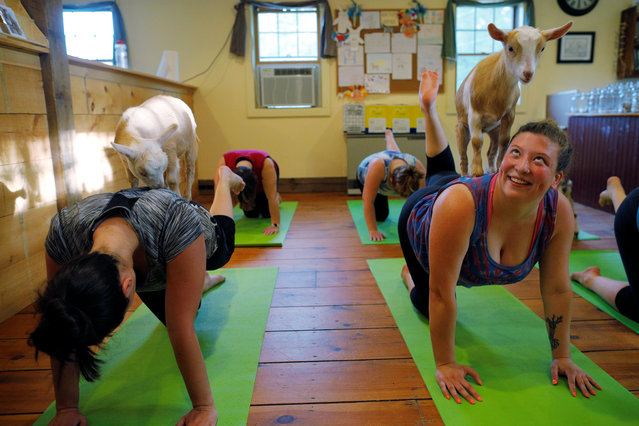
Goats climb on students during a yoga class with eight students and five goats at Jenness Farm in Nottingham, New Hampshire, U.S. on May 18, 2017. Tucked away in a wooded corner of southern New Hampshire, Jenness Farm is the latest small U.S. agricultural operation to cash in on the social media-driven trend, in which yoga enthusiasts practice moves like the cat pose and bridge pose while goats climb around and sometimes on them. (Photo by Brian Snyder/Reuters)

Goats climb on students during a yoga class with eight students and five goats at Jenness Farm in Nottingham, New Hampshire, U.S. on May 18, 2017. Tucked away in a wooded corner of southern New Hampshire, Jenness Farm is the latest small U.S. agricultural operation to cash in on the social media-driven trend, in which yoga enthusiasts practice moves like the cat pose and bridge pose while goats climb around and sometimes on them. (Photo by Brian Snyder/Reuters)
Details
20 May 2017 09:31:00
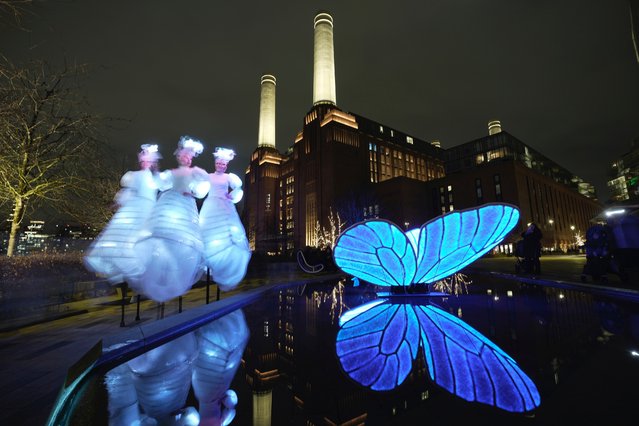
Performers walk past a light installation “Butterfly Effect” designed by Japan artist Masamichi Shimada, at the Battersea Power Station in London, Thursday, January 25, 2024. The Light Festival involved seven light installations from British and international artists at Battersea Power Station, which illuminated the winter evenings between Jan. 25 and Feb, 25. (Photo by Kin Cheung/AP Photo)

Performers walk past a light installation “Butterfly Effect” designed by Japan artist Masamichi Shimada, at the Battersea Power Station in London, Thursday, January 25, 2024. The Light Festival involved seven light installations from British and international artists at Battersea Power Station, which illuminated the winter evenings between Jan. 25 and Feb, 25. (Photo by Kin Cheung/AP Photo)
Details
20 Feb 2024 03:27:00


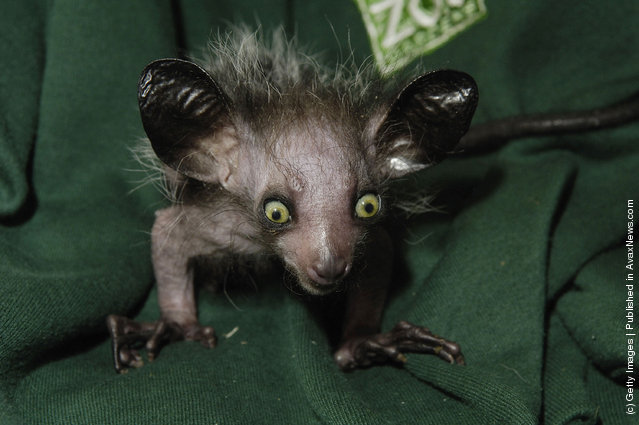
“The aye-aye (Daubentonia madagascariensis) is a lemur, a strepsirrhine primate native to Madagascar that combines rodent-like teeth and a special thin middle finger to fill the same ecological niche as a woodpecker. It is the world's largest nocturnal primate, and is characterized by its unusual method of finding food; it taps on trees to find grubs, then gnaws holes in the wood and inserts its narrow middle finger to pull the grubs out. The only other animal species known to find food in this way is the striped possum. From an ecological point of view the aye-aye fills the niche of a woodpecker as it is capable of penetrating wood to extract the invertebrates within”. – Wikipedia

Photo: In this handout image from Bristol Zoo is seen the first captive bred aye-aye in the UK named “Kintana” (meaning star in Malagasy) April 15, 2005 at Bristol Zoo Gardens, England. The zoo announced today only the second baby aye-aye to be hand-reared in the world (the first was in Jersey Zoo) and has now made his first public appearance since his birth on 11 February 2005. (Photo by Rob Cousins/Bristol Zoo via Getty Images)
Details
13 Apr 2011 13:33:00