Loading...
Done
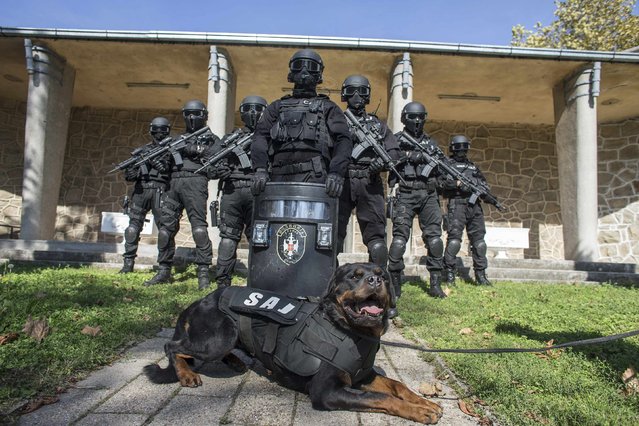
Serbian police officers of the Special Anti-Terrorist Unit pose for a picture in their base outside Belgrade October 8, 2014. (Photo by Marko Djurica/Reuters)

Serbian police officers of the Special Anti-Terrorist Unit pose for a picture in their base outside Belgrade October 8, 2014. When the killing of an unarmed black teenager by a white policeman in Ferguson, Missouri, in August sparked sometimes violent protests, the response of police in camouflage gear and armoured vehicles wielding stun grenades and assault rifles seemed more like a combat operation than a public order measure. Some U.S. police departments have recently acquired U.S. military-surplus hardware from wars abroad, but there are many law enforcers around the world whose rules of engagement also allow the use of lethal force with relatively few restrictions. But for every regulation that gives police wide scope to use firearms, there is another code that sharply limits their use. In Serbia, police may use measures ranging from batons to special vehicles, water cannon and tear gas on groups of people who have gathered illegally and are behaving in a way that is violent or could cause violence, but they may use firearms only when life is endangered. (Photo by Marko Djurica/Reuters)
Details
27 Nov 2014 14:53:00
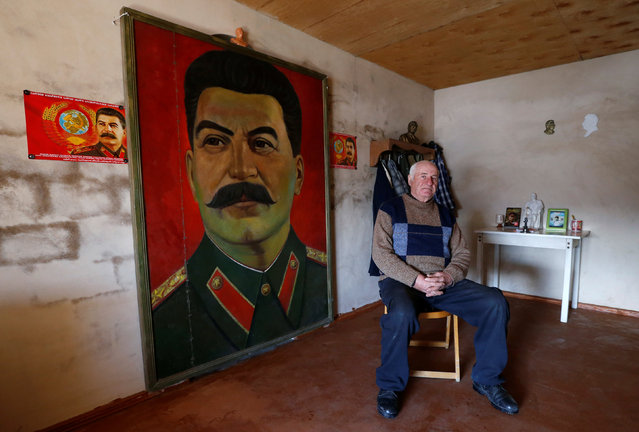
Retired builder Vasili Sidamonidze, 70, poses for a portrait at his home in Gori, Georgia, December 6, 2016. “Unfortunately, Stalin is not popular nowadays. Our people don't respect him. Only we, members of the (Communist) Party, respect him”, Sidamonidze said. “I always try to attend Stalin's birthday anniversaries in Gori. Unfortunately many people don't want to join us even if they live nearby. They look at us from their windows”. Stalin, who was born in Gori in 1878 and died in 1953, is largely reviled today in Georgia, which regained its independence during the 1991 collapse of the Soviet Union. Over the years, his memorials have been dismantled, most recently in 2010 when authorities removed a statue of the dictator from Gori's central square. But Stalin is still revered by a small group of mainly elderly supporters who stress his role in the industrialisation of the Soviet Union and in defeating Nazi Germany in World War Two. Each Dec. 21, a few dozen people mark his birthday by gathering outside a Gori museum dedicated to Stalin, where they make speeches and walk to the square where a 6-meter-high bronze statue of him once stood, calling for it to be reinstated. Opponents say it was a symbol of Moscow's still lingering shadow. In 2008, Russia fought a brief war with Georgia and recognised its breakaway regions of Abkhazia and South Ossetia as independent states. (Photo by David Mdzinarishvili/Reuters)

Retired builder Vasili Sidamonidze, 70, poses for a portrait at his home in Gori, Georgia, December 6, 2016. “Unfortunately, Stalin is not popular nowadays. Our people don't respect him. Only we, members of the (Communist) Party, respect him”, Sidamonidze said. “I always try to attend Stalin's birthday anniversaries in Gori. Unfortunately many people don't want to join us even if they live nearby. They look at us from their windows”. (Photo by David Mdzinarishvili/Reuters)
Details
17 Dec 2016 07:59:00
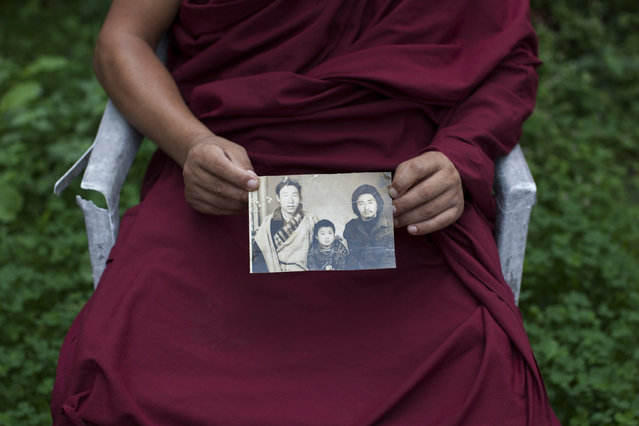
In this Saturday, September 27, 2014 photo, Tibetan monk Dorjee, 38, displays a photograph of his father, left, and himself, center, taken in Tibet, in Dharamsala, India. Dorjee said he held back his tears when he spoke with his parents on the phone after a separation period of 27 years. He exchanged a few words with his father but said his mother fainted on hearing his voice. (Photo by Tsering Topgyal/AP Photo)

“When I was 8 years old, my parents paid a smuggler to take me across the Himalayas, a weekslong walk over the mountains from Tibet to India. It was a trek that tens of thousands of other Tibetans have taken since the Dalai Lama fled a failed 1959 uprising against Chinese rule. My parents must have had their reasons to send me here; they must have had the best of intentions. But 18 years later, I still don't know why they did it. They are not political people. They are small farmers who raise barley and a few yak in a rural area not far from Lhasa, the Tibetan capital. I have not seen them since I left...”. – Tsering Topgyal via The Associated Press. (Photo by Tsering Topgyal/AP Photo)
Details
05 Nov 2014 12:27:00
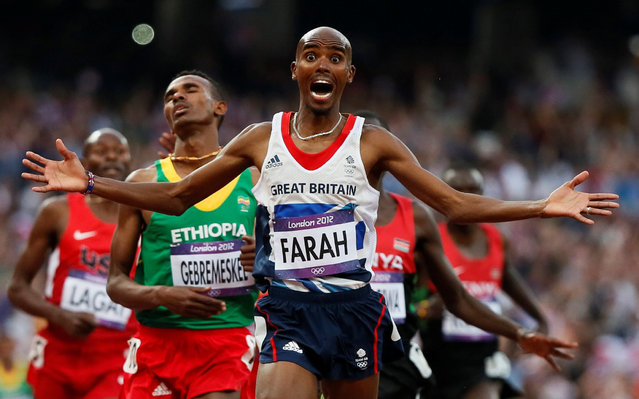
Britain's Mo Farah reacts as he wins the men's 5000m final at the London 2012 Olympic Games at the Olympic Stadium in Britain August 11, 2012. Lucy Nicholson: “When Mo Farah was rounding the final corner for the 5000m the huge stadium was electric, everybody was on their feet and he knew he was going to win as he came into that final stretch. All the photographers were excited because we knew he was going to react in a very dramatic way so it was a lovely sequence of photos as he crossed the finish line – he put his hands over his head, he wrapped himself in the British flag, it was a very long celebration sequence, which is all you can really wish for as a photographer”. (Photo by Lucy Nicholson/Reuters)

The Rio de Janeiro Olympics kick off on August 5 for some two weeks of competitive games drawing athletes as well as audiences from around the world. As they prepare to cover the event, Reuters photographers look back on their favourite pictures from past Olympics where they captured the action on the ground as well as the participants' tears and joy that followed. (Photo by Lucy Nicholson/Reuters)
Details
03 Aug 2016 11:19:00
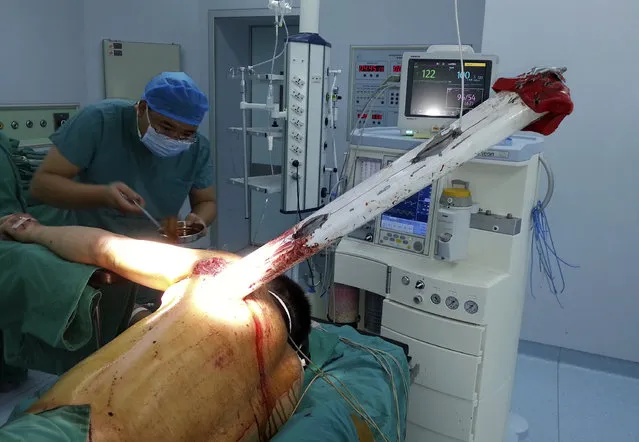
A doctor performs surgery on an injured man with a part of an aluminium alloy fence through his chest after a car accident in Zhumadian, Henan province, China, September 15, 2014. The doctor managed to surgically remove the piece. (Photo by Reuters/Stringer)

A doctor performs surgery on an injured man with a part of an aluminium alloy fence through his chest after a car accident in Zhumadian, Henan province, China, September 15, 2014. The doctor managed to surgically remove the piece. (Photo by Reuters/Stringer)
Details
20 Sep 2014 10:59:00
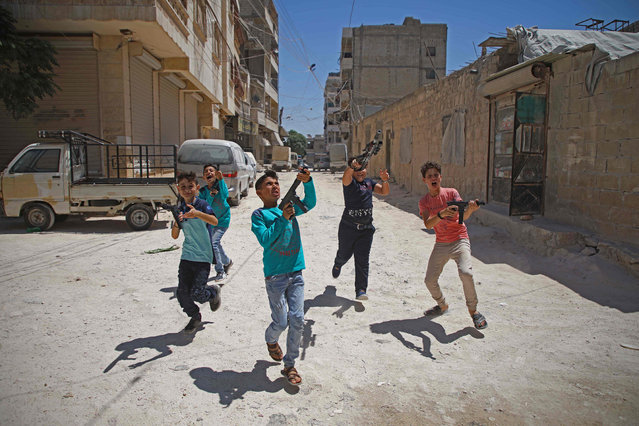
Syrian boys play with plastic guns on the first day of the Muslim religious festival of Eid al-Adha in al-Dana in Syria's rebel-controlled Idlib region, near the border with Turkey, on August 11, 2019. Muslims across the world are celebrating the first day of the Feast of Sacrifice, which marks the end of the hajj pilgrimage to Mecca and commemorates prophet Abraham's sacrifice of a lamb after God spared Ishmael, his son. (Photo by Aaref Watad/AFP Photo)

Syrian boys play with plastic guns on the first day of the Muslim religious festival of Eid al-Adha in al-Dana in Syria's rebel-controlled Idlib region, near the border with Turkey, on August 11, 2019. Muslims across the world are celebrating the first day of the Feast of Sacrifice, which marks the end of the hajj pilgrimage to Mecca and commemorates prophet Abraham's sacrifice of a lamb after God spared Ishmael, his son. (Photo by Aaref Watad/AFP Photo)
Details
13 Aug 2019 00:03:00
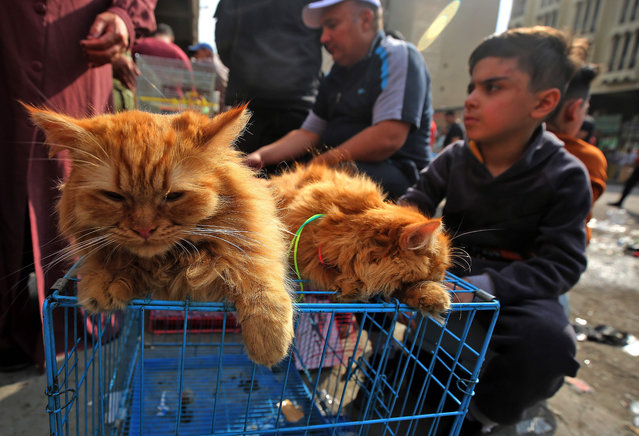
An Iraqi boy sits next to cats for sale at the Ghazl Market in central Baghdad on November 20, 2020. (Photo by Ahmad Al-Rubaye/AFP Photo)

An Iraqi boy sits next to cats for sale at the Ghazl Market in central Baghdad on November 20, 2020. (Photo by Ahmad Al-Rubaye/AFP Photo)
Details
30 Nov 2020 00:05:00
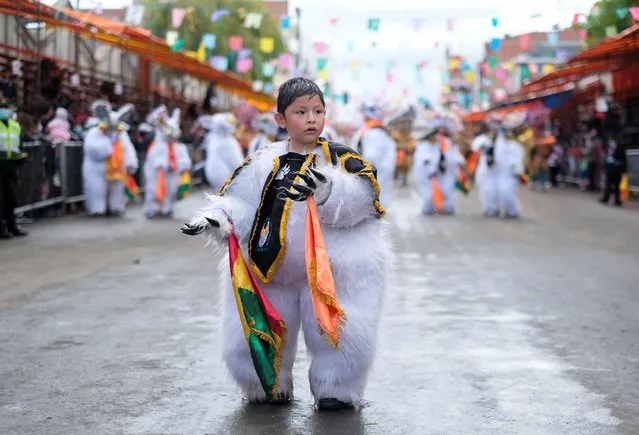
Kalep, 5, in a bear costume, participates in parade where his father Johnny Lopez was the Elder Angel, during the Oruro Carnival, a traditional celebration that can be traced back to the indigenous Ito festival, in Oruro, Bolivia February 26, 2022. (Photo by Wara Vargas/Reuters)

Kalep, 5, in a bear costume, participates in parade where his father Johnny Lopez was the Elder Angel, during the Oruro Carnival, a traditional celebration that can be traced back to the indigenous Ito festival, in Oruro, Bolivia February 26, 2022. (Photo by Wara Vargas/Reuters)
Details
08 Apr 2023 03:49:00