Loading...
Done
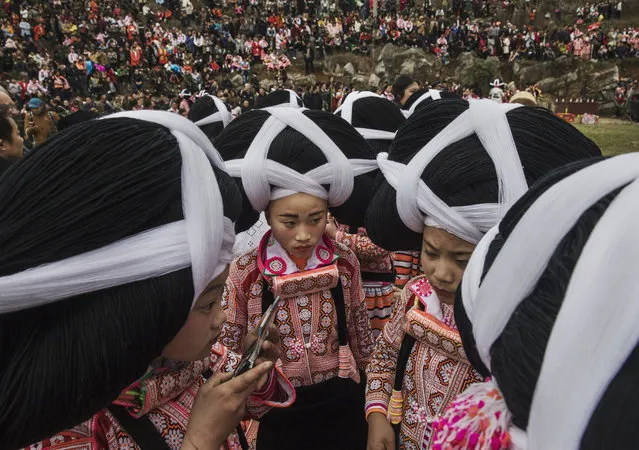
Girls of the Long Horn Miao ethnic minority group wear headdresses as they prepare gather for Tiaohua or Flower Festival as part of the Lunar New Year on February 6, 2017 in Longga village, Guizhou province, southern China. The Long Horn Miao are recognized for their declining practice of wrapping a blend of linen, wool, and the hair of their ancestors around animal horns or a wooden clip to make headdresses. Many young women say they now wear the headdresses only for special occasions and festivals, as the ornaments, which are attached by the horns to their real hair, have proved impractical for modern daily life in a fast changing world. China officially recognizes 56 different ethnic minorities, and statistics show over 7 million Chinese identifying themselves as Miao. But the small Long Horn Miao community counts only around 5000 people living in 12 villages, whose age-old traditions, language, and culture are fading. It is increasingly difficult in a modernizing China, as young people are drawn from remote rural villages to opportunities in bigger cities amongst wide-scale urbanization. Farming and labour remain the mainstays of life for the Long Horn Miao, leaving the area relatively poor in comparison with many parts of China. The government has invested significant amounts into local infrastructure and the tourism industry to try to bolster the local economy. (Photo by Kevin Frayer/Getty Images)

Girls of the Long Horn Miao ethnic minority group wear headdresses as they prepare gather for Tiaohua or Flower Festival as part of the Lunar New Year on February 6, 2017 in Longga village, Guizhou province, southern China. (Photo by Kevin Frayer/Getty Images)
Details
13 Feb 2017 00:01:00
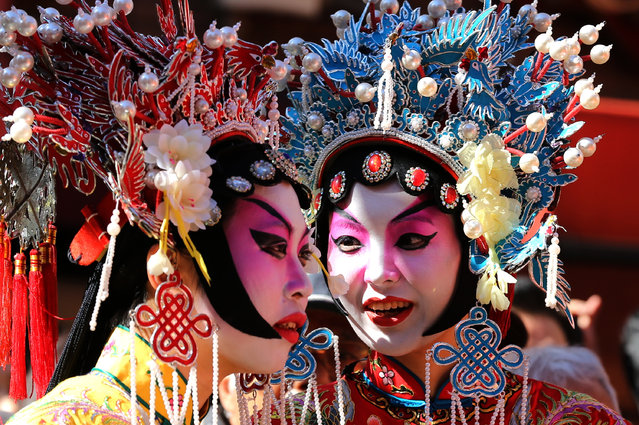
Women dressed in traditional Chinese costumes wait perform in celebration of the Chinese New Year at the Nankinmachi square, China Town on February 8, 2016 in Kobe, Japan. In Nankinmachi, the district known as Kobe Chinatown, tourists enjoyed Chinese food, lion dance and the parade organized to celebrate the Lunar New Year. (Photo by Buddhika Weerasinghe/Getty Images)

Women dressed in traditional Chinese costumes wait perform in celebration of the Chinese New Year at the Nankinmachi square, China Town on February 8, 2016 in Kobe, Japan. In Nankinmachi, the district known as Kobe Chinatown, tourists enjoyed Chinese food, lion dance and the parade organized to celebrate the Lunar New Year. (Photo by Buddhika Weerasinghe/Getty Images)
Details
09 Feb 2016 13:13:00
North Korean children wave to people on a Chinese tourist boat on the banks of Yalu River near the Chongsong county of North Korea, opposite the Chinese border city of Dandong, May 8, 2011. (Photo by Jacky Chen/Reuters)

North Korean children wave to people on a Chinese tourist boat on the banks of Yalu River near the Chongsong county of North Korea, opposite the Chinese border city of Dandong, May 8, 2011. (Photo by Jacky Chen/Reuters)
Details
02 Apr 2015 12:30:00
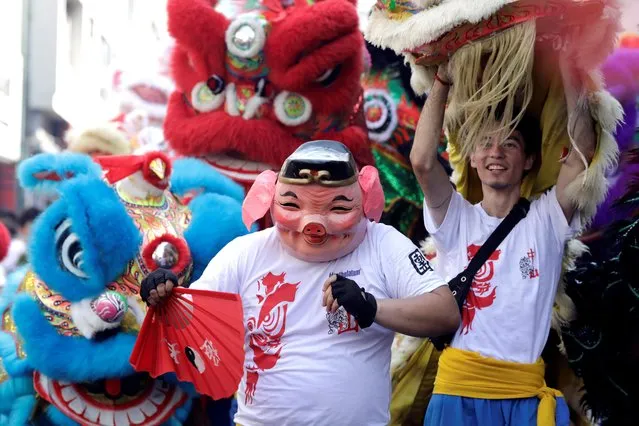
People perform Chinese Lion dance in Chinatown during the Chinese Lunar New Year in Lima, Peru February 5, 2019. (Photo by Guadalupe Pardo/Reuters)

People perform Chinese Lion dance in Chinatown during the Chinese Lunar New Year in Lima, Peru on February 5, 2019. (Photo by Guadalupe Pardo/Reuters)
Details
06 Feb 2019 11:49:00
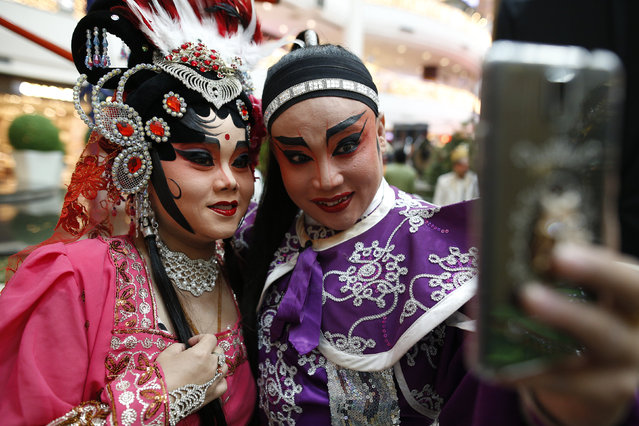
Members of a Chinese opera take a selfie before a performance at a shopping mall ahead of the Chinese Lunar New Year celebrations in Bangkok, Thailand, February 4, 2016. (Photo by Athit Perawongmetha/Reuters)

Members of a Chinese opera take a selfie before a performance at a shopping mall ahead of the Chinese Lunar New Year celebrations in Bangkok, Thailand, February 4, 2016. (Photo by Athit Perawongmetha/Reuters)
Details
05 Feb 2016 11:06:00
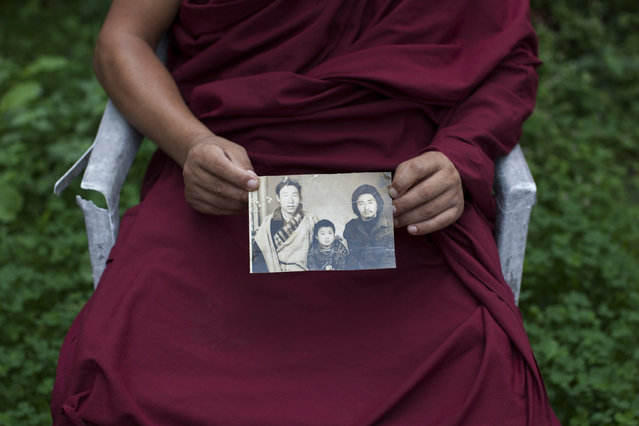
In this Saturday, September 27, 2014 photo, Tibetan monk Dorjee, 38, displays a photograph of his father, left, and himself, center, taken in Tibet, in Dharamsala, India. Dorjee said he held back his tears when he spoke with his parents on the phone after a separation period of 27 years. He exchanged a few words with his father but said his mother fainted on hearing his voice. (Photo by Tsering Topgyal/AP Photo)

“When I was 8 years old, my parents paid a smuggler to take me across the Himalayas, a weekslong walk over the mountains from Tibet to India. It was a trek that tens of thousands of other Tibetans have taken since the Dalai Lama fled a failed 1959 uprising against Chinese rule. My parents must have had their reasons to send me here; they must have had the best of intentions. But 18 years later, I still don't know why they did it. They are not political people. They are small farmers who raise barley and a few yak in a rural area not far from Lhasa, the Tibetan capital. I have not seen them since I left...”. – Tsering Topgyal via The Associated Press. (Photo by Tsering Topgyal/AP Photo)
Details
05 Nov 2014 12:27:00
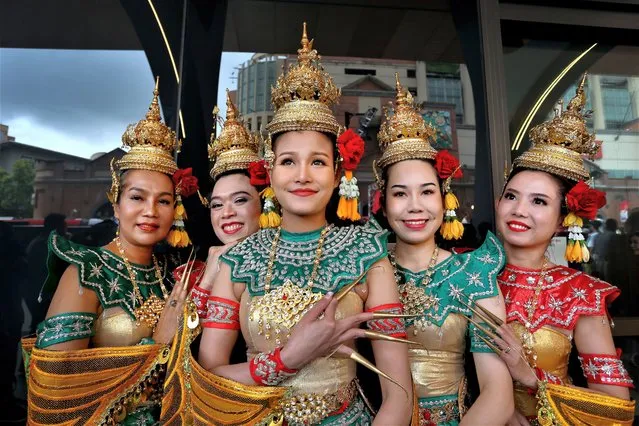
Members of Siam Classic Dance Studio perform for onlookers at Haymarket on January 21, 2023 in Sydney, Australia. The Lunar New Year or Spring Festival marks the transition of the Chinese zodiac sign from one animal to the next. 2023 sees in the Year of the Rabbit, which begins on January 22. In Chinese culture, the Rabbit is a symbol of longevity, peace and prosperity. The festival is celebrated in Australia by the country's significant Chinese-origin minority, who follow much of the same traditions as the Chinese diaspora in the rest of the world. (Photo by Lisa Maree Williams/Getty Images)

Members of Siam Classic Dance Studio perform for onlookers at Haymarket on January 21, 2023 in Sydney, Australia. The Lunar New Year or Spring Festival marks the transition of the Chinese zodiac sign from one animal to the next. 2023 sees in the Year of the Rabbit, which begins on January 22. In Chinese culture, the Rabbit is a symbol of longevity, peace and prosperity. The festival is celebrated in Australia by the country's significant Chinese-origin minority, who follow much of the same traditions as the Chinese diaspora in the rest of the world. (Photo by Lisa Maree Williams/Getty Images)
Details
13 Apr 2024 05:28:00
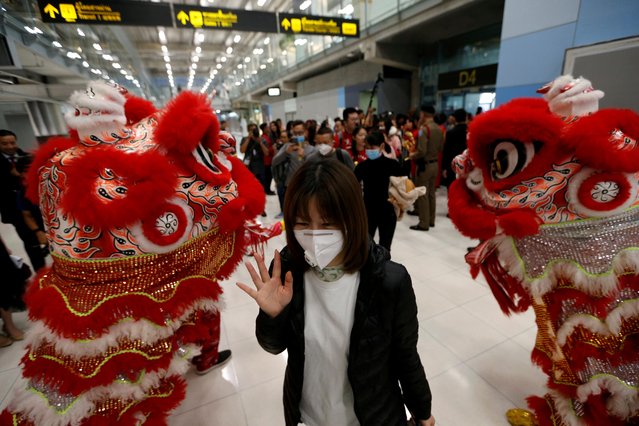
A Chinese tourist wears a mask as she arrives at Suvarnabhumi Airport during a welcome ceremony of Chinese Lunar New Year travellers in Bangkok, Thailand on January 22, 2020. (Photo by Soe Zeya Tun/Reuters)

A Chinese tourist wears a mask as she arrives at Suvarnabhumi Airport during a welcome ceremony of Chinese Lunar New Year travellers in Bangkok, Thailand on January 22, 2020. (Photo by Soe Zeya Tun/Reuters)
Details
24 Jan 2020 00:05:00