Loading...
Done
Cats By Kim Haskins

Kim Haskins was born in 1981 in Hitchin, Hertfordshire. Throughout school she was known as the class artist - the one who drew pictures in other peoples’ exercise books, made posters for school plays, designed t-shirts etc. Even growing up she pictures always fell into one of two categories: humorous or still life.
Details
06 Feb 2014 13:50:00
Russian-born Zlata is pictured in Fifties style glam while still managing to bend herself in half. (Photo by Barcroft Media)

For many of us, simply bending over to touch our toes can be a difficult. But it's not a problem for the world's bendiest woman Julia Günthel aka Zlata (27). Russian-born Zlata can twist herself like a snake into the most extreme poses imaginable – and has broken numerous world records for her flexibility. The former gymnast, who is 5ft 8in, is so flexible she can cram herself into a 50cm squared box. Photo: Russian-born Zlata is pictured in Fifties style glam while still managing to bend herself in half. (Photo by Barcroft Media)
Details
25 Oct 2013 08:21:00
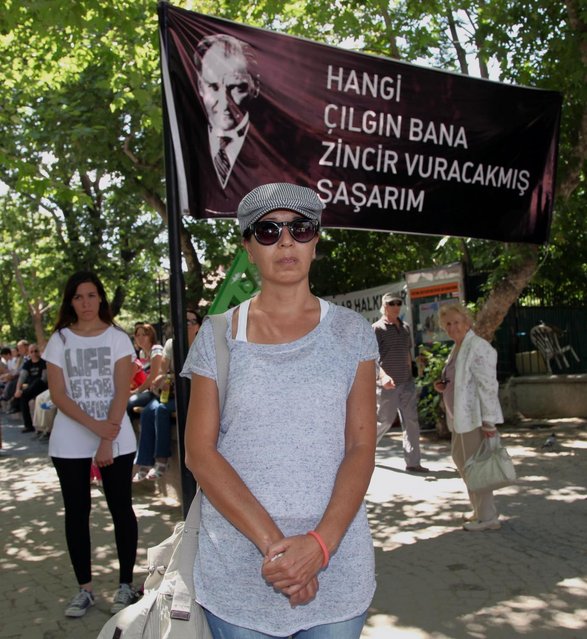
Turks stand in a silent protest in Kugulu Park in Ankara, Turkey, Wednesday, June 19, 2013. After weeks of sometimes-violent confrontation with police, Turkish protesters have found a new form of resistance: standing still and silent. The banner with an image of Turkey's founder Kemal Ataturk reads: “Which crazy person thinks they can put me in chains”. (Photo by Burhan Ozbilic/AP Photoi)

Turks stand in a silent protest in Kugulu Park in Ankara, Turkey, Wednesday, June 19, 2013. After weeks of sometimes-violent confrontation with police, Turkish protesters have found a new form of resistance: standing still and silent. The banner with an image of Turkey's founder Kemal Ataturk reads: “Which crazy person thinks they can put me in chains”. (Photo by Burhan Ozbilic/AP Photoi)
Details
20 Jun 2013 09:37:00
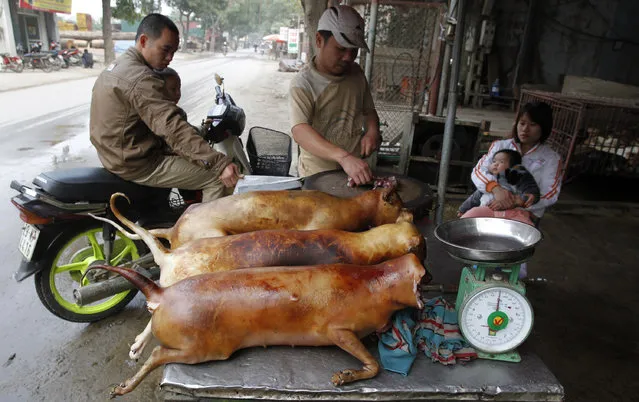
A vendor (C) cuts slaughtered dogs for sale at his roadside stall in Duong Noi village, outside Hanoi December 16, 2011. While animal rights activists have condemned eating dog meat as cruel treatment of the animals, it is still an accepted popular delicacy for some Vietnamese, as well in some other Asian countries. (Photo by Reuters/Kham)

A vendor (C) cuts slaughtered dogs for sale at his roadside stall in Duong Noi village, outside Hanoi December 16, 2011. While animal rights activists have condemned eating dog meat as cruel treatment of the animals, it is still an accepted popular delicacy for some Vietnamese, as well in some other Asian countries. Duong Noi is well-known as a dog-meat village, where hundreds of dogs are killed each day for sale as popular traditional food. Dog-eating as a custom is rooted in Vietnam and was developed as a result of poverty. One kilogram of dog meat costs about 130,000 dongs ($6.2). (Photo by Reuters/Kham)
Details
16 Jul 2013 11:40:00
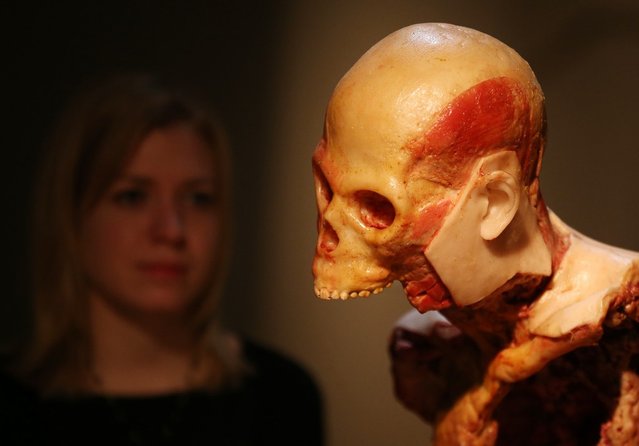
An artwork entitled 'Are you still mad at me ?' by John Isaacs is displayed at the Death: A Self-portrait exhibition at the Wellcome Collection on November 14, 2012 in London, England. The exhibition showcases 300 works from a unique collection by Richard Harris, a former antique print dealer from Chicago, devoted to the iconography of death. The display highlights art works, historical artifacts, anatomical illustrations and ephemera from around the world and opens on November 15, 2012 until February 24, 2013.  (Photo by Peter Macdiarmid)

An artwork entitled “Are you still mad at me?” by John Isaacs is displayed at the Death: A Self-portrait exhibition at the Wellcome Collection on November 14, 2012 in London, England. The exhibition showcases 300 works from a unique collection by Richard Harris, a former antique print dealer from Chicago, devoted to the iconography of death. The display highlights art works, historical artifacts, anatomical illustrations and ephemera from around the world and opens on November 15, 2012 until February 24, 2013. (Photo by Peter Macdiarmid)
Details
15 Nov 2012 09:41:00
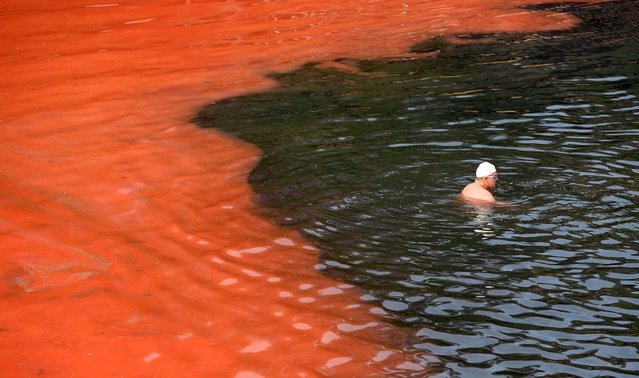
A swimmer stops short of a red algae bloom at Sydney's Clovelly Beach on November 27, 2012, which closed some beaches for swimming including Bondi Beach for a period of time.  While the red algae, known as Noctiluca scintillans or sea sparkle, has no toxic effects, people are still advised to avoid swimming in areas with discoloured water because the algae, which can be high in ammonia, can cause skin irritation. (Photo by William West/AFP Photo)

A swimmer stops short of a red algae bloom at Sydney's Clovelly Beach on November 27, 2012, which closed some beaches for swimming including Bondi Beach for a period of time. While the red algae, known as Noctiluca scintillans or sea sparkle, has no toxic effects, people are still advised to avoid swimming in areas with discoloured water because the algae, which can be high in ammonia, can cause skin irritation. (Photo by William West/AFP Photo)
Details
28 Nov 2012 09:52:00
A woman poses for a picture as bunches of paprika hang on the walls of her house to dry in the village of Donja Lakosnica, Serbia October 6, 2016. Donja Lokosnica is the Serbian “capital of paprika”, since almost all of the 1300 inhabitants are involved in growing paprika. As autumn approaches, the whole village turns red, because of many threads of dried peppers, that hang around Lokosnica, waiting for their winter use. Each of these paprika threads is handmade, still dried according to traditional techniques, assisted solely by the sun and fresh air. (Photo by Marko Djurica/Reuters)

A woman poses for a picture as bunches of paprika hang on the walls of her house to dry in the village of Donja Lakosnica, Serbia October 6, 2016. Donja Lokosnica is the Serbian “capital of paprika”, since almost all of the 1300 inhabitants are involved in growing paprika. As autumn approaches, the whole village turns red, because of many threads of dried peppers, that hang around Lokosnica, waiting for their winter use. Each of these paprika threads is handmade, still dried according to traditional techniques, assisted solely by the sun and fresh air. (Photo by Marko Djurica/Reuters)
Details
08 Oct 2016 12:04:00
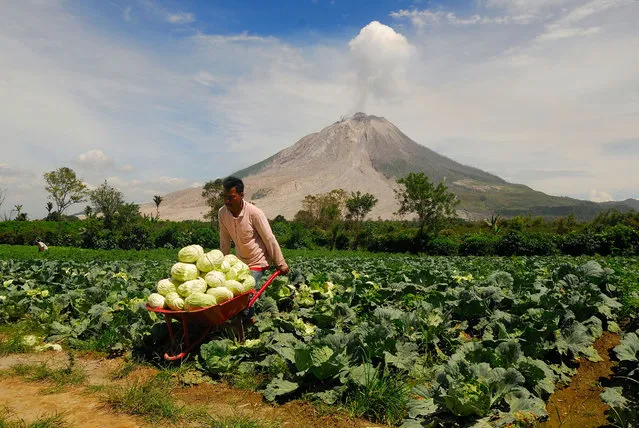
A farmer seen harvesting his crops while Mount Sinabung spewing out volcanic ash on July 4, 2017 in North Sumatera, Indonesia. The increased volume of lava dome that reaches one million eight hundred cubic meters, said volcanologist, through radio communications, do not dampen the activities of the people around sinabung, such as farming, harvesting their crops, picking up objects that are still left behind, or just take a picture while walking around near mount Sinabung. (Photo by Sabirin Manurung/Pacific Press/Barcroft Images)

A farmer seen harvesting his crops while Mount Sinabung spewing out volcanic ash on July 4, 2017 in North Sumatera, Indonesia. The increased volume of lava dome that reaches one million eight hundred cubic meters, said volcanologist, through radio communications, do not dampen the activities of the people around sinabung, such as farming, harvesting their crops, picking up objects that are still left behind, or just take a picture while walking around near mount Sinabung. (Photo by Sabirin Manurung/Pacific Press/Barcroft Images)
Details
06 Aug 2017 07:50:00