Loading...
Done
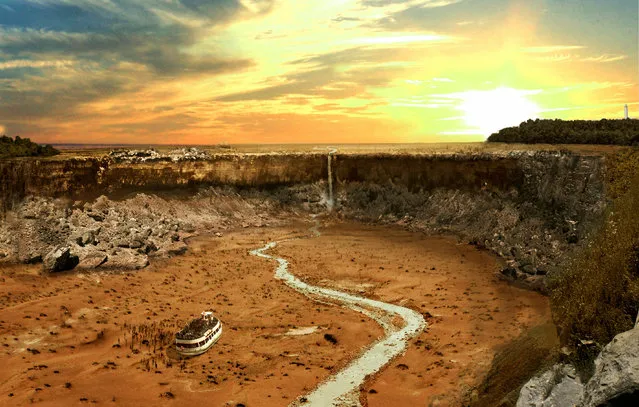
Niagara Falls, Canada, after severe drought. (Photo by Joel Krebs/Caters News)

A graphic designer has produced a haunting look at what the world’s most famous landmarks would look like if they were hit by a severe drought. Joel Krebs has intricately dried up hot spots such as the Tower Bridge in London, the Capitol in Washington, D.C., Niagara Falls and Machu Picchu. Here: Niagara Falls, Canada, after severe drought. (Photo by Joel Krebs/Caters News)
Details
14 Feb 2016 11:49:00
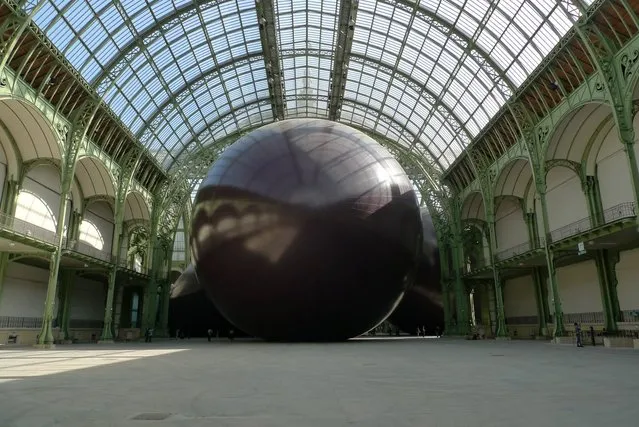
Leviathan By Anish Kapoor

A single object, a single shape, a single colour,' is how Anish Kapoor summed up Leviathan, his response to the Monumenta challenge this year. Radically departing from Christian Boltanski’s busy collage-like approach in Personnes for Monumenta 2010, Kapoor has filled the 13,500 square metre space with a single cavernous entity which surges through the Grand Palais roof.
Details
06 May 2014 13:11:00
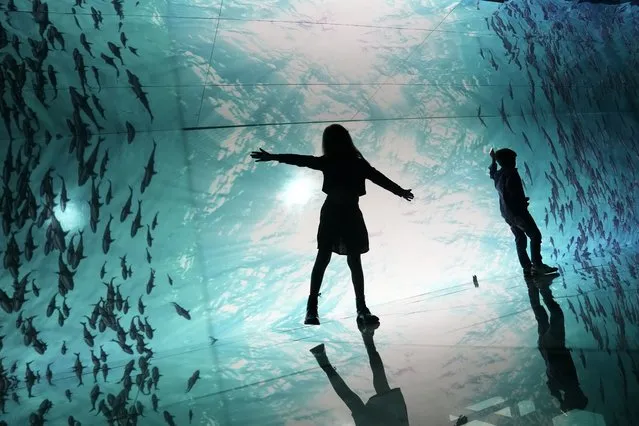
Children walk amid a mirror installation titled “Sea of Mirrors”, featuring digital images of fish in the ocean during a preview tour the day before the show's public opening at the AquaRio aquarium in Rio de Janeiro, Brazil, Wednesday, June 14, 2023. (Photo by Silvia Izquierdo/AP Photo)

Children walk amid a mirror installation titled “Sea of Mirrors”, featuring digital images of fish in the ocean during a preview tour the day before the show's public opening at the AquaRio aquarium in Rio de Janeiro, Brazil, Wednesday, June 14, 2023. (Photo by Silvia Izquierdo/AP Photo)
Details
19 Jul 2023 02:50:00
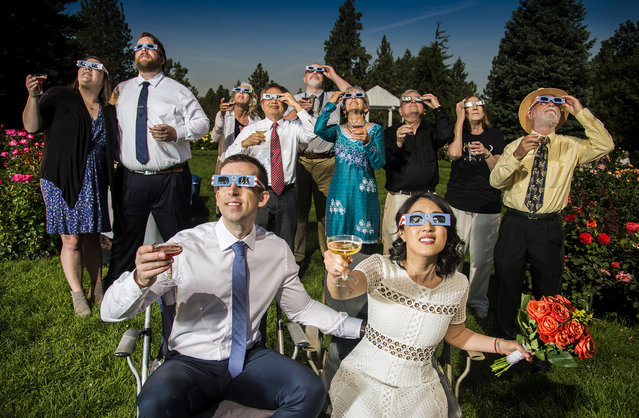
After their wedding ceremony, groom and bride, Nathan Mauger, Connie Young with family and friends, toast to the solar eclipse from the Rose Garden in Manito Park, Monday, August 21, 2017, in Spokane, Wash. (Photo by Colin Mulvany/The Spokesman-Review via AP Photo)

After their wedding ceremony, groom and bride, Nathan Mauger, Connie Young with family and friends, toast to the solar eclipse from the Rose Garden in Manito Park, Monday, August 21, 2017, in Spokane, Wash. (Photo by Colin Mulvany/The Spokesman-Review via AP Photo)
Details
22 Aug 2017 07:54:00
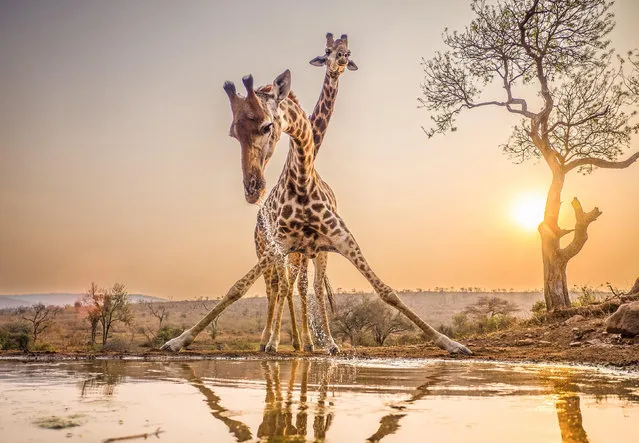
A giraffe appears almost to be doing the splits as it bends to drink at a watering hole on a reserve in Mkuze, South Africa in September 2023. (Photo by Peter Batty/Solent News)

A giraffe appears almost to be doing the splits as it bends to drink at a watering hole on a reserve in Mkuze, South Africa in September 2023. (Photo by Peter Batty/Solent News)
Details
27 Dec 2023 20:10:00
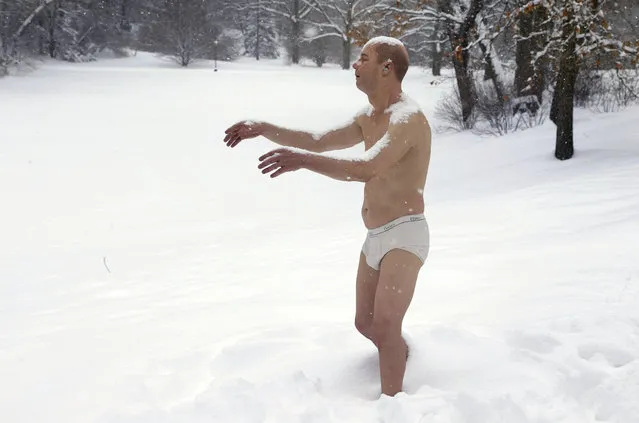
A statue of a man sleepwalking in his underpants is surrounded by snow on the campus of Wellesley College, in Wellesley, Mass., Wednesday, Feb. 5, 2014. The sculpture entitled "Sleepwalker" is part of an exhibit by sculptor Tony Matelli at the college's Davis Museum. (AP Photo/Steven Senne)

A statue of a man sleepwalking in his underpants is surrounded by snow on the campus of Wellesley College, in Wellesley, Mass., Wednesday, February 5, 2014. The sculpture entitled “Sleepwalker” is part of an exhibit by sculptor Tony Matelli at the college's Davis Museum. (Photo by Steven Senne/AP Photo)
Details
07 Feb 2014 07:09:00
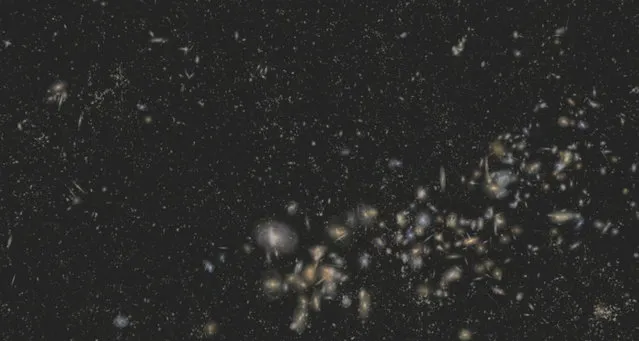
New 3-D Map of Massive Galaxies and Distant Black Holes Offers Clues to Dark Matter and Dark Energy

“The Sloan Digital Sky Survey III (SDSS-III) has released the largest-ever three-dimensional map of massive galaxies and distant black holes, which will help astronomers explain the mysterious “dark matter” and “dark energy” that scientists know makes up 96 percent of the Universe”. – SDSS-III
Details
10 Aug 2012 09:01:00
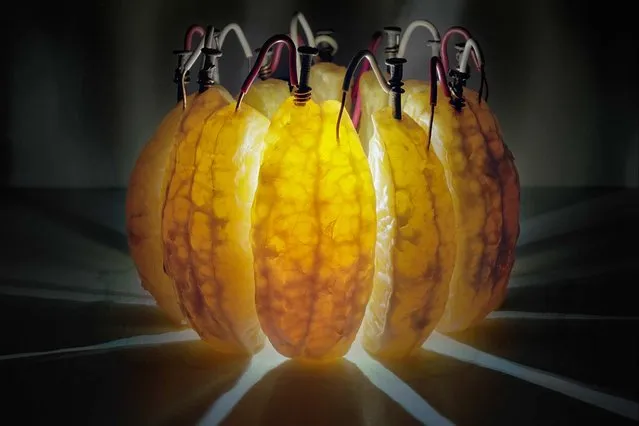
Wedges of an orange generate enough current and electrical juice – 3.5 volts – to power an LED. The fruit’s citric acid helps electrons flow from galvanized nails to copper wire in this 14-hour exposure. This image was published in September’s Visions of Earth, a trio of photos that appear in each issue of National Geographic. (Photo by Caleb Charland/National Geographic)

Wedges of an orange generate enough current and electrical juice – 3.5 volts – to power an LED. The fruit’s citric acid helps electrons flow from galvanized nails to copper wire in this 14-hour exposure. This image was published in September’s Visions of Earth, a trio of photos that appear in each issue of National Geographic. (Photo by Caleb Charland/National Geographic)
Details
06 Jan 2014 12:09:00